The post Smart Locker Security: How They Protect Packages 24/7 appeared first on Smiota.
]]>Smart locker security combines physical reinforcement, encrypted digital access controls, complete audit trails, and optional video surveillance to create a layered protection system that has near-zero theft rates. Each compartment is built with reinforced steel, controlled by authenticated software, and monitored continuously through the cloud platform — every interaction logged with timestamps, user identity, and chain-of-custody data.
Compared to unattended package rooms (where 26 percent of Americans report theft) or porch deliveries (where 49 million packages were stolen in 2024), smart lockers are dramatically more secure. They are also compliant with major regulatory standards including HIPAA, SOC 2 Type II, GDPR, and FIPS 140-2 for government and military deployments.
Physical Security Features
Reinforced steel construction: Smart locker units are built with 14-16 gauge steel walls, doors, and frames, far stronger than typical mailbox or package room enclosures.
Tamper-resistant locks: Electronic locks are recessed and protected by anti-pry plates. Physical override keys (for emergencies) are stored in tamper-evident enclosures.
Reinforced hinges and frames: Doors are mounted on heavy-duty hinges and welded to the frame, resisting prying or kicking attempts.
Anti-drilling protection: Lock mechanisms are protected by hardened steel plates that resist drilling attacks.
Tamper alerts: Built-in sensors detect impacts, prying attempts, and unauthorized access. Alerts are sent to administrators in real time via SMS or email.
Outdoor protection: Outdoor-rated lockers include weatherproofing (IP54 or higher), UV-resistant coatings, and reinforced anti-vandal exteriors.
Digital Security and Encryption
AES-256 encryption: All data in transit and at rest is encrypted with AES-256, the same standard used by banks and government agencies.
Secure authentication: Users authenticate via unique PIN codes (one-time use), mobile app with biometric login (Face ID, Touch ID), QR codes, or RFID cards. Codes are time-limited and tied to specific compartments.
Multi-factor authentication for administrators: Locker administrators must use 2FA (typically password plus authenticator app) to access the management portal.
Secure key exchange: Communication between lockers and the cloud uses TLS 1.3 with certificate pinning to prevent man-in-the-middle attacks.
Role-based access control: Different user roles (resident, courier, admin, super-admin) have different permissions to prevent privilege escalation.
Access Control Methods
PIN codes: One-time PINs sent via SMS or email when a package arrives. Codes expire after pickup or after a configurable time period (typically 7 days).
Mobile app: Residents authenticate via the mobile app using biometric login. The app displays available packages and opens compartments with a tap.
QR codes: Notifications include scannable QR codes that open compartments at the locker kiosk camera.
RFID cards: Many corporate and university deployments use RFID badge access integrated with existing access control systems.
Carrier authentication: Couriers (FedEx, UPS, USPS, Amazon, DoorDash) authenticate with their own credentials, ensuring only authorized delivery personnel can drop off packages.
Biometric (optional): Some high-security deployments add fingerprint or facial recognition for additional authentication.
Audit Trails and Chain of Custody
Every interaction with a smart locker is logged in the cloud platform with a timestamp, user identity, compartment number, package ID (if scanned), and event type (delivery, pickup, attempted access, alert).
Audit logs are immutable and exportable, satisfying requirements for HIPAA (healthcare), evidence chain-of-custody (law enforcement), Sarbanes-Oxley (financial records), and FERPA (student records).
Some systems also capture photo evidence at every transaction using a built-in camera, creating visual proof of who accessed which compartment and when.
Camera and Surveillance Integration
Smart lockers integrate with existing video surveillance systems (Axis, Hanwha, Avigilon, Verkada) for additional accountability.
When a tamper alert fires, the system can automatically pull video from nearby cameras and attach it to the alert notification, giving administrators immediate visibility.
For high-security deployments, lockers can include built-in cameras at the kiosk that capture every user interaction and store the footage in cloud or on-premise storage.
Compliance and Regulatory Standards
HIPAA (healthcare): Smart lockers used for medication, lab specimens, or PHI must meet HIPAA standards including encryption, audit logs, access controls, and breach notification procedures.
SOC 2 Type II: Smart locker software providers should be SOC 2 Type II audited annually, demonstrating strong controls around security, availability, confidentiality, and privacy.
GDPR: For deployments in Europe or with European users, GDPR compliance includes data minimization, consent management, the right to deletion, and data protection impact assessments.
FIPS 140-2: Government and military deployments may require FIPS 140-2 Level 2 or higher cryptographic modules.
FERPA: University deployments handling student records must meet FERPA requirements for student privacy.
PCI DSS: If smart lockers process payments (vending, paid pickup), PCI DSS compliance is required.
Incident Response and Tamper Detection
Real-time alerts: Tamper detection sensors trigger immediate notifications to administrators via SMS, email, push notification, or webhook to a SIEM/SOC system.
Automatic lockdown: In response to tamper attempts, the system can automatically lock all compartments and require administrator override to resume normal operation.
Forensic logs: All security events are logged in detail, with the ability to export forensic data for law enforcement or insurance investigations.
Service-level agreements: Premium providers offer 24/7 monitoring and incident response SLAs with guaranteed response times.
Smart Lockers vs Traditional Storage Comparison
Traditional package rooms: No authentication, no audit trail, packages visible to anyone with building access. Theft rates: 15-30 percent in unsecured environments.
Front desk holding: Limited to staff hours, manual logging, prone to errors and lost packages. Staff time intensive.
Lobby tables and shelves: Worst-case scenario for theft and lost packages. No accountability.
Smart lockers: Authenticated access, complete audit trail, 24/7 availability, near-zero theft rates, integration with security systems.
Frequently Asked Questions
How secure are smart lockers?
Smart lockers use reinforced steel construction, AES-256 encryption, multi-factor authentication, tamper detection, and complete audit trails. They have near-zero theft rates compared to unattended package rooms.
Can smart lockers be hacked?
Reputable smart locker systems use enterprise-grade security including AES-256 encryption, TLS 1.3, multi-factor authentication, and SOC 2 Type II audited cloud platforms. While no system is 100 percent unhackable, smart lockers are dramatically more secure than traditional alternatives.
What happens if someone tries to break into a smart locker?
Tamper sensors detect prying, drilling, or impact attempts and trigger immediate alerts to administrators. Many systems also automatically lock down all compartments until an administrator clears the alert.
Do smart lockers have cameras?
Many smart lockers include built-in cameras at the kiosk that capture every user interaction. They can also integrate with existing video surveillance systems for additional monitoring.
Are smart lockers HIPAA compliant?
Yes. HIPAA-compliant smart lockers are used in healthcare facilities for medication management, lab specimen tracking, and other PHI-related workflows. They include encryption, audit logs, access controls, and breach notification procedures.
Do smart lockers comply with SOC 2?
Reputable smart locker software providers are SOC 2 Type II audited annually, demonstrating strong controls around security, availability, confidentiality, and privacy.
What encryption do smart lockers use?
Smart lockers use AES-256 encryption for data at rest and TLS 1.3 for data in transit. This is the same encryption standard used by banks and government agencies.
How are pickup codes secured?
Pickup codes are unique, one-time use, time-limited (typically 7 days), and sent only to the verified recipient via SMS, email, or in-app notification. They cannot be reused or guessed.
Can administrators see what’s in each locker?
Administrators can see metadata (which compartment is occupied, who delivered it, who’s authorized to pick it up) but cannot see the contents of packages without physical access. Camera-equipped systems may capture exterior photos at delivery.
What audit trails do smart lockers create?
Every interaction is logged with timestamp, user identity, compartment number, event type, and (optionally) photo evidence. Audit logs are immutable, exportable, and meet HIPAA, FERPA, and chain-of-custody requirements.
The post Smart Locker Security: How They Protect Packages 24/7 appeared first on Smiota.
]]>The post Smart Lockers for Apartments: Benefits, ROI, and Implementation Guide appeared first on Smiota.
]]>Smart lockers for apartments are secure, self-service package delivery systems that eliminate the package management problem property managers face daily. With the average resident receiving more than 60 packages per year, and one in four Americans reporting a stolen package, smart lockers solve three critical problems at once: package theft, staff time spent on package handling, and resident frustration with missed deliveries.
Implementation typically takes 1-3 days, costs $12,000-$36,000 for a standard 200-unit community, and pays back within 12-18 months through labor savings, reduced complaints, and higher resident satisfaction scores. For property management companies, smart lockers have become a baseline amenity expectation, not a luxury.
Why Apartments Need Smart Lockers
E-commerce volume has exploded. The average apartment resident now receives 60-90 packages per year, and that number grew over 20 percent during the COVID-19 pandemic. Traditional package rooms, lobby tables, and front-desk holding fail under this volume.
Package theft is endemic. According to FBI data and industry surveys, nearly 26 percent of Americans have had at least one package stolen, and theft incidents in multifamily housing are particularly high because packages are often left in unsecured common areas.
Staff time is expensive. Property managers report that package handling consumes 5-15 hours of staff time per week in mid-size communities. That’s 250-750 hours per year diverted from leasing, maintenance coordination, and resident service.
Residents expect 24/7 access. Modern renters work non-traditional hours and want to pick up packages on their own schedule, not during front desk business hours. Communities that don’t offer this lose competitive ground.
Resident Experience Benefits
Notifications: Residents get automatic SMS, email, or app notifications the moment a package is delivered, so they know exactly when something arrives.
24/7 self-service pickup: No more waiting for the front desk to open or coordinating with staff schedules. Residents pick up packages whenever it’s convenient.
Privacy: Packages aren’t visible to other residents in a common area. Each pickup is private and authenticated.
Theft elimination: Locked compartments behind authenticated access have near-zero theft rates compared to package piles in lobbies.
Refrigerated options: Some communities deploy refrigerated lockers for grocery delivery and meal kit services, an increasingly popular amenity.
Multi-recipient support: Households with multiple adults can have shared access, and residents can grant temporary access codes to family members or roommates.
Property Management Benefits
Reclaimed staff time: Front desk and leasing staff stop spending hours per day on package logging, sorting, and recipient lookup. That time goes back into leasing, maintenance, and resident communication.
Reduced liability: Lost or stolen packages are a constant headache. Smart lockers create a complete audit trail with timestamps, photo evidence, and chain-of-custody data.
Higher resident retention: Communities that solve the package problem see 10-15 percent higher renewal rates compared to those that don’t, according to industry surveys.
Marketing advantage: Smart locker amenities are now a standard checklist item for prospective renters, especially millennials and Gen Z. Communities without them lose tours.
Insurance and compliance: Reduced theft incidents lower insurance claims and protect against resident disputes.
ROI Analysis with Real Numbers
Consider a 200-unit apartment community receiving 12,000-18,000 packages per year. Without smart lockers, staff spends 8-12 hours per week handling packages, equal to 416-624 hours per year. At a fully loaded cost of $35 per hour, that’s $14,560-$21,840 in annual labor cost.
Add 15-30 package theft incidents per year at an average resolution cost (replacement, complaint handling, retention impact) of $500 each, and you have another $7,500-$15,000 per year in soft and hard costs.
Total annual cost without smart lockers: $22,000-$37,000 per year, plus reputation damage and lost renewals.
Smart locker investment: $15,000-$30,000 hardware (one-time) plus $2,000-$4,000 annual software. Payback period is typically 12-18 months, after which the system delivers $20,000+ in annual net savings.
Beyond cost savings, communities report 15-25 percent improvements in resident satisfaction scores, which directly correlates to renewal rates.
Implementation Steps
Step 1 — Assessment: Site walk with vendor to determine package volume, available space, electrical and network requirements, and compartment mix.
Step 2 — Configuration: Choose locker model (indoor/outdoor, refrigerated capability), compartment sizes, and software integration with your property management system.
Step 3 — Installation: Most installations are completed in 1-3 days. Outdoor or large custom installations may take longer.
Step 4 — Resident communication: Announce the new amenity, post signage, and provide quick-start instructions. Most residents learn the system in under a minute.
Step 5 — Launch and monitor: Track usage analytics, identify peak times, and adjust compartment mix or capacity as needed.
Property Management Software Integration
Modern smart locker platforms integrate with major property management systems including Yardi, RealPage, Entrata, AppFolio, and ResMan. Integration enables automated resident sync, lease status checks (so move-outs lose access automatically), and unified reporting.
Look for smart locker providers that offer open APIs and pre-built integrations rather than proprietary closed systems that require manual data entry.
Common Questions from Property Managers
How do residents get set up? Most providers handle resident onboarding via SMS or email when a package is first delivered. Residents create an account in seconds.
What if a resident moves out? Integration with property management software automatically deactivates access on lease end date.
What happens to packages left in lockers too long? Most systems send escalating reminders and can either notify staff or charge a holding fee after a configured time period.
Can we use smart lockers for non-package items? Yes — communities use them for amenity reservations (pickleball gear), maintenance keys, dry cleaning pickup, and resident-to-resident handoffs.
Case Study Examples
Mariner’s Village (300 units): Installed Smiota smart lockers in 2024. Reduced staff package handling time from 12 hours per week to under 1 hour. Resident satisfaction scores increased from 78 to 91. Zero package theft incidents in the first 12 months.
Towne West Apartments (180 units): Deployed smart lockers as part of a competitive amenity upgrade. Renewal rate increased from 62 percent to 74 percent in the year following installation. Front desk staff redirected to leasing activities.
Allora Bella Terra (250 units): Installed 39-door smart locker system. Handles 95 percent of package deliveries automatically. Property manager reports saving $35,000 per year in labor and reducing package complaints to near zero.
Frequently Asked Questions
What are smart lockers for apartments?
Smart lockers for apartments are secure, internet-connected storage units that automate package delivery, pickup, and chain-of-custody for residents. They eliminate package theft, free up staff time, and provide 24/7 self-service access for residents.
Do apartments really need package lockers?
Yes. With residents receiving 60-90 packages per year on average, and 26 percent of Americans reporting package theft, traditional package rooms can’t keep up. Smart lockers have become a baseline expectation for modern renters.
How much do smart lockers cost for an apartment building?
Hardware typically costs $12,000-$36,000 for a 150-300 unit community, plus $2,000-$4,000 in annual software fees. Total cost varies based on package volume, compartment mix, and integration requirements.
What is the ROI on smart lockers for apartments?
Most communities recover their investment in 12-18 months through staff labor savings, reduced theft losses, and improved resident retention. Net annual savings after payback typically run $20,000-$40,000.
Do smart lockers integrate with Yardi, RealPage, or other property management software?
Yes. Leading smart locker providers offer integrations with all major property management platforms including Yardi, RealPage, Entrata, AppFolio, and ResMan.
How long does installation take?
Standard installations are completed in 1-3 days. Larger or outdoor installations may take 1-2 weeks. Site assessment and prep work happen in advance.
Can smart lockers handle refrigerated items?
Yes, many providers offer refrigerated compartments for grocery delivery, meal kits, and similar perishable items.
What happens if a package is too large for the locker?
Most systems have a mix of compartment sizes including extra-large options. For oversized packages, the system can notify staff to handle separately or alert the recipient to pick up at the leasing office.
Do residents have to pay to use smart lockers?
Typically no. Smart lockers are an amenity provided by the property, included in operating expenses or absorbed as a cost of doing business.
Can residents grant access to family or roommates?
Yes. Modern smart locker systems support shared household access, temporary guest codes, and authorized pickup by third parties (Uber Eats, dry cleaners, etc.).
The post Smart Lockers for Apartments: Benefits, ROI, and Implementation Guide appeared first on Smiota.
]]>The post What Are Smart Package Lockers? The Complete 2026 Guide appeared first on Smiota.
]]>Smart package lockers are internet-connected, modular storage units that automate the secure handoff of packages, assets, and goods between senders and recipients without requiring staff to be present. Each locker compartment is controlled by software that grants access through a unique PIN, mobile app, RFID card, or QR code, and every transaction is logged in a centralized cloud platform with timestamps, recipient identity, and chain-of-custody data.
Unlike traditional mailrooms or unlocked package rooms, smart lockers eliminate human bottlenecks, reduce package theft, and provide 24/7 self-service pickup. They are used across multifamily housing, retail (BOPIS pickup), corporate offices, universities, libraries, healthcare facilities, government buildings, and logistics operations. The global smart locker market is projected to reach $6.7 billion by 2030, driven by e-commerce growth, last-mile delivery challenges, and rising consumer expectations for contactless service.
How Smart Lockers Work
A smart locker system has three core components working together: the physical locker unit, the cloud-based locker operating system, and the user interface (mobile app, kiosk touchscreen, or web portal).
When a package is delivered, a courier or staff member scans the package barcode at the locker kiosk. The system identifies the recipient, selects an available compartment that matches the package size, and opens the door. The package is placed inside, the door closes, and the recipient receives an automated notification (SMS, email, or push notification) with a unique pickup code or link. The recipient walks to the locker, enters their code or scans a QR code, and the door opens automatically. Every step is logged in the cloud platform, creating a permanent audit trail.
Modern smart lockers integrate with property management systems, e-commerce platforms, shipping carriers (FedEx, UPS, USPS, Amazon), and access control systems. They can also handle returns, dry cleaning pickup, library holds, food delivery, IT asset management, weapon storage for law enforcement, and cold chain pharmaceutical delivery.
Components: Hardware and Software
Hardware: Smart lockers come in a wide range of configurations — small parcel sizes (5x12x12 inches) up to extra-large (24x24x36 inches) — and can be installed indoors or outdoors with weather-resistant cabinets. Premium systems include refrigerated compartments for grocery delivery, climate control for sensitive items, and reinforced steel construction for evidence or weapon storage.
Software: The cloud platform (such as Smiota’s L-DOS — Locker Device Operating System) manages every interaction. It handles user authentication, compartment assignment, notifications, reporting, multi-tenant management, and integrations. Administrators can monitor usage in real time, run audit reports, and configure access rules for different user groups.
Connectivity: Lockers connect to the cloud via Wi-Fi, cellular (4G/5G), or Ethernet, with offline mode for temporary network outages. Most systems use AES-256 encryption for data in transit and at rest, and require two-factor authentication for administrator access.
Use Cases by Industry
Multifamily housing: Apartment buildings use smart lockers to handle the average resident’s 60+ packages per year, reducing theft, freeing staff time, and improving resident satisfaction scores by 15-25 percent.
Retail: Stores deploy smart lockers for buy-online-pickup-in-store (BOPIS), curbside pickup, and returns. Retailers report 30-40 percent faster order fulfillment and reduced staffing costs at the customer service desk.
Universities: Campus libraries and bookstores use smart lockers for textbook pickup, library holds, and student package delivery. Some universities also operate food security programs that distribute meals through smart lockers anonymously.
Healthcare: Hospitals and clinics use HIPAA-compliant smart lockers for medication dispensing, lab specimen tracking, medical equipment checkout, and secure handoffs between shifts.
Government and law enforcement: Police stations, courthouses, and military bases use smart lockers for evidence storage, weapon management, asset tracking, and chain-of-custody compliance.
Corporate offices: Businesses deploy smart lockers for IT asset management (laptop checkout), employee package delivery, dry cleaning pickup, and contactless mailroom operations.
Libraries: Public libraries offer 24/7 hold pickup through smart lockers, extending service hours without adding staff and serving patrons who can’t visit during business hours.
Benefits of Smart Lockers
Operational efficiency: Smart lockers eliminate manual package logging, sorting, and recipient lookup. Property managers report saving 5-15 hours per week of staff time previously spent on package management.
Reduced theft: Packages stored in locked compartments behind authenticated access have near-zero theft rates compared to unattended package rooms or porch deliveries, where 1 in 4 Americans report having a package stolen.
24/7 accessibility: Recipients pick up packages on their own schedule, eliminating missed deliveries and the need to coordinate with staff or front desk hours.
Audit and compliance: Every transaction is logged with timestamps, user identity, and photo evidence. This is critical for regulated industries (healthcare, government, legal) and useful for any organization that needs accountability.
Resident and customer satisfaction: Apartment communities, retailers, and corporate offices that deploy smart lockers consistently see higher net promoter scores and reduced complaints about delivery issues.
Scalability: Modular designs allow organizations to add or reconfigure compartments as needs change, without replacing the entire system.
Cost and ROI
Smart locker systems typically cost between $9,000 and $45,000 for a standard installation, depending on size, features, and customization. Refrigerated, outdoor, or specialty units cost more. Software is usually licensed annually at $1,500-$5,000 per locker bank.
Return on investment varies by use case but is often realized within 12-24 months. For a 200-unit apartment community, smart lockers typically save $18,000-$30,000 per year in staff labor while reducing package-related complaints by 70-90 percent. Retailers report that BOPIS smart lockers increase same-day pickup completion rates from 60 percent (manual) to over 95 percent (automated), driving incremental in-store visits and revenue.
Security Features
Smart lockers protect contents through layered security: reinforced steel construction, tamper-resistant locks, video surveillance integration, motion sensors, and tamper alerts that notify administrators of suspicious activity.
On the digital side, top systems use AES-256 encryption, secure key exchange, multi-factor authentication for administrators, and comply with SOC 2 Type II, HIPAA (for healthcare), GDPR (for international deployments), and government security standards (FIPS 140-2 for federal use).
Top Smart Locker Providers
The smart locker market includes both hardware-focused vendors and platform-first providers. Smiota differentiates through its L-DOS cloud platform, which works across hardware types and verticals, plus deep integrations with property management systems, e-commerce platforms, and enterprise software.
Other notable players include Luxer One (multifamily focus), Parcel Pending (multifamily and retail), Cleveron (retail and last-mile), Quadient (corporate mailroom), and Package Concierge (multifamily). Each has strengths in specific verticals, and the right choice depends on your use case, integration needs, and total cost of ownership.
Implementation Guide
Step 1 — Assess your needs: Estimate package volume, peak times, available space, recipient count, and required features. Walk the proposed installation site with a vendor for accurate sizing.
Step 2 — Choose hardware and software: Select indoor vs. outdoor, compartment mix, refrigerated capability, and software platform that integrates with your existing systems.
Step 3 — Plan installation: Most installations take 1-3 days for standard units, 1-2 weeks for large or custom configurations. Confirm electrical, network, and floor load requirements with your facilities team.
Step 4 — User onboarding: Send announcements, post signage, and create quick-start guides. Most users learn the system in under 60 seconds.
Step 5 — Monitor and optimize: Use the platform’s analytics to identify peak usage times, compartment utilization, and any issues. Adjust compartment mix or operations as needed.
Frequently Asked Questions
What is a smart package locker?
A smart package locker is an internet-connected, secure storage unit that automates package delivery and pickup. Each compartment is controlled by software that grants access through a unique code, mobile app, or QR scan, and every transaction is logged in the cloud.
How do smart lockers work?
When a package arrives, a courier scans it at the locker kiosk. The system assigns a compartment, opens the door, and notifies the recipient with a unique pickup code. The recipient retrieves the package on their schedule using the code, and the system logs every step.
Are smart lockers secure?
Yes. They use reinforced steel construction, tamper-resistant locks, AES-256 encryption, audit trails, and optional video surveillance. They have near-zero theft rates compared to unattended package rooms.
What is the difference between smart lockers and a traditional mailroom?
Traditional mailrooms require staff to log, sort, and hand off packages during business hours. Smart lockers automate this process and provide 24/7 self-service pickup, eliminating staff bottlenecks and missed deliveries.
How much do smart lockers cost?
Smart locker systems typically range from $9,000 to $45,000 for hardware, plus annual software fees of $1,500-$5,000 per bank. Costs vary based on size, features, and customization.
Can smart lockers handle refrigerated items?
Yes. Many providers offer refrigerated compartments for grocery delivery, meal kits, and pharmaceuticals that need temperature control.
Do smart lockers work outdoors?
Yes. Outdoor smart lockers are built with weather-resistant materials, climate control, and IP-rated enclosures to operate in harsh conditions including extreme heat, cold, and rain.
Can smart lockers integrate with property management software?
Yes. Modern smart locker platforms integrate with property management systems (Yardi, RealPage, Entrata), e-commerce platforms, shipping carriers, and enterprise access control systems.
How long does smart locker installation take?
Standard installations take 1-3 days. Large or custom configurations may take 1-2 weeks. Site assessment, electrical, and network setup are typically completed in advance.
What industries use smart lockers?
Smart lockers are used in multifamily housing, retail, corporate offices, universities, libraries, healthcare facilities, government and military, and logistics operations.
The post What Are Smart Package Lockers? The Complete 2026 Guide appeared first on Smiota.
]]>The post More Than Storage: How Smart Lockers Are Strengthening Campus Security appeared first on Smiota.
]]>This combination often results in overcrowded mailrooms, misplaced packages, and limited control over who accesses stored items. These aren’t just operational inefficiencies but genuine security concerns.
Smart lockers are emerging as a practical solution to these challenges. While often seen as a convenience feature, they are quickly becoming an essential part of modern campus security by introducing structure, control, and accountability.
The Security Gaps in Traditional Campus Systems
Traditional campus storage and delivery systems rely heavily on manual processes. Staff members are responsible for receiving, sorting, and distributing large volumes of packages daily. Under such pressure, errors are almost inevitable.
Packages can be misplaced, handed over to the wrong person, or left unattended in shared spaces. In many cases, there is no reliable way to track where things went wrong. The lack of a proper audit trail makes it difficult to investigate issues or assign accountability.
Common gaps include:
- Limited tracking of package movement
- Unauthorized access to storage areas
- High dependency on staff availability
- Increased chances of human error during peak times
These vulnerabilities highlight the need for a more structured and secure system.
What Makes Smart Lockers “Smart”?
Smart lockers bring automation and digital intelligence into what was traditionally a manual process. They use secure authentication methods such as PIN codes, QR codes, or RFID-enabled ID cards to ensure that only authorized users can access specific compartments.
Once an item is placed in a locker, the intended recipient is instantly notified with access details. This removes the need for manual coordination and reduces delays. More importantly, every interaction, whether it’s delivery, access, or retrieval, is automatically recorded in a digital system.
Key capabilities include:
- Controlled, user-specific access
- Instant notifications for pickups
- Automated logs for every transaction
- Integration with campus systems and apps
These features work together to create a system that is not only efficient but also highly secure and transparent.
Key Ways Smart Lockers Strengthen Campus Security
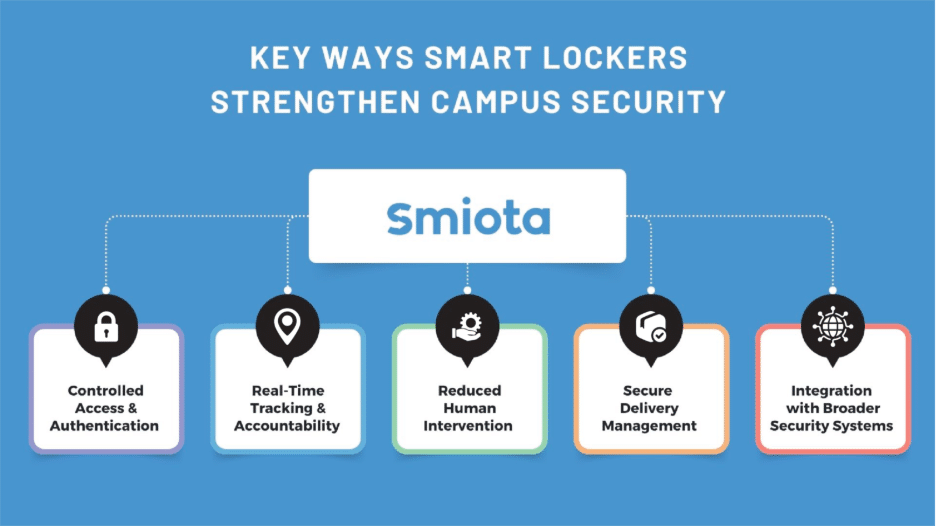
Controlled Access & Authentication
One of the most significant advantages of smart lockers is their ability to restrict access. Unlike traditional storage areas, where multiple people may have entry, smart lockers ensure that only the intended recipient can open a specific compartment. This eliminates ambiguity and significantly reduces the risk of unauthorized access or theft.
Real-Time Tracking & Accountability
Every interaction with a smart locker is recorded and time-stamped, creating a clear digital trail. This level of visibility allows administrators to track the exact journey of a package from delivery to pickup. In case of disputes, this data becomes invaluable, enabling quick resolution and improved accountability.
Reduced Human Intervention
By automating the handling process, smart lockers reduce the need for manual involvement. Staff no longer need to manage every package directly, which minimizes the chances of human error. It also reduces internal risks associated with mishandling or miscommunication.
Secure Delivery Management
With smart lockers, delivery personnel can securely deposit packages into designated compartments without needing staff assistance. This ensures that items are not left unattended or exposed to theft. In many ways, this system addresses the campus equivalent of “porch piracy,” providing a safe and reliable last-mile delivery solution.
Integration with Broader Security Systems
Smart lockers do not operate in isolation. They can be integrated with existing campus infrastructure such as surveillance systems and access control platforms. This creates a more cohesive security environment where multiple systems work together to enhance visibility and control.
Use Cases Beyond Package Delivery
While package management is the most common application, smart lockers serve multiple purposes across campus. Their flexibility makes them a valuable asset in different departments and scenarios.
For instance, libraries can use lockers to facilitate contactless book pickups and returns, reducing queues and ensuring secure handling. IT departments can streamline the distribution and collection of devices like laptops, maintaining a clear record of asset movement. Similarly, lockers can be used to store lab equipment, ensuring that only authorized individuals can access sensitive materials.
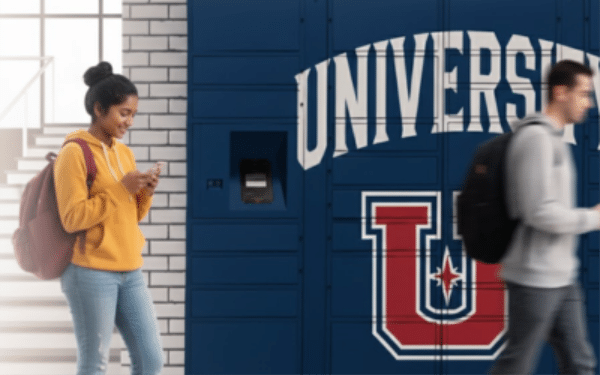
Additional use cases include:
- Contactless food delivery on campus
- Temporary storage for students and staff
- Secure exchange of documents or materials
This versatility makes smart lockers more than just a delivery solution – they become a shared infrastructure for secure access.
Impact on Campus Safety Culture
The adoption of smart lockers has a broader impact beyond operations. It influences how safety is perceived on campus. When students and staff know that their belongings are stored securely and can only be accessed by them, it builds a sense of trust in the system.
It also introduces a culture of accountability. Since every interaction is recorded, users become more conscious of their actions. This transparency reduces misuse and encourages responsible behavior.
Over time, these systems contribute to a more secure and organized campus environment. They also signal that the institution is investing in modern, technology-driven solutions to enhance safety and convenience.
Implementation Considerations for Universities
Implementing smart lockers requires thoughtful planning to maximize their benefits. Placement plays a crucial role and lockers should be installed in accessible yet secure locations such as residence halls, libraries, and academic buildings.
Equally important is integration with existing campus systems. A seamless connection with ID cards, mobile apps, and IT infrastructure ensures a smooth user experience. Universities should also consider scalability, ensuring that the system can expand as demand grows.
Other key considerations include:
- Ensuring user awareness and easy onboarding
- Providing clear instructions for use
- Addressing data privacy and security requirements
A well-executed implementation ensures that both security and usability goals are met.
Final Thoughts: Why Universities Are Turning to Smarter Locker Solutions
As campuses evolve, so do their security challenges. Traditional systems are no longer sufficient to handle the scale and complexity of modern university operations. Smart lockers offer a practical solution by combining security, efficiency, and convenience into a single system.
They strengthen campus security by:
- Restricting access to authorized users
- Creating a transparent audit trail
- Securing deliveries and shared resources
Solutions like Smiota lockers are helping universities take this step forward. With advanced access control, seamless integration, and scalable deployment options, Smiota enables institutions to modernize their infrastructure without added complexity.
For universities aiming to create safer, smarter campuses, smart lockers are no longer optional but an essential part of the security ecosystem. Learn more about how Smiota lockers can enhance student and staff experience in your university by talking to one of our locker experts.
The post More Than Storage: How Smart Lockers Are Strengthening Campus Security appeared first on Smiota.
]]>The post From Reservation to Retrieval: The Journey of a Book Through a Smart Locker System appeared first on Smiota.
]]>A student remembers they need a textbook for tomorrow’s lecture. A professional wants to pick up a book after a long workday. A researcher needs quick access to a reference but cannot align their schedule with library hours.
What should be a simple task often turns into a frustrating experience.
Libraries, despite being essential spaces for learning and discovery, still operate within constraints. Fixed timings, long queues, manual processes, and occasional mismanagement of reserved books can create unnecessary friction. For users who are already managing packed schedules, even small delays feel significant.
But what if accessing a book felt as seamless as ordering something online?
This is where smart locker systems step in. Not loudly, not disruptively, but in a way that quietly transforms the experience from end to end.
To understand this better, let’s follow the journey of a single book. From the moment it is reserved to the moment it is picked up and returned; every step tells a story of how efficiency, convenience, and technology come together.
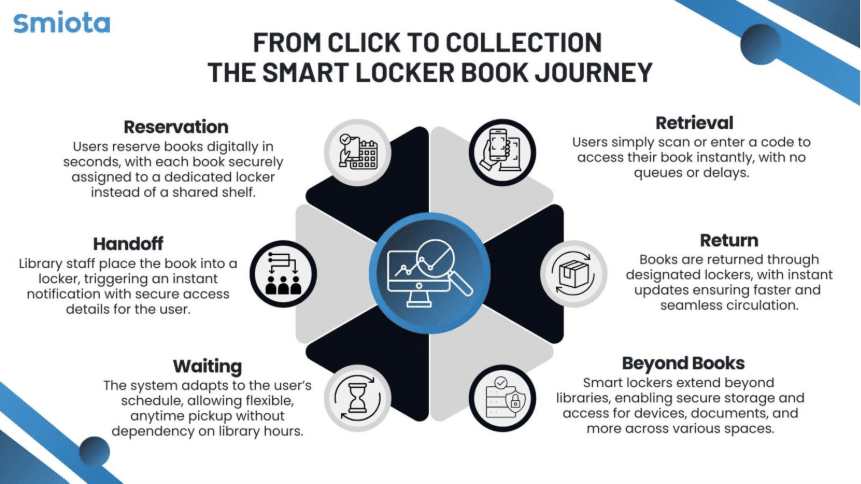
Chapter 1: The Reservation Stage
The journey starts with intent and a few clicks.
Instead of walking through rows of shelves, the user opens a digital platform. They search for the book, check availability, and place a reservation within seconds. It is quick, precise, and far more efficient than traditional browsing.
But in many libraries, this is where the efficiency stops.
Reserved books are often placed on shared shelves. Multiple users, multiple requests, and limited tracking can lead to confusion. Books may be misplaced, delayed, or difficult to locate when the user arrives.
Smart lockers introduce a simple yet powerful shift.
Instead of placing reserved books in a common area, each book is assigned a specific compartment. This creates structure. The book is no longer just “reserved” but securely allocated to a particular user.
This small change sets the tone for the entire journey. It replaces uncertainty with clarity and ensures that the process begins on a strong, reliable note.
Chapter 2: The Handoff Process
Once the reservation is in place, the responsibility shifts to the library staff.
They locate the book and prepare it for the next step. In traditional systems, this might involve manual coordination, verbal confirmations, or physical handovers that depend on timing.
With smart lockers, the process becomes far more streamlined.
The staff member places the book into a designated locker compartment. The system connects this physical action with digital tracking. The moment the locker is closed, the system updates automatically.
The user receives a notification.
It might be a message, an email, or an app alert. Along with it comes a secure access method such as a PIN or QR code. There is no ambiguity. The user knows exactly when their book is ready and how to access it.
This step removes one of the biggest pain points in traditional systems, which is the lack of real time communication. Instead of guessing or following up, the user stays informed without any effort.
Chapter 3: The Waiting Experience
Waiting is often where traditional systems create the most inconvenience.
Users must align their schedules with library hours. If they arrive late, they may miss their window. If they are too early, the book might not be ready. This dependency on timing can make even a simple pickup feel like a task.
Smart lockers completely change this dynamic.
The book waits for the user, not the other way around.
Whether it is early morning, late evening, or even outside standard operating hours, the locker remains accessible. Users can pick up their books when it fits naturally into their day.
This flexibility is more than just convenience. It gives users control.
A student can pick up a book after a late study session. A professional can stop by on their way home without worrying about closing times. The process adapts to their routine instead of disrupting it.
This shift, though subtle, has a significant impact on user satisfaction. It turns what used to be a rigid system into a flexible experience.
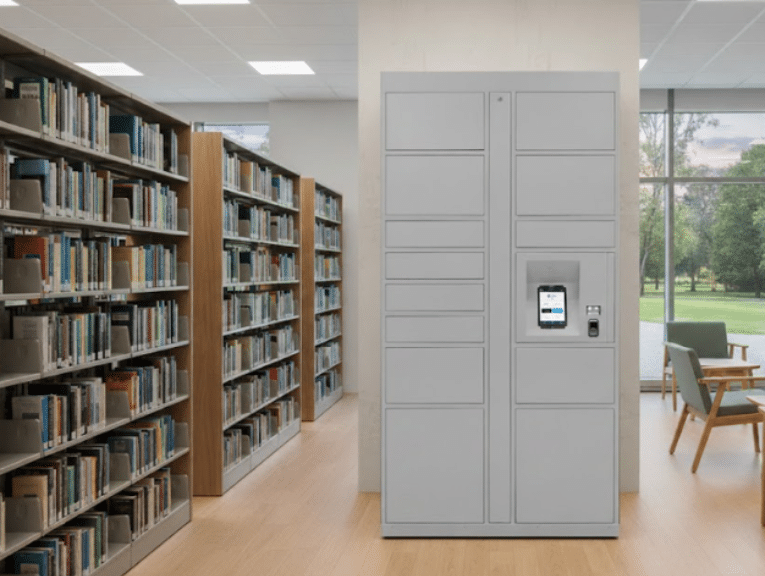
Chapter 4: The Retrieval Moment
Now comes the moment that defines the entire journey.
The user arrives at the locker system. There are no lines. No waiting counters. No need to interact with staff unless they choose to.
They enter their PIN or scan their QR code. Within seconds, the locker opens and the book is right there.
This interaction is simple, but it carries a sense of efficiency that traditional systems often lack. The entire process takes only a few seconds, yet it eliminates delays that could otherwise take several minutes or more.
Behind the scenes, the system records everything. It logs the transaction, updates the status, and maintains a clear record of who accessed what and when.
For the user, it feels effortless. For the organization, it ensures accountability and accuracy. This is where the true value of smart lockers becomes visible. They remove friction without adding complexity.
Chapter 5: The Return Process
Every journey eventually comes full circle.
After using the book, the user needs to return it. Traditionally, this involves visiting the return desk, waiting in line, and relying on staff to process the return.
Smart lockers simplify this step just as effectively as they simplify pickup.
Users can drop the book into a designated return compartment. The system logs the return instantly and updates the inventory. There is no need for manual intervention or extended waiting.
This creates a continuous and efficient cycle. Books move faster between users. Staff spend less time managing routine transactions. The entire system operates more smoothly.
What was once a multi-step, time consuming process becomes quick and seamless.
Chapter 6: Beyond Books
While this journey focuses on books, the potential of smart lockers goes far beyond library systems.
In universities, they can be used to store laptops, lab equipment, and important documents. In offices, they manage internal asset distribution and package deliveries. In residential spaces, they simplify parcel management for residents.
The core idea remains the same. Create a secure, automated, and user-friendly system for handling physical items.
This adaptability makes smart lockers a valuable addition across multiple environments. They are not limited to one use case. Instead, they evolve with the needs of the organization.
Enabling the Experience with Smiota Smart Lockers
While the concept of smart lockers is powerful, the real impact comes from how well the system is designed and implemented.
This is where Smiota smart lockers play a critical role.
Smiota brings together technology, usability, and scalability to support the entire journey from reservation to retrieval. It ensures that every step is connected, visible, and easy to manage.
With features like real time tracking, secure access controls, and seamless system integration, Smiota enables organizations to deliver a consistent and reliable experience. It reduces manual effort, minimizes errors, and improves operational efficiency.
At the same time, it keeps the user experience simple and intuitive.
Whether it is a library, a university campus, or a corporate environment, Smiota smart lockers adapt to different needs without adding complexity. They act as the backbone that supports a smooth and efficient system.
Conclusion
The journey of a book may seem simple at first glance. But when you break it down, it reveals how many steps are involved in making access smooth and reliable.
From reservation to retrieval and return, each stage plays a role in shaping the user experience.
Smart locker systems transform this journey into something far more efficient and user focused. They remove delays, reduce dependency on timing, and create a sense of ease that users appreciate instantly.
What was once a process filled with small frustrations becomes something seamless and intuitive. And in a world where time matters more than ever, this shift is not just beneficial. It is necessary.
Access to books and knowledge should never feel complicated. It should feel natural, flexible, and always within reach.
The post From Reservation to Retrieval: The Journey of a Book Through a Smart Locker System appeared first on Smiota.
]]>The post Smart Lockers as Psychological Boundaries in Extended Stay Hotels appeared first on Smiota.
]]>Yet, a key challenge remains: the space rarely feels fully “theirs.”
Even well-designed rooms cannot completely replicate the sense of ownership and stability people experience at home. This is where smart lockers – typically seen as simple storage tools – can play a more meaningful role. Not through customization or advanced features, but through something more subtle: creating psychological boundaries and a sense of control.
The Challenge of Living in a “Temporary Permanent” Space
Extended stay guests live in an in-between state. They are neither tourists nor permanent residents. This creates a few consistent challenges:
- Limited sense of ownership over space
- Difficulty maintaining routines
- Overuse of a single room for multiple purposes (work, rest, storage)
- Mental fatigue from constantly adapting
Unlike a home, where spaces are naturally divided (closet, office, storage areas), hotel rooms compress everything into one environment. Over time, this lack of separation can feel overwhelming.
The issue is not just physical – it’s psychological. People function better when they have clear, stable zones for different aspects of their lives.
What Smart Lockers Really Offer
Smart lockers are usually defined by their functionality – secure compartments, digital or code-based access, and self-service usage – but in extended stay settings, their value extends beyond simple utility.
Even without personalization features, lockers provide something important: a fixed, consistent space outside the room, a reliable storage point that does not change daily, and a clear boundary between different types of belongings. Together, these qualities transform them into micro-territories – small but meaningful extensions of personal space.
They don’t need to be customized to feel personal. They simply need to be predictable and exclusively accessible.
Creating Psychological Boundaries
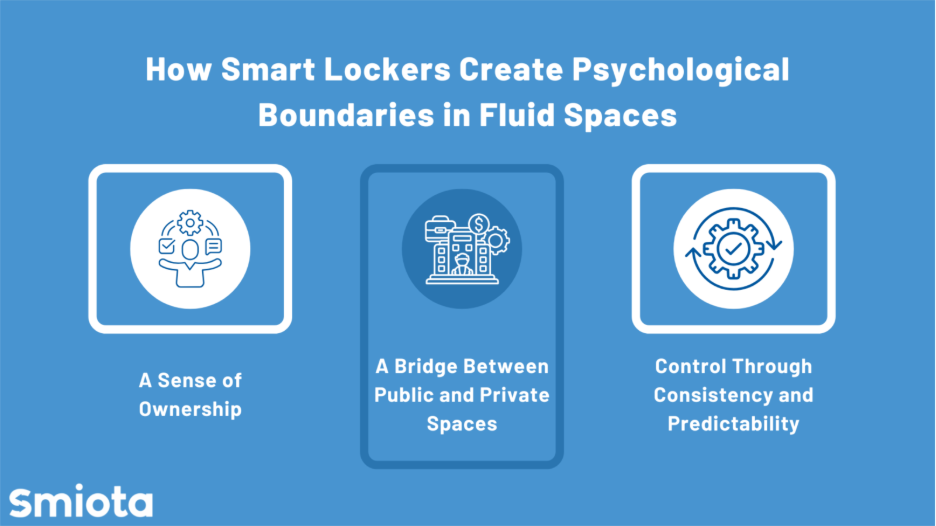
Smart lockers help introduce structure into an otherwise fluid environment. They do this in a few key ways:
1. A Sense of Ownership
Even a basic assigned locker can create a subtle feeling of “this is mine.”
- No decoration or customization is required
- Ownership comes from consistent access over time
- Guests begin to associate the space with their routine
This small sense of ownership can improve comfort in a temporary setting.
2. A Middle Layer Between Public and Private
Hotels typically offer two extremes:
- Public spaces (lobby, corridors)
- Private room
Lockers introduce a third layer that is semi-private, offers controlled access, and remains personal while existing outside the room. This creates a more natural flow between spaces, similar to how people use storage areas at home.
3. Control and Predictability
One of the biggest stressors in extended stays is the lack of control. But smart lockers help restore some of that by allowing guests to decide what goes in, ensuring access is always available when needed, and providing a space that remains consistent throughout the stay. This predictability becomes a mental anchor in daily life.
Supporting Routine and Reducing Mental Load
When everything happens in one room, even simple decisions – like where to keep items – add up over time. Smart lockers help by acting as external storage anchors.
They allow guests to:
- Move non-essential items out of the room
- Create clearer separation between activities
- Maintain consistent placement of belongings
For example, work-related materials can be stored separately, fitness gear can be kept from cluttering the living space, and less-used items can remain out of sight yet accessible. This, in turn, leads to reduced clutter, fewer daily decisions, and improved focus and productivity.
Importantly, none of this depends on advanced features. The benefit comes from having a stable, designated place.
Identity Without Customization
In smart lockers, identity is expressed through how the locker is used. By providing a dedicated space for a guest to store gym gear, a remote worker to manage professional equipment, or a long-term resident to organize seasonal items, these lockers function as behavioral extensions of the guest that reinforce personal routines and maintain lifestyle structure. In this capacity, they serve as essential tools that support specific habits and daily choices, ultimately proving that they don’t just display a guest’s identity – they actively enable it.
Design Implications for Extended Stay Hotels
If hotels recognize this psychological role, lockers can be positioned more intentionally. Here are a few design elements extended stay hotels should consider when it comes to smart lockers:
Here are the core principles broken down into three focused bullet points:
- Strategic Placement and Visibility: Lockers should be positioned in well-lit, easily accessible areas rather than being tucked away as hidden back-end infrastructure. Maintaining high visibility ensures they feel like a seamless part of the guest experience rather than a utility afterthought.
- Operational Consistency and Simplicity: Prioritizing long-term assignments over frequent rotations creates a more stable environment for guests. Simple, reliable systems that function consistently are far more valuable than feature-heavy technology that introduces unnecessary complexity.
- Scalable Design and Intuitive Access: To minimize daily friction, the system must offer varied locker sizes to accommodate different needs and sufficient capacity for long-stay guests. Access methods, whether via codes or apps, must remain intuitive to ensure the user experience is as effortless as possible.
The goal is not to add complexity, but to reinforce clarity, stability, and ease.
A Small Feature with a Disproportionate Impact
In extended stay environments, comfort is not only about furniture or amenities – it is also about how space is structured and experienced. Smart lockers can play a significant role in putting space to the best possible use.
For example, Smiota lockers can be integrated into extended stay hotels to offer a personalized customer experience. They may appear to be a small addition, but they address deeper guest needs in subtle yet meaningful ways.
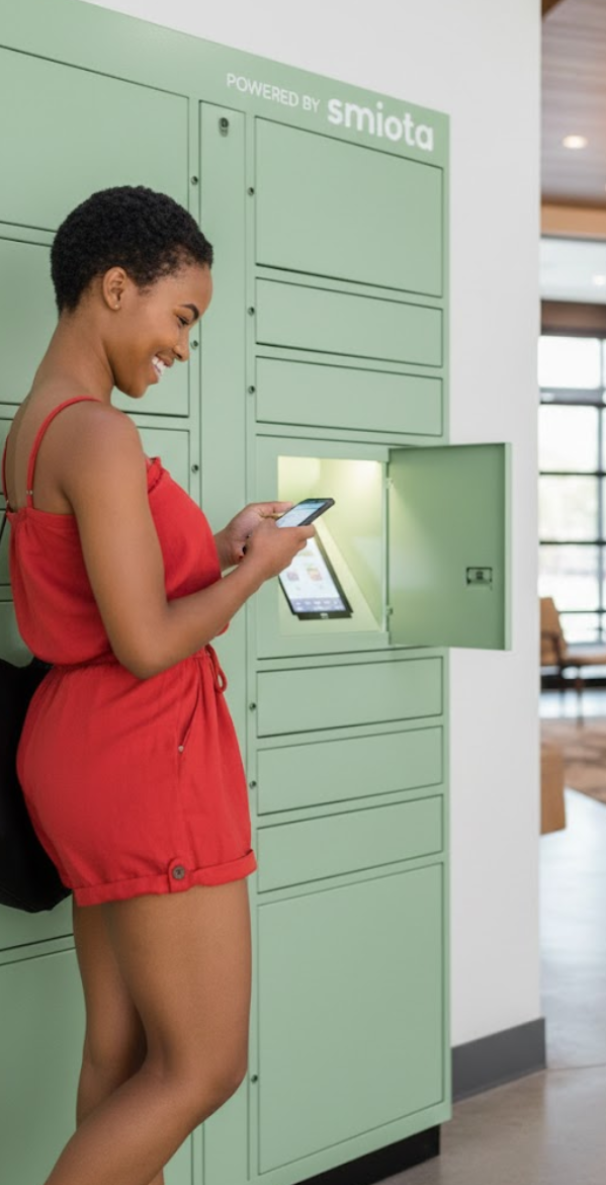
They help create a sense of defined personal space beyond the room, support routine and order by offering a consistent storage point, and restore a level of control in what is otherwise a temporary environment. Importantly, they achieve this without relying on extensive customization, complex technology, or significant operational investment, making them a practical yet impactful enhancement to the guest experience.
Conclusion: Rethinking the Role of Smart Lockers
Smart lockers are often treated as purely functional – tools for storage, delivery, or efficiency. But in extended stay hotels, their role can be broader. They can act as:
- Psychological boundaries
- Routine stabilizers
- Extensions of personal space
Even in their simplest form, they help guests navigate the complexity of temporary living.
As extended stay hospitality continues to grow, the focus will increasingly shift from providing space to shaping how that space feels. And sometimes, it is the smallest, most practical elements – like a simple locker – that make the biggest difference.
Looking to elevate the guest experience at your extended stay hotel? Talk to one of Smiota’s smart locker experts here.
The post Smart Lockers as Psychological Boundaries in Extended Stay Hotels appeared first on Smiota.
]]>The post How Smart Lockers Help Rural Libraries Expand Their Reach appeared first on Smiota.
]]>For many residents, visiting the library can mean a long drive, arranging transportation, or adjusting to restricted operating hours. Over time, these barriers reduce engagement – even among people who value the library deeply.
Smart lockers offer a practical solution. By enabling secure, self-service pickup at flexible times and locations, they allow rural libraries to extend access without constructing new branches or increasing payroll. Instead of expanding buildings, libraries expand reach.
The Core Challenges Rural Libraries Face
Rural libraries operate in conditions that differ significantly from urban systems. Their challenges are shaped by geography, funding limitations, and evolving patron expectations.
Geographic barriers are often the most visible obstacle. A single rural library may serve multiple towns or even an entire county. For many patrons, accessing services requires significant time commitment.
- Residents may live 20, 30, or even 40 minutes away
- Weather conditions can make travel unsafe or unreliable
- Unpaved roads add additional difficulty
- Public transportation is often limited or unavailable
- Seniors and families with one shared vehicle face added constraints
Budget and staffing limitations further complicate access in rural libraries. Many operate with small teams, where staff members juggle multiple responsibilities – from circulation and program management to technology support and community outreach. With limited personnel, expanding services through traditional methods becomes increasingly difficult.
Increasing access often requires additional payroll, higher utility expenses, extended security coverage, and long-term operational commitments. For most rural libraries working within tight municipal budgets, these added costs are rarely feasible or sustainable.
At the same time, patron expectations continue to evolve. Even in rural communities, convenience and flexibility matter more than ever. Students need after-hours access to complete assignments and research. Shift workers may only be available late at night. Working families value flexible pickup options that fit around busy schedules. Patrons also expect streamlined, user-friendly services that mirror the convenience they experience elsewhere.
The central challenge becomes clear: how can rural libraries expand access and meet modern expectations without significantly increasing costs?
What Smart Lockers Do
Smart lockers are secure, electronically controlled compartments that can integrate with a ILS (Integrated Library System). When a patron places a hold, staff assign the item to a locker. The patron receives a secure code or digital notification and retrieves the material at a convenient time.
The process is simple:
- A hold is placed online or in person.
- Staff prepare the item and load it into a locker compartment.
- The patron receives an access code.
- Pickup happens independently – often 24/7.
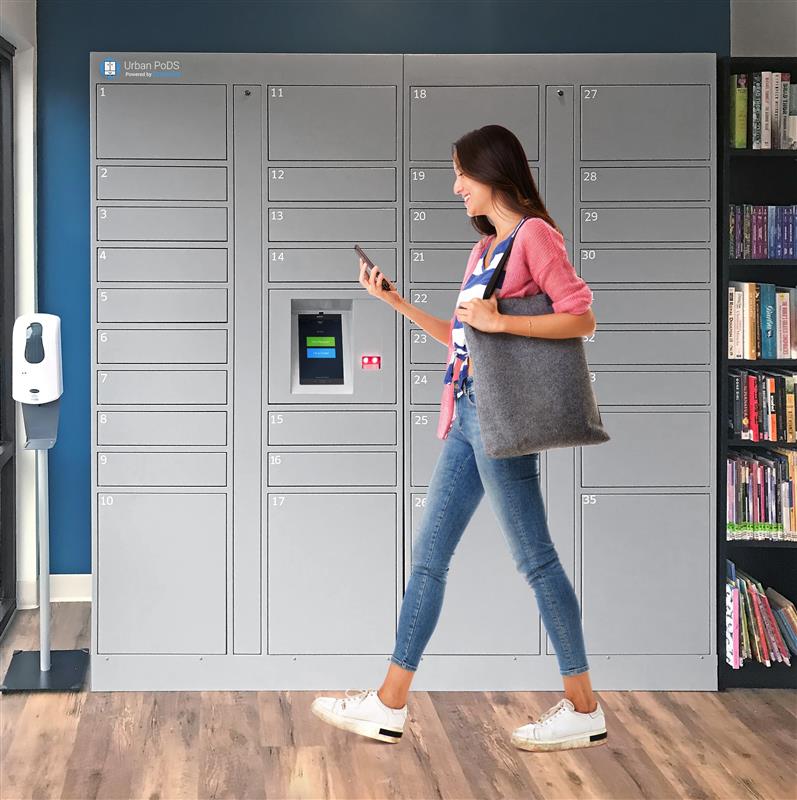
This system separates material access from staffed service hours. The library building may close at 5 or 6 p.m., but access to requested materials continues.
Extending Service Without Extending Hours
One of the most immediate benefits of smart lockers is the ability to provide round-the-clock pickup without keeping the entire facility open.
For rural libraries, this means:
- Serving shift workers who cannot visit during daytime hours
- Supporting students with evening commitments
- Reducing congestion during peak times
- Offering convenience without additional staffing
Instead of increasing payroll or stretching staff schedules, libraries create flexible access points that operate independently.
This is especially impactful in small communities where even minor scheduling conflicts can prevent visits altogether.
Creating Satellite Access Points
Beyond after-hours access, smart lockers enable something even more transformative: distributed service locations.
Rather than constructing new branches, libraries can install lockers in strategic community locations such as:
- Municipal buildings
- Community centers
- Local grocery stores
- Schools or colleges
These locker installations function like “micro-branches,” extending the library’s presence beyond its main building. Patrons in neighboring towns can place holds and retrieve materials locally, eliminating the need to travel long distances to access services.
This approach significantly reduces travel time for remote residents while increasing the library’s visibility in surrounding communities. Because these locations do not require permanent staffing, they avoid the operational complexities associated with traditional branches. The overall costs are also far lower than constructing and maintaining a new facility.
In effect, the library transforms from a single physical destination into a distributed network of access points, bringing services closer to the communities it serves.
Improving Equity and Access
Distance often creates hidden inequities. Seniors with mobility limitations, families without reliable transportation, and residents in remote agricultural areas may engage less simply because visiting the library is inconvenient.
Smart lockers help level the playing field. By positioning pickup points closer to where people live and work, libraries reduce dependence on transportation and fixed schedules.
This expanded accessibility is particularly important for:
- Technology lending programs
- Educational materials for students
- Workforce development resources
- Interlibrary loan items
When access becomes easier, participation increases – and so does community impact.
A Cost-Effective Growth Strategy
For rural systems operating within strict financial limits, smart lockers provide a scalable alternative to traditional expansion. Compared to opening a new branch, lockers require significantly fewer resources. They involve a lower upfront investment, do not require full-time staffing commitments, and incur minimal additional utility costs. Additionally, lockers typically demand limited long-term maintenance, making them a more cost-efficient option.
They also increase the efficiency of existing collections. When pickup becomes more convenient, hold fulfillment improves and circulation rates often rise.
From a strategic standpoint, lockers allow rural libraries to expand services without committing to long-term structural costs. They offer flexibility – something especially valuable in small communities where budgets fluctuate.
Supporting More Than Books
While often associated with book pickup, smart lockers can support a wide range of materials.
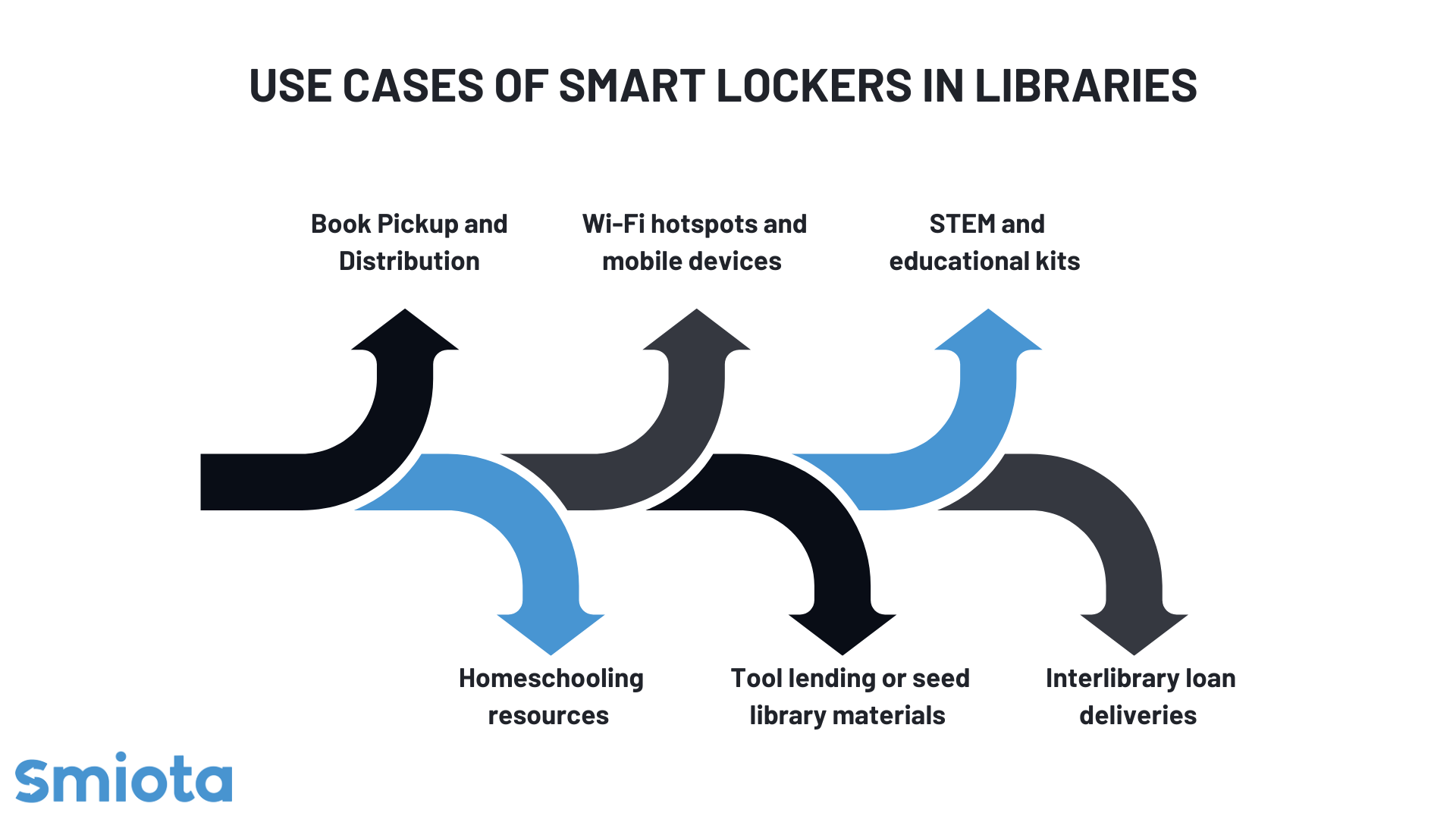
They are particularly valuable for distributing:
- Wi-Fi hotspots and mobile devices
- STEM and educational kits
- Homeschooling resources
- Tool lending or seed library materials
- Interlibrary loan deliveries
In rural areas where broadband access and educational resources may be limited, this capability significantly strengthens the library’s role as a community support center.
Increasing Community Visibility
Strategically placed lockers also reinforce the library’s presence. When installed in high-traffic areas, they act as constant reminders that the library is active, modern, and accessible.
This visibility can help encourage new memberships, strengthen partnerships with local businesses, and increase awareness of additional services offered by the library. It also helps position the library as an innovative leader within the community.
Implementation Considerations
Successful deployment requires thoughtful planning. Rural libraries should evaluate:
- Secure, accessible locations
- Reliable power and internet connectivity
- Weather protection and lighting
- Clear communication to patrons
- A phased rollout approach
Starting with one pilot location allows libraries to measure demand and refine processes before expanding further.
Conclusion: Expanding Reach Without Expanding Buildings
Rural libraries face undeniable structural challenges – geographic spread, limited budgets, and small teams. Yet their mission remains the same: to provide equitable access to information, education, and opportunity.
Smart lockers offer a practical way to meet that mission. They extend service hours, reduce travel barriers, create satellite access points, and support diverse lending programs – all without major infrastructure investment.
In communities where distance can limit opportunity, smart lockers bring the library closer to the people it serves. Instead of asking patrons to travel farther, rural libraries can now extend their reach outward – one secure pickup point at a time.
The post How Smart Lockers Help Rural Libraries Expand Their Reach appeared first on Smiota.
]]>The post Transforming Airport Maintenance Operations with Smart Lockers appeared first on Smiota.
]]>In this article, let us dive deep into how smart lockers help improve operational efficiency and enhance customer experience in airports.
Maintenance Challenges in Modern Airport Environments
Airport maintenance directly impacts safety, operational efficiency, and passenger satisfaction. Because airports operate around the clock, even minor issues require immediate attention to avoid service disruptions.
1. Diverse and Time-Sensitive Requirements
Maintenance teams handle a wide variety of critical tasks, including:
- Electrical maintenance – replacing bulbs, repairing fixtures, maintaining power systems, fixing panels
- Plumbing repairs – restroom maintenance and water system fixes
- Mechanical upkeep – escalators, conveyor belts, and other essential equipment
- General infrastructure maintenance in passenger-facing areas
Since many of these issues occur in high-traffic zones, delays can quickly lead to congestion, safety concerns, and negative passenger experiences. Fast response times are essential to maintaining smooth airport operations.
2. Limitations of Traditional Tool and Spare-Part Management
Despite urgent maintenance needs, many airports rely on conventional storage systems. While common tools may be readily available, specialized equipment is often stored in centralized warehouses or off-site facilities, causing retrieval delays.
Traditional systems also create operational gaps, such as:
- Time-consuming coordination between teams
- Manual tracking and limited visibility
- Difficulty monitoring tool access and returns
- Risk of misplaced equipment and stock shortages
- Increased maintenance downtime
As airports expand and modernize, these inefficiencies highlight the need for a more secure, automated, and responsive storage solution.
Understanding Smart Lockers and Their Role in Airports
Smart lockers are secure, automated storage systems designed to provide controlled access to tools, spare parts, and maintenance supplies. Using new-age technology, they allow airports to digitally manage and track stored items in real time.
Key features include:
- Secure access control for authorized personnel
- Real-time digital tracking of tools and components
- Customizable compartments for different equipment types
- Automated access records for every transaction
Many solutions, such as Smiota’s smart locker systems, include locker software that continuously monitors inventory levels and logs usage data. This eliminates manual tracking, reduces errors, and improves operational visibility.
Additionally, smart lockers are scalable, enabling airports to expand installations as infrastructure and maintenance demands grow.
Key Benefits of Using Smiota Smart Lockers in Airport Maintenance
Smiota smart lockers are built for high-security, fast-paced environments like airports. They integrate seamlessly with existing IT and security systems, allowing supervisors to centrally monitor usage, manage inventory, and control access. With flexible deployment across terminals and maintenance zones, these lockers provide quick tool access wherever needed, while their user-friendly interface supports efficient, time-sensitive operations.
Here, let us look at the benefits of using Smiota smart lockers in airports in detail.
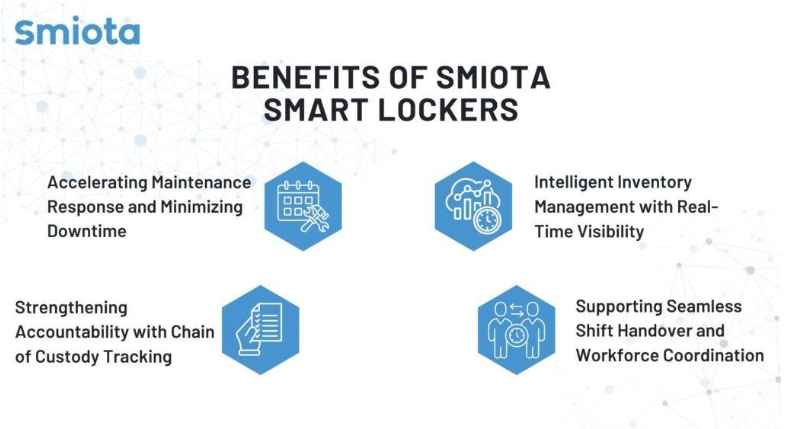
1. Faster Maintenance Response
By placing essential tools and spare parts closer to operational areas, smart lockers eliminate delays caused by warehouse retrieval or equipment transport. This enables:
- Immediate access to required tools
- Faster repair completion
- Reduced equipment downtime
- Fewer service interruptions
As a result, airport operations remain smooth and uninterrupted.
2. Stronger Accountability with Chain-of-Custody Tracking
Smart lockers record every access event, creating a transparent and secure audit trail. The system tracks:
- Who accessed the locker
- When an item was removed
- When it was returned
This visibility reduces equipment loss, prevents misuse, and provides airport management with greater operational control.
3. Real-Time Inventory Visibility
With automated inventory monitoring, maintenance teams can track stock levels accurately without relying on manual processes. Key advantages include:
- Continuous inventory updates
- Early identification of shortages
- Proactive replenishment planning
- Reduced administrative workload
This intelligent inventory management ensures essential tools and spare parts are always available when needed.
4. Supporting Seamless Shift Handover and Workforce Coordination
Airport maintenance operations run around the clock, requiring smooth coordination between different work shifts. Smiota smart lockers serve as secure exchange points where outgoing teams can deposit tools or replacement components for incoming personnel. This ensures seamless communication, prevents misplaced equipment, and supports uninterrupted maintenance operations.
The major operational advantages of Smiota smart lockers include:
- Faster access to tools and spare parts, reducing maintenance delays
- Secure authentication methods that restrict unauthorized access
- Comprehensive tracking and accountability for all stored items
- Real-time inventory monitoring and proactive replenishment planning
- Improved coordination between maintenance teams across multiple shifts
Enhancing Passenger Experience and Operational Efficiency with Smiota Smart Lockers
Maintenance efficiency directly impacts passenger satisfaction and overall airport reputation. Malfunctioning lighting, damaged equipment, or plumbing issues can inconvenience passengers and create safety concerns. Smiota smart lockers enable maintenance teams to resolve issues quickly, ensuring airport facilities remain safe, clean, and fully functional.
By reducing time spent searching for tools or coordinating with warehouse teams, maintenance personnel can focus on repair tasks. This improved productivity helps airports maintain consistent service standards while optimizing workforce efficiency. Faster maintenance turnaround times also help airports avoid operational bottlenecks and maintain smooth passenger flow.
Conclusion: Why Smiota Smart Lockers Are a Strategic Investment for Airports
Airport maintenance operations require secure, efficient, and reliable solutions to ensure continuous infrastructure performance and passenger satisfaction. Traditional storage and tool management methods often result in delays, inefficiencies, and accountability challenges. Smiota smart lockers address these issues by providing automated and secure storage solutions that improve maintenance response times, enhance inventory visibility, and strengthen operational transparency.
By supporting seamless workforce coordination and storage, Smiota smart lockers help airports achieve higher efficiency and reliability. As airports continue to modernize and adopt advanced technologies, Smiota smart lockers represent a strategic investment that enhances maintenance operations and contributes to a superior passenger experience.
To explore how our smart lockers can enhance your airport’s operations, get in touch with us today.
The post Transforming Airport Maintenance Operations with Smart Lockers appeared first on Smiota.
]]>The post Sustainable Campuses: How Smart Lockers Reduce Waste and Carbon Footprints appeared first on Smiota.
]]>As universities push toward sustainability goals, these everyday inefficiencies are becoming harder to ignore. This is where smart lockers step in, not just as a convenience feature, but as a practical, tech-driven solution to a much larger problem. Beyond simplifying storage and deliveries, smart lockers actively help reduce waste, cut down unnecessary transport, and lower carbon footprints. For campuses striving to become greener and more responsible, smart lockers are emerging as an essential part of sustainable infrastructure.
The Environmental Cost of Traditional Campus Logistics
Traditional campus logistics come with environmental costs that often go unnoticed. When packages are missed or misplaced, they are frequently returned to distribution centers, doubling transportation emissions for a single delivery. Multiply that by thousands of packages over a semester, and the carbon impact becomes significant.
The same applies to shared campus assets. Misplaced library books, lab equipment, or sports gear often lead to unnecessary replacements. Each replacement means new manufacturing, packaging, shipping, and eventually disposal, all contributing to increased landfill waste and resource depletion. Even temporary misplacement can cause departments to over-order “just in case,” adding to excess inventory that may never be fully used.
Fuel consumption from repeated campus delivery runs, maintenance trips, and internal transport adds another layer of emissions. Delivery vehicles idling, driving short inefficient routes, or making multiple attempts all increase CO₂ output. When combined with discarded packaging materials and damaged goods, traditional campus logistics quietly undermine sustainability efforts, despite good intentions.
Smart Lockers as a Solution to Reduce Waste
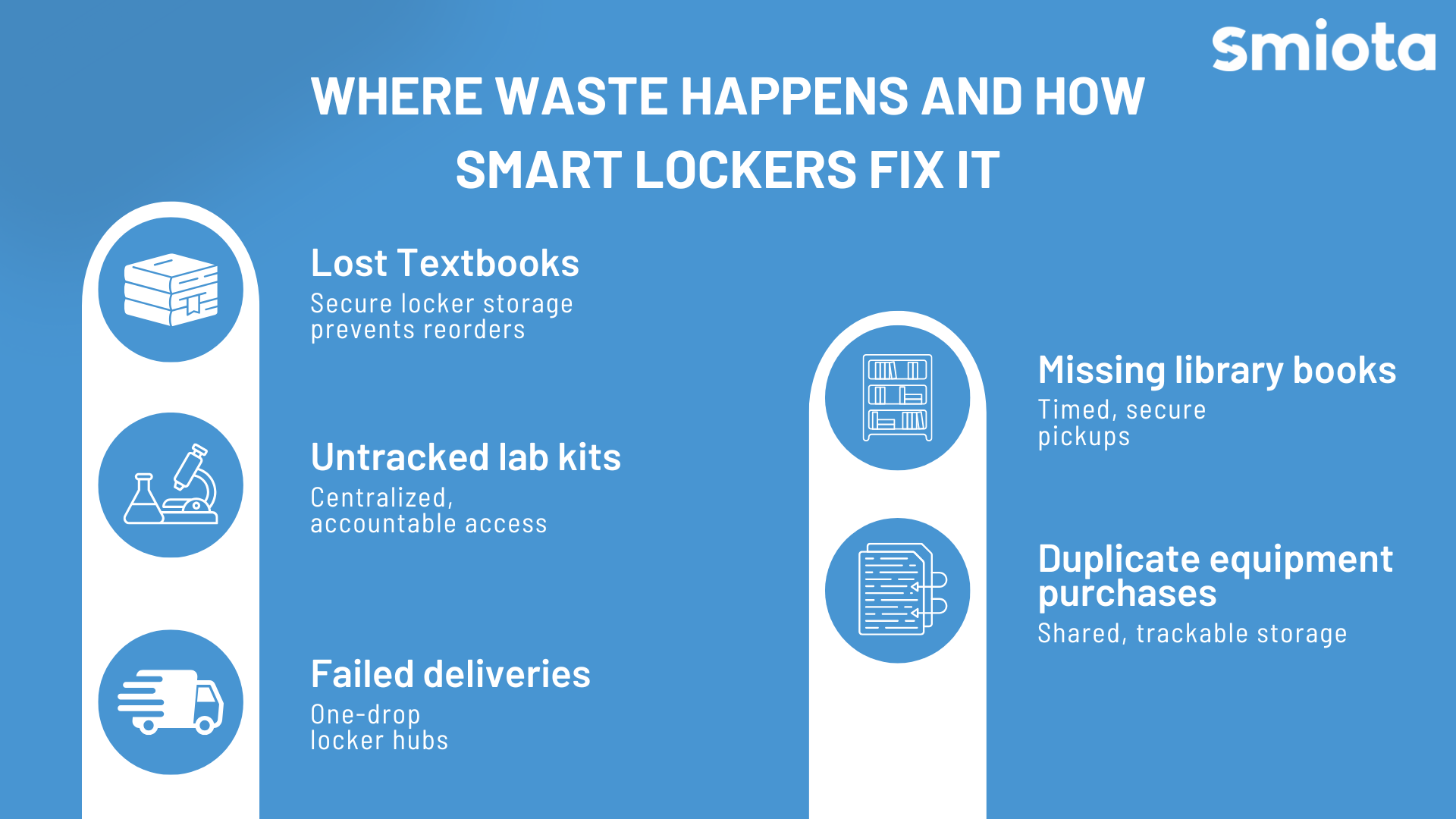
Smart lockers prevent waste by eliminating common points of loss and inefficiency on campus. Secure compartments, digital access controls, app notifications, and timed pickups ensure that items are stored correctly and collected on time, reducing uncertainty for both users and administrators. When items are less likely to go missing, campuses avoid unnecessary replacements and the waste that comes with them.
Examples of how smart lockers reduce waste on campus:
- Students no longer misplace textbooks, lab equipment, or project materials, cutting down on repeated purchases and replacements.
- Shared lab kits and academic resources remain tracked and accounted for, reducing overstocking and excess inventory.
- Centralized package deliveries into smart locker hubs reduce failed delivery attempts, returns, and damaged parcels.
- Library books and learning materials are securely stored for pickup, minimizing losses and replacement orders.
- Sports equipment, art supplies, or student organization materials are stored and retrieved efficiently, preventing duplicate purchases.
Every avoided replacement directly reduces environmental impact. Fewer replacements mean less manufacturing, reduced shipping and transport emissions, and lower disposal rates. Over time, smart lockers help campuses shift from waste-heavy, reactive systems to intentional, sustainable resource management.
Minimizing Carbon Footprint through Smarter Deliveries
One of the most direct sustainability benefits of smart lockers is their impact on delivery efficiency. Centralized locker hubs allow multiple deliveries to be completed in a single stop, rather than across scattered buildings or departments. This consolidation significantly reduces the number of delivery trips required across campus.
Fewer delivery attempts also mean fewer miles traveled. Missed deliveries are a major contributor to unnecessary emissions, and smart lockers eliminate this issue by ensuring secure, 24/7 access for recipients. Couriers no longer need to return multiple times or reroute packages.
In addition, reduced vehicle movement leads to lower fuel consumption, fewer emissions, and less congestion on campus. For universities tracking their carbon output, these incremental reductions add up quickly over the academic year.
Smart lockers also align seamlessly with broader campus sustainability initiatives. Whether a university is aiming to reduce Scope 3 emissions or promote greener operations, locker-based delivery systems integrate technology into environmental planning, making sustainability measurable rather than aspirational.
Also read: Beyond Packages: Multi-Department Uses for Campus Lockers
Supporting a Circular Economy on Campus
Beyond logistics, smart lockers open the door to circular economy within campus communities. They can act as secure hubs for sharing, reuse, and redistribution, encouraging students and staff to consume less and share more.
Universities can use smart lockers to facilitate book exchanges, lab kit reuse, or shared access to art supplies and sports equipment. Student-run marketplaces and sustainability initiatives can leverage lockers as pickup and drop-off points, reducing friction in peer-to-peer exchanges.
By making sharing easy and reliable, smart lockers reduce the demand for new products. Fewer purchases mean less manufacturing, lower transport emissions, and reduced landfill waste. Over time, this fosters a campus culture where reuse becomes normal rather than inconvenient.
The long-term impact goes beyond waste reduction. Students exposed to sharing systems during their education are more likely to carry sustainable habits into their professional and personal lives. Smart lockers, in this sense, become enablers of behavioral change, not just storage solutions.
Challenges and Considerations
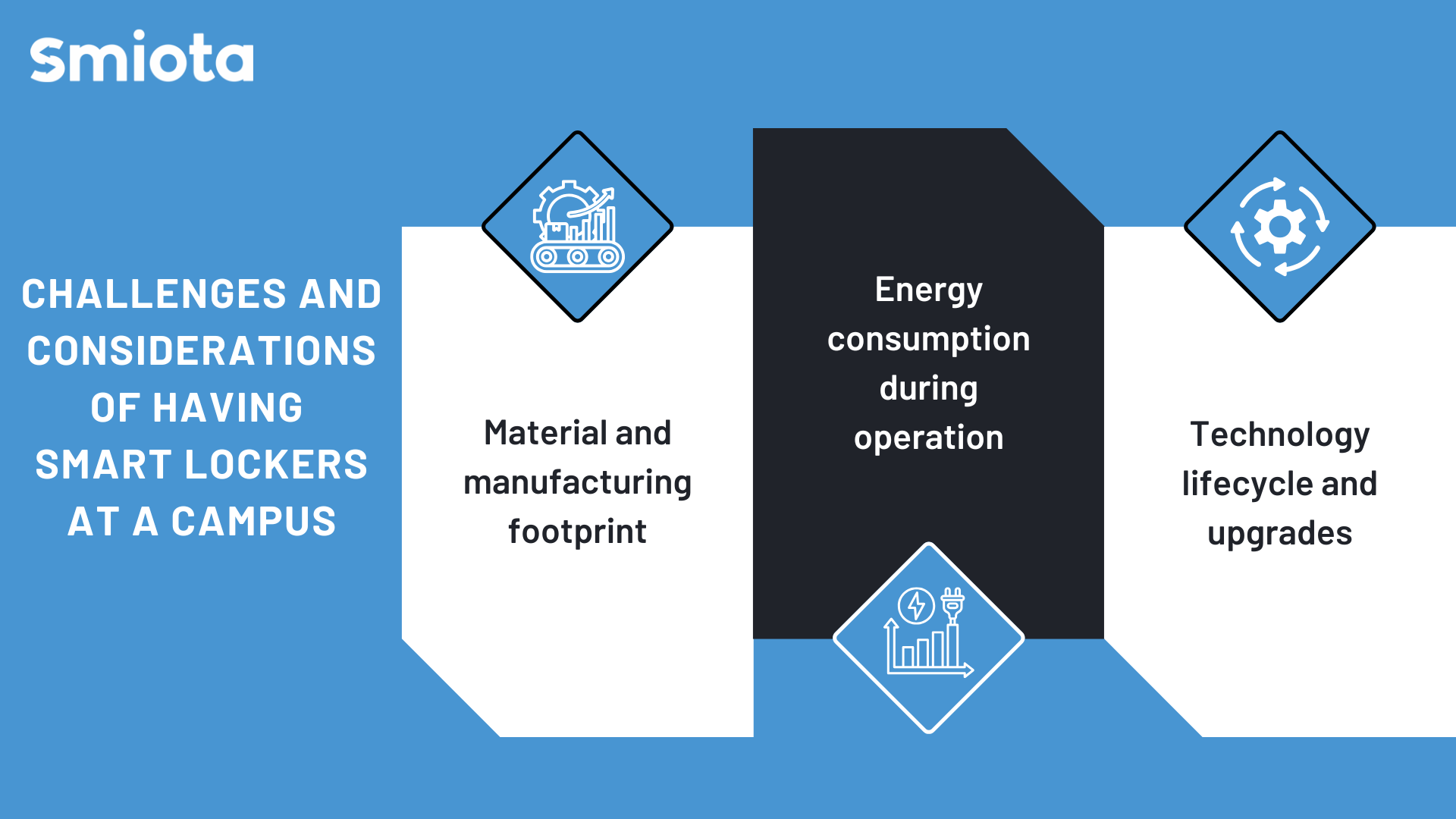
Like any infrastructure investment, smart lockers come with their own set of challenges. The key is not to overlook them, but to address them thoughtfully so sustainability goals remain intact from day one.
- Material and manufacturing footprint:
Manufacturing locker systems requires raw materials and energy, which can raise concerns about environmental impact. This can be mitigated by choosing lockers made from durable, recyclable materials and designs built for long-term use, reducing the need for frequent replacements.
- Energy consumption during operation:
Smart lockers rely on power for connectivity, access control, and notifications. Using energy-efficient components, low-power systems, and integrating lockers with renewable energy sources or energy-efficient campus grids helps significantly lower ongoing energy consumption.
- Technology lifecycle and upgrades:
Like all technology, smart lockers require maintenance, updates, and eventual upgrades. Opting for modular, scalable systems allows universities to upgrade individual components rather than replace entire units, extending the system’s lifecycle and minimizing waste.
When universities plan for these considerations early and view smart lockers as long-term infrastructure rather than quick fixes, the sustainability benefits far outweigh the initial footprint, making lockers a truly responsible investment for greener campuses.
Conclusion
Sustainable campuses are built through a series of practical, everyday decisions. Smart lockers play a powerful role in this journey by reducing waste, optimizing delivery logistics, and enabling sharing and reuse across campus communities. What might seem like a small infrastructure upgrade can create a ripple effect across sustainability goals, student behavior, and operational efficiency.
More importantly, smart lockers show how technology and sustainability can work together in meaningful ways. They are not just about convenience or efficiency. They represent smarter campus planning that aligns operational needs with long-term environmental responsibility.
Solutions like Smiota’s smart lockers are designed with this balance in mind. Built for durability, scalability, and real campus use cases, Smiota lockers help universities reduce unnecessary deliveries, prevent resource loss, and support circular practices, all while improving the day-to-day experience for students and staff.
As universities rethink how they manage resources, cut emissions, and engage students in sustainability efforts, smart lockers deserve a place in the conversation. Not as an add-on, but as a strategic investment in building greener, more resilient campuses for the future. Talk to us today to explore how you can use Smiota lockers to accelerate your sustainability goals.
The post Sustainable Campuses: How Smart Lockers Reduce Waste and Carbon Footprints appeared first on Smiota.
]]>The post Improving Guest Satisfaction Scores in Extended Stay Hotels with Smart Locker Technology appeared first on Smiota.
]]>As expectations evolve, extended stay hotels must look beyond traditional amenities to improve the day-to-day guest experience. One increasingly important yet often overlooked area is package management. Smart locker technology is emerging as a powerful solution that directly improves guest satisfaction while also streamlining hotel operations.
Why Guest Satisfaction Matters More in Extended Stay Hotels
Guest satisfaction carries extra weight in extended stay properties. A minor inconvenience that might be overlooked during a two-night stay can become a major frustration over several weeks. Delays, inefficiencies, or repeated service interruptions are far more noticeable when guests interact with hotel systems daily.
Extended stay guests – such as business travelers, relocating families, and digital nomads – prioritize:
- Independence and flexibility
- Secure handling of personal belongings
- Minimal friction in everyday activities
Hotels that consistently deliver smooth, reliable experiences are far more likely to earn positive reviews, higher satisfaction scores, and longer stays. Technology-driven amenities like smart lockers directly support these expectations.
Key Factors That Influence Guest Satisfaction in Extended Stay Properties
Several factors shape how long-term guests perceive their stay. While room comfort and cleanliness remain essential, operational convenience increasingly influences overall satisfaction.
Key drivers include:
- Autonomy: Guests want to manage their schedules without relying on staff availability.
- Reliability: Daily services must work consistently, not just occasionally.
- Security: Long-term guests often receive valuable personal and business deliveries.
- Ease of use: Systems should feel intuitive and unobtrusive.
Package handling may seem like a small operational detail, but for extended stay guests who frequently receive online orders, groceries, and work-related shipments, it becomes a recurring touchpoint that significantly affects satisfaction.
Package Management Challenges in Extended Stay Hotels
The rise of e-commerce and food delivery has dramatically increased package volumes in extended stay hotels. Traditional front-desk-based package handling struggles to scale under this demand.
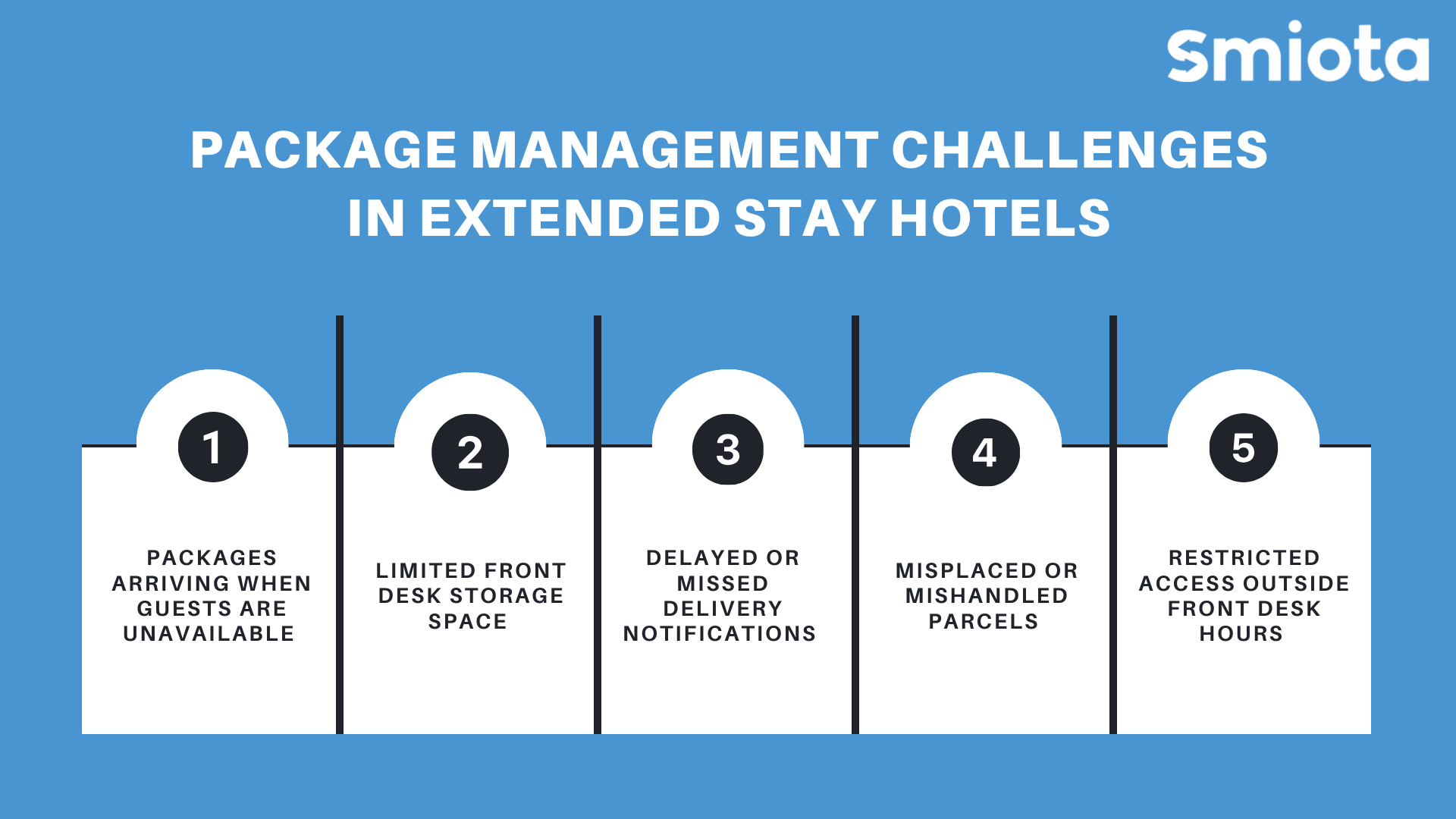
Common challenges include:
- Packages arriving when guests are unavailable
- Limited front desk storage space
- Delayed or missed delivery notifications
- Misplaced or mishandled parcels
- Restricted access outside front desk hours
These issues often surface in guest complaints and reviews, negatively impacting satisfaction scores. Over time, repeated friction around package retrieval erodes trust and convenience – two pillars of the extended stay experience.
How Smart Locker Technology Directly Improves Guest Satisfaction
Smart lockers address these challenges by automating package management and giving guests full control over retrieval. Their impact on satisfaction is both immediate and measurable. Let us look at some of the key benefits of using smart lockers in extended stay hotels.
1. 24/7 Access and Guest Convenience
Smart lockers allow guests to collect packages whenever it suits them – early morning, late at night, or between meetings – without depending on front desk availability. This flexibility is especially valuable for long-term guests with busy or unpredictable schedules.
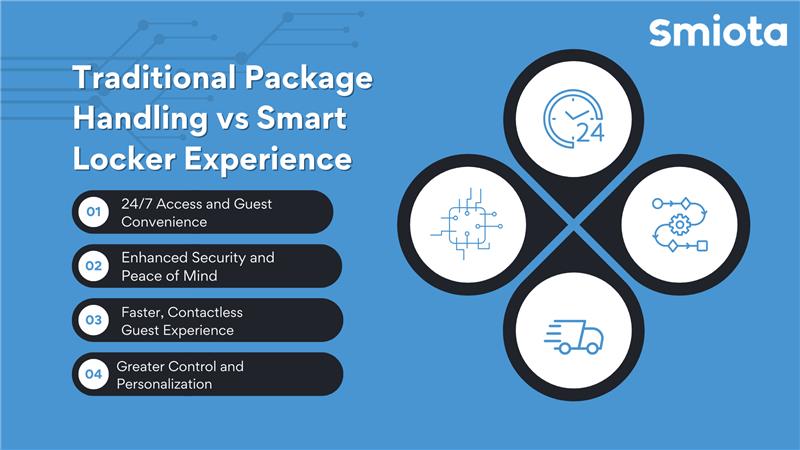
2. Enhanced Security and Peace of Mind
Smart lockers use secure access methods such as:
- PIN codes
- QR codes
- Biometric authentication
This ensures only authorized users can access specific compartments. Guests feel confident knowing their packages are protected from loss or theft, an important factor for those receiving high-value or sensitive deliveries.
3. Faster, Contactless Guest Experience
Once a package is delivered:
- The system logs it automatically
- The guest receives an instant notification
- Retrieval is self-service and contactless
This eliminates waiting times and reduces unnecessary interactions, supporting both convenience and modern guest preferences.
4. Greater Control and Personalization
Smart lockers give guests direct control over their belongings. Whether storing deliveries, personal items, or valuables, guests manage access independently. This level of control aligns closely with the residential-style living experience that extended stay hotels aim to provide.
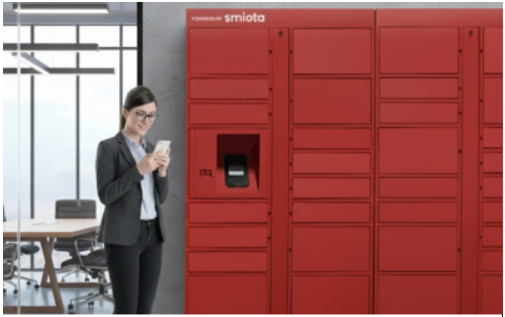
The Impact of Smart Lockers on Online Reviews and Ratings
Guest reviews increasingly reflect day-to-day convenience rather than just room quality. Experiences with package delivery, security, and accessibility frequently appear in feedback – both positive and negative.
Smart lockers help hotels:
- Reduce complaints related to lost or delayed packages
- Increase mentions of convenience and efficiency
- Improve overall sentiment in online reviews
While guests may not always explicitly mention smart lockers, the smooth experience they enable often translates into higher ratings and more favorable feedback.
Operational Benefits That Indirectly Improve Guest Satisfaction
The benefits of smart lockers extend beyond guests. By automating package handling, hotels reduce the operational burden on staff, particularly at the front desk.
Operational improvements include:
- Fewer interruptions for package inquiries
- Reduced manual logging and storage tasks
- Lower risk of errors or losses
- More consistent service across shifts
When staff are freed from repetitive tasks, they can focus on meaningful guest interactions. This improved service quality further enhances guest satisfaction scores.
Measuring the Impact on Guest Satisfaction Scores
Hotels can track the effectiveness of smart locker implementation by using a combination of qualitative and quantitative metrics, such as guest satisfaction surveys, Net Promoter Score (NPS), and review sentiment analysis, to gain a well-rounded understanding of guest experience and overall performance.
Many smart locker systems also provide usage analytics, offering insights into delivery volumes, peak usage times, and guest behavior. These data points help hotels continuously refine both operations and the guest experience.
Best Practices for Maximizing Guest Satisfaction with Smart Lockers
To fully realize the benefits of smart lockers, thoughtful implementation is essential. Best practices include:
- Choosing locker sizes that match typical delivery volumes
- Placing lockers in visible, secure, high-traffic areas
- Clearly communicating locker usage during check-in and pre-arrival messaging
- Providing simple signage and instructions near the lockers
- Training staff to support guest onboarding and troubleshooting
When implemented correctly, smart lockers quickly become a seamless part of the guest journey.
Why Extended Stay Hotels Should Choose Smiota Smart Lockers
Smart lockers are most effective when they are designed specifically for hospitality environments. Smiota smart lockers are well-suited for extended stay hotels because they combine security, convenience, and operational intelligence in a single solution.
Smiota offers:
- Customizable locker configurations to match guest needs and package volumes
- Secure access options, real-time notifications, and robust tracking
- Detailed analytics dashboards to monitor usage and performance
- Seamless integration with existing hotel systems and workflows
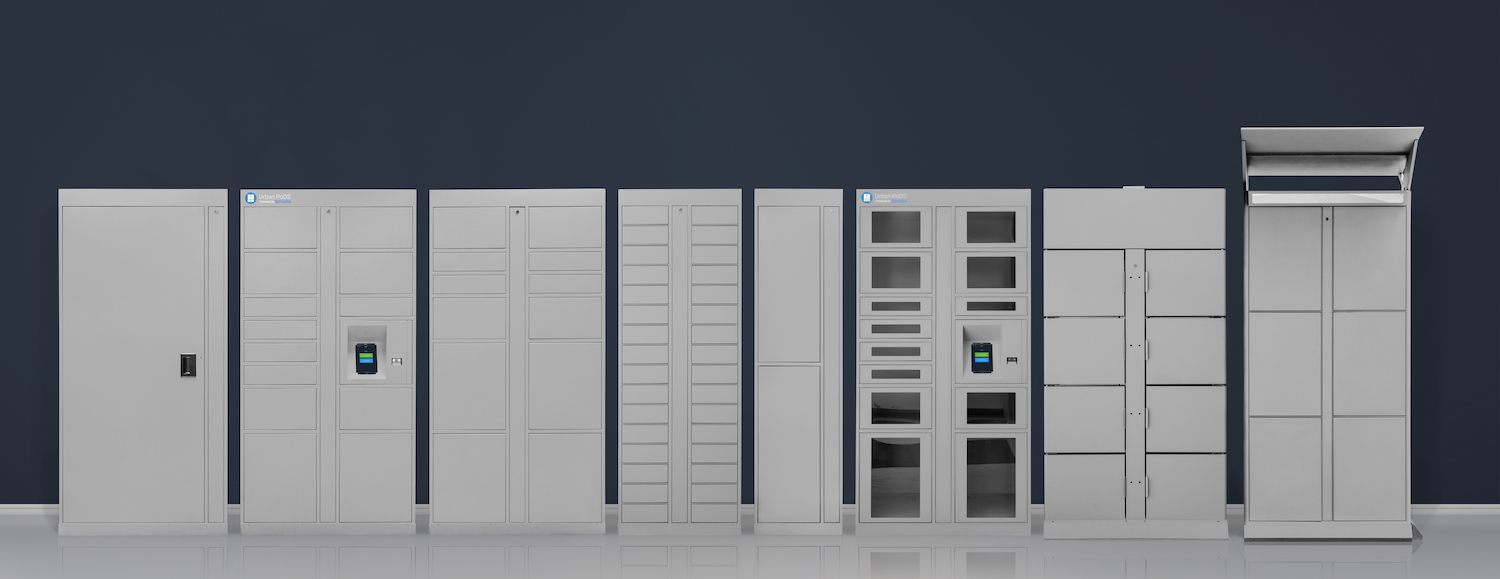
With proven deployments in extended stay environments, Smiota smart lockers help hotels reduce operational inefficiencies, minimize package-related issues, and deliver a more guest-centric experience. By investing in Smiota’s smart locker solutions, extended stay hotels position themselves to improve satisfaction scores, strengthen guest loyalty, and gain a competitive edge in an increasingly experience-driven market.
The post Improving Guest Satisfaction Scores in Extended Stay Hotels with Smart Locker Technology appeared first on Smiota.
]]>