The post Key Features to Look for in Locker Management Software appeared first on Smiota.
]]>Locker management software is the operational backbone that controls access, tracks usage, automates communication, and ensures security. Choosing the right smart locker and locker software can dramatically reduce manual workload, eliminate errors, and improve user experience across every touchpoint. In this blog, we break down the most important features to look for when evaluating locker management software, so you can invest with confidence.
Features to Consider While Evaluating a Locker Management Software
1. Centralized Dashboard for Complete Visibility
At the heart of any effective locker system is a centralized dashboard. This is where administrators gain full visibility into locker availability, usage patterns, system health, and user activity. High-quality locker management software provides a single interface to monitor operations in real time, whether you are managing one location or hundreds.
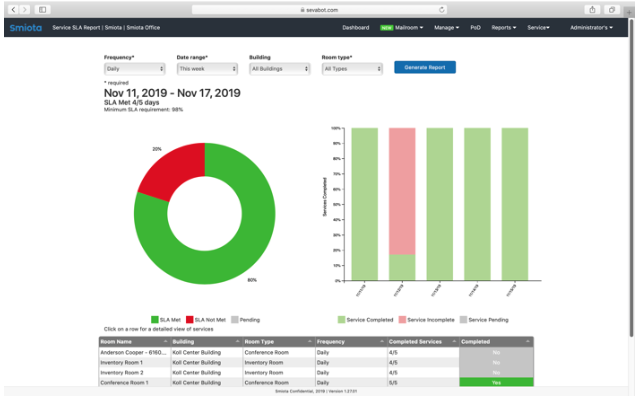
A centralized dashboard allows teams to identify bottlenecks quickly, resolve issues proactively, and maintain consistent performance across locations. Instead of juggling spreadsheets, emails, or manual logs, everything lives in one secure, easy-to-use platform.
2. Automated Notifications and Smart Communication
One of the biggest operational drains in locker-based workflows is manual communication. Calling recipients, sending reminder emails, or following up on uncollected items wastes valuable staff time. This is where automation becomes essential.
Modern locker management software should automatically notify users when items are delivered, ready for pickup, overdue, or returned. These notifications can be sent via SMS, email, or mobile app alerts. Automation not only improves efficiency but also sets clear expectations for users, reducing confusion and missed pickups.
3. Secure and Flexible Access Control
Security is non-negotiable when it comes to lockers, especially in environments handling packages, documents, or high-value assets. The best locker management software supports multiple authentication methods to balance security with convenience.
This includes PIN codes, QR codes, RFID cards, mobile app access, and time-bound credentials. Flexible access control ensures that only authorized users can retrieve items, while also allowing organizations to tailor access based on roles, schedules, or use cases. A secure system protects both the contents of the lockers and the trust of your users.
4. Seamless Integrationwith Existing Systems
No system should operate in isolation. Locker management software must integrate seamlessly with the tools you already use. This might include property management systems, HR platforms, asset management tools, access control systems, or internal databases. For example, Smiota’s smart locker systems can be integrated with popular ILS (Integrated Library System) such as Koha, Polaris, and Sirsi Dynix.
Robust APIs allow locker software to fit naturally into existing workflows rather than disrupting them. Integration reduces duplication of effort, improves data accuracy, and ensures that locker operations support broader organizational processes instead of creating new silos.
5. Scalability for Growing Needs
What works today may not work tomorrow. As organizations grow, so do their locker requirements. Scalable locker management software allows you to add more lockers, users, locations, or features without overhauling the system.
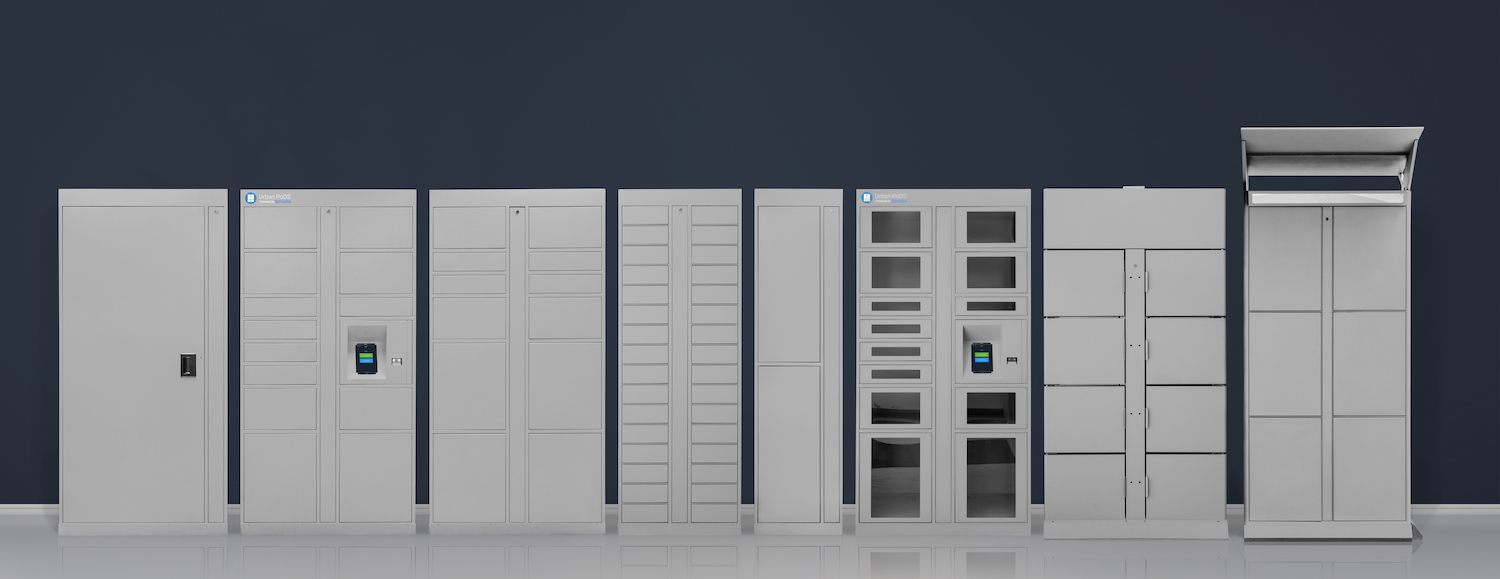
Cloud-based architecture plays a key role here. It enables remote management, centralized updates, and easy expansion across multiple sites. Scalable software ensures that your investment remains relevant as your operations evolve.
6. Real-Time Analytics and Actionable Reporting
Data-driven decision-making is no longer optional. The right locker management software provides detailed analytics and reporting that help organizations understand how lockers are being used.
These insights may include locker utilization rates, pickup times, delivery volumes, peak usage periods, and user behavior trends. With access to real-time data, administrators can optimize locker placement, adjust workflows, and improve overall efficiency. Analytics turn lockers from passive storage units into active operational assets.
7. Role-Based Access and Administrative Controls
Not every administrator needs the same level of access. Role-based controls are an essential feature of enterprise-grade locker management software. They allow organizations to assign specific permissions to different users, such as super admins, site managers, or support staff.
This improves accountability, enhances security, and ensures that teams can manage their responsibilities without unnecessary risk. Role-based access is especially important in large organizations or multi-site deployments.
8. Reliability and Offline Functionality
Locker systems often operate in environments where uninterrupted access is critical. Whether it is a hospital, a residential community, or a logistics hub, downtime can quickly turn into frustration.
Reliable locker management software should support offline functionality, allowing lockers to continue operating even during temporary network disruptions. Once connectivity is restored, data should sync automatically. This ensures consistent service, protects user trust, and minimizes operational risk.
9. Enterprise-Grade Security and Compliance
Security extends beyond physical access. Locker management software handles sensitive data, including user information, access logs, and transaction records. Strong security measures are essential to protect this data.
Look for software that includes encryption, secure cloud infrastructure, regular security audits, and compliance with standards such as SOC 2 and ISO 27001. Enterprise-grade security not only protects your organization but also reassures users that their data is handled responsibly. For instance, Smiota’s locker management software comes with world-class security features and has been approved (and used) by some of the tech giants such as Facebook and Spotify. This is testament to our focus on security and data protection.
10. Customization and Branding Capabilities
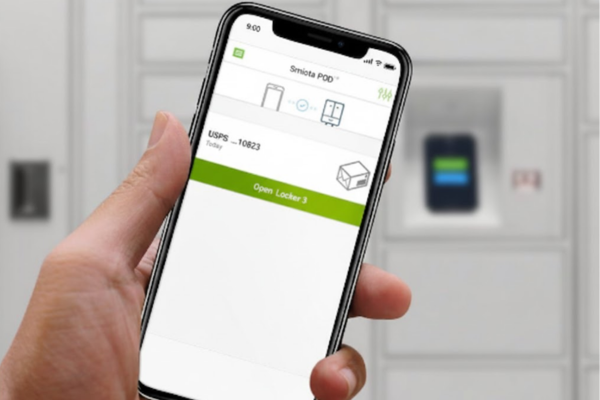
User experience matters. Locker management software should be customizable to reflect your brand, workflows, and communication style. This may include branded user interfaces, customized notification templates, and configurable rules for locker usage.
Customization helps lockers feel like a seamless extension of your organization rather than a generic third-party tool. It also improves adoption rates and overall satisfaction among users.
11. Easy Deployment, Training, and Ongoing Support
Even the most powerful software fails if it is difficult to deploy or use. Intuitive design, clear onboarding processes, and comprehensive training resources are key features to look for.
In addition, responsive support and regular updates ensure long-term success. Reliable locker management software evolves with user needs, introducing new features and improvements without disrupting operations.
How the Right Locker Management Software Transforms Operations
When all these features come together, the impact is significant. The right locker management software reduces manual effort, eliminates errors, enhances security, and delivers a smoother experience for both administrators and users.
Across industries, organizations see faster delivery turnaround, lower operational costs, improved accountability, and higher satisfaction levels. Lockers stop being a pain point and start becoming a strategic advantage.
Final Words
Selecting the right locker management software is about more than checking boxes. It is about choosing a solution that aligns with your operational goals, scales with your growth, and delivers real value every day. From centralized dashboards and automated notifications to security, analytics, and integrations, the features you choose will shape how effectively your locker system performs.
Smiota’s lockers and locker management software are designed with these principles at its core. Built to be secure, scalable, and intuitive, they empower organizations to manage lockers smarter, faster, and more efficiently. If you are ready to modernize your locker operations and unlock their full potential, connect with the Smiota team today to explore a solution tailored to your needs.
The post Key Features to Look for in Locker Management Software appeared first on Smiota.
]]>The post How to Set Up a Smart Package Room in Multifamily Buildings? appeared first on Smiota.
]]>A recent report estimates that the average US resident receives over 20 packages per year, and this number is only expected to grow. For apartment buildings, this translates to a constant stream of parcels arriving, often left unattended in lobbies or mailrooms. This can lead to frustration for residents worried about package security, and additional work for property staff tasked with managing and logging deliveries.
Enter the smart package room: a secure and convenient solution for managing package deliveries in multifamily buildings. These innovative spaces utilize smart lockers and advanced software to streamline the entire delivery process, improving resident satisfaction, enhancing security, and saving property staff valuable time. This blog post will guide you through the process of setting up a smart package room in your apartment building, covering everything from planning and budgeting to installation, operation management, and security measures.
Planning Your Smart Package Room
Assessing the Space
Before diving into specific equipment, it’s crucial to evaluate the available space within your apartment complex.
- Location: Ideally, the smart package room should be in a secure, easily accessible area with controlled access. Common locations include lobbies, hallways near elevators, or dedicated spaces within the building.
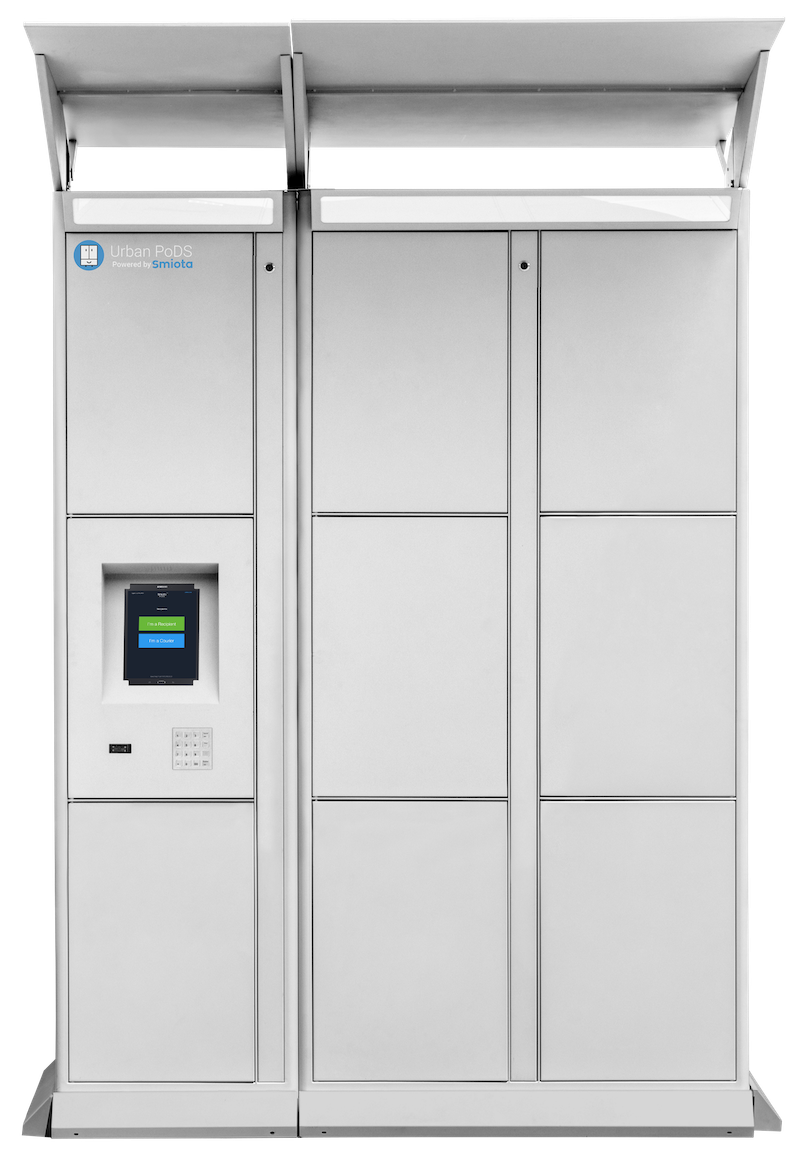
- Space Requirements: Estimate the volume of packages you typically receive and consider future growth. Lockers come in a variety of sizes. So plan for a layout that can accommodate a mix of small, medium, and potentially large packages. Aim for a comfortable flow of residents entering, retrieving their packages, and leaving.
Determining the Technology and Equipment
- Smart Lockers: These are the heart of the system, providing secure compartments for package storage. Choose lockers with a sturdy build and user-friendly interfaces. For example, Smiota’s smart lockers come with a tablet or mobile app for easy access, enhancing convenience and user experience.
- Security Systems: Security is vital. Implement security cameras that provide clear views of the entire package room. Additionally, consider access control systems that allow entry only to authorized users.
- Software Solutions: Invest in user-friendly software that manages the entire delivery process. This software should handle resident and delivery personnel notifications, track package delivery and retrieval, and integrate with any existing property management systems. Smiota’s mailroom app is a great example of this.
Budgeting and Costs
- Initial Costs: Anticipate initial expenses for hardware and software acquisition, including smart lockers, security cameras, access control systems, and software implementation. Installation costs will also need to be factored in.
- Ongoing Costs: Ongoing costs include software subscriptions, maintenance for lockers and security systems, and potential upgrades as your needs evolve.
- Funding Options: Explore funding options with your management team. Leasing, purchasing, or financing smart locker systems are possibilities, depending on your budget and long-term goals.
Setting Up the Smart Package Room
Installation Process
- Vendor Selection: Choose reliable vendors with a proven track record in smart locker and security system installations. Gather quotes, compare features, and select a vendor that aligns with your budget and requirements.
- Installation Steps: The installation process typically involves physically installing the smart lockers, security cameras, and access control systems in the designated space. Reliable vendors usually provide experienced personnel to handle this process efficiently.
- Integration: Connect the smart package room system with your existing property management system, allowing seamless data transfer and resident information management.
Configuring the System
- Software Setup: Familiarize yourself with the software provided by your chosen vendor. Configure settings, define user roles (residents, delivery personnel, and staff), and tailor notifications for each group.
- User Access: Establish a user access system for residents. Residents can typically register through the software or a dedicated app, allowing them to receive delivery notifications and access their packages electronically. Delivery personnel may require separate access codes or fobs to deposit packages into designated lockers.
Testing and Quality Assurance
- System Testing: Once everything is set up, perform thorough testing of the entire system. Ensure that lockers function properly, access controls work as intended, and residents can access the system seamlessly.
- Troubleshooting: Be prepared for minor technical issues during initial setup. Many vendors offer troubleshooting guides or online support to address common problems.
Managing the Smart Package Room
Resident Training and Communication
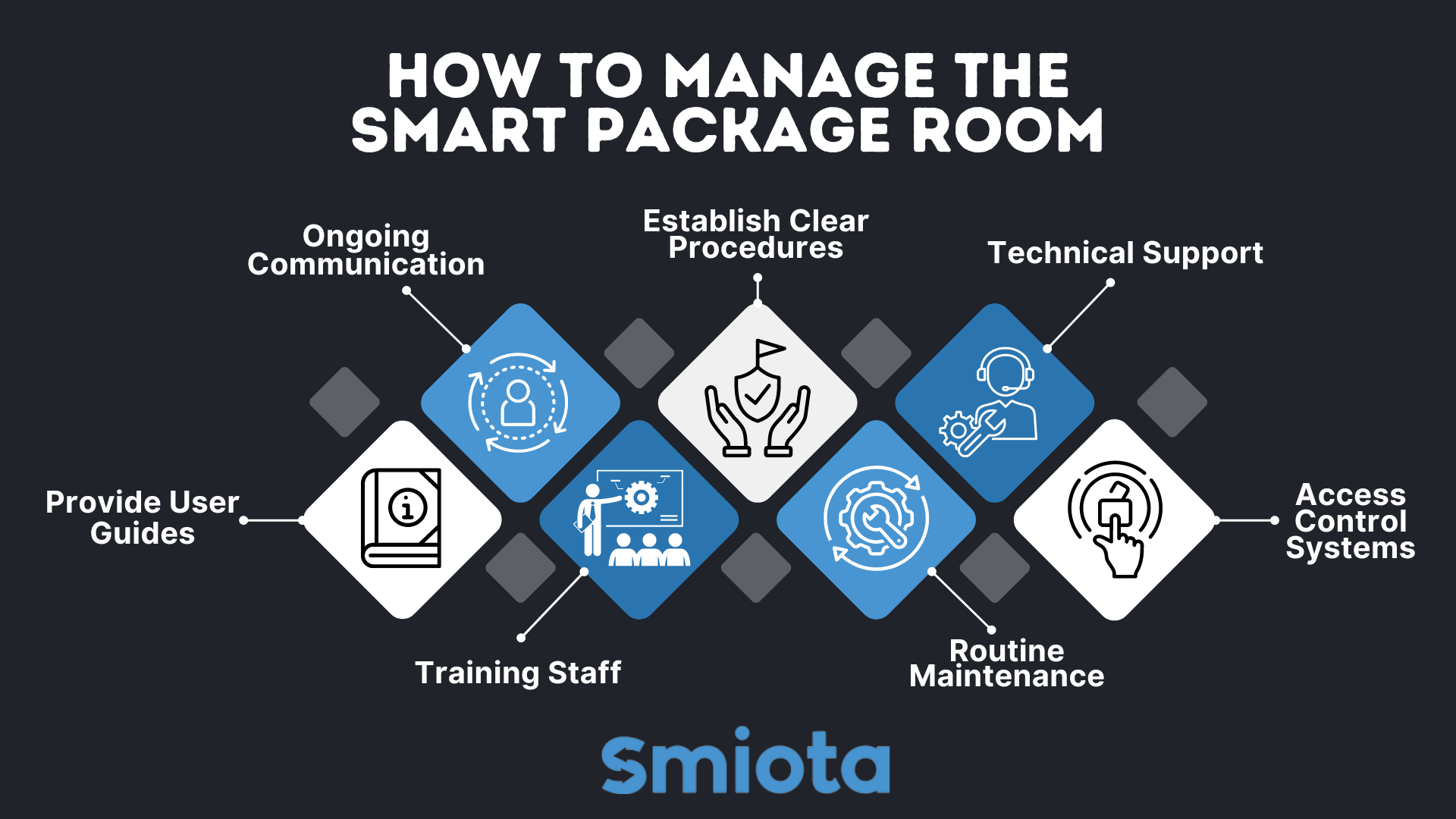
- User Guides: Provide user guides or create video tutorials available online or through the package management app. These resources should explain how to register, receive notifications, access lockers, and troubleshoot any potential issues.
- Ongoing Communication: Maintain open communication channels with residents. Address any concerns promptly and keep them informed about system updates or changes in procedures.
Daily Operations
- Staff Responsibilities: Train property staff on the management of the smart package room. Staff will be responsible for monitoring the system, handling any delivery exceptions, and maintaining a clean and orderly space.
- Handling Exceptions: Establish clear procedures for handling oversized packages, misdelivered items, or situations where residents have difficulty accessing their lockers. This may involve temporary storage solutions or contacting delivery companies for assistance.
Maintenance and Support
- Routine Maintenance: Regularly perform preventive maintenance on lockers, access control systems, and security cameras to ensure smooth operation. Cleaning the package room and addressing any minor issues promptly are also crucial.
- Technical Support: Many vendors offer technical support services. Ensure your staff knows how to access support when needed to resolve technical issues they can’t handle themselves.
Enhancing Security and Efficiency
Having the right security measures and steps to maintain efficient operations are key while managing a smart package room.
Security Features
- Access Control: Implement a robust access control system that restricts entry to the package room. This could involve key cards, key fobs, or smartphone app access for authorized personnel. Consider tiered access levels for residents and staff, depending on their roles.
- Surveillance: Maintain a well-lit package room equipped with high-resolution security cameras that provide clear views of all entrances, lockers, and common areas. Consider integrating these cameras with your existing security system for centralized monitoring.
Efficiency Improvements
- Automation: Leverage the automated features of the smart package room system. Automatic notifications sent to residents upon package delivery eliminate the need for manual contact from property staff. Additionally, some systems can automatically schedule delivery windows for residents with specific needs.
- Data Analytics: Utilize the data generated by the package management software to optimize operations. Analyze package volume trends, identify peak delivery times, and adjust locker configurations or staffing schedules to improve efficiency.
Conclusion
By implementing a well-designed and effectively managed smart package room, multifamily buildings can significantly enhance resident satisfaction and security. This innovative solution allows residents to conveniently pick up their packages 24/7, while ensuring secure storage. Property staff can streamline their workload, reduce package handling times, and dedicate more time to essential tasks.
Ready to transform your apartment complex into a smart package room? Smiota’s smart lockers are designed with both residents and property managers in mind.
But Smiota goes beyond just exceptional hardware. Our powerful Locker Delivery Operating System (L-DOS) is the brain behind the brawn. Our smart locker solutions are more than just a package storage system; they’re an investment in resident satisfaction, operational efficiency, and the future of your multifamily building.
Contact Smiota today for a free consultation!
The post How to Set Up a Smart Package Room in Multifamily Buildings? appeared first on Smiota.
]]>The post Technology Behind Smiota’s Automated Mailroom Tracking System appeared first on Smiota.
]]>The answer lies in the power of automation. An automated mailroom tracking system helps to make your mailroom management smart. In this blog post, we’ll dive into the inner workings of Smiota’s automated mailroom tracking system, exploring the technologies, components, and functionalities that make it tick. Get ready to discover how Smiota creates efficiency in your mailroom.
Understanding Automated Mailroom Tracking Systems
An automated mailroom tracking system replaces the manual processes of receiving, sorting, tracking, and delivering mail and packages with a streamlined, digitized solution. This system utilizes a combination of software, hardware, and innovative technologies to achieve operational excellence within your mailroom.
A Look at the Components of an Automated Mailroom
Smiota’s automated mailroom tracking system operates like a well-oiled engine, with each component playing a crucial role:
Software: The key to the system, the software, manages the entire workflow – from receiving and logging items to generating reports and facilitating communication between staff and recipients.
Hardware: These are the physical components that make the magic happen – tablets for enabling secure access and smart locker compartments for storage, delivery, and pickup.
Scanners: They quickly read barcodes or RFID tags on incoming items or user ID cards, feeding data into the software for allowing access or instant tracking.
Technologies:
- One Click Pickup: The button goes green for pickup when the item is available in the locker.
- Concurrent Use: Lockers open when the user is present in front of lockers. Multiple users can access lockers at the same time. Deposits and pickups can happen concurrently.
- Sensors for Package Detection: Ensures full chain of custody.
- UV Sanitization: UV Bulbs integrated into lockers offer a simple and fast way to sanitize locker surfaces when doors are closed. Save time and labor to clean lockers and make them safe to use in seconds. Programmable and managed through the cloud.
- Antimicrobial: Wilsonart® HD® with Antimicrobial Protection works in combination with proper cleaning and disinfection practices to keep surfaces cleaner.
How Automated Mailroom Tracking Systems Work
Let’s look at the typical workflow of a package managed using Smiota’s automated system:
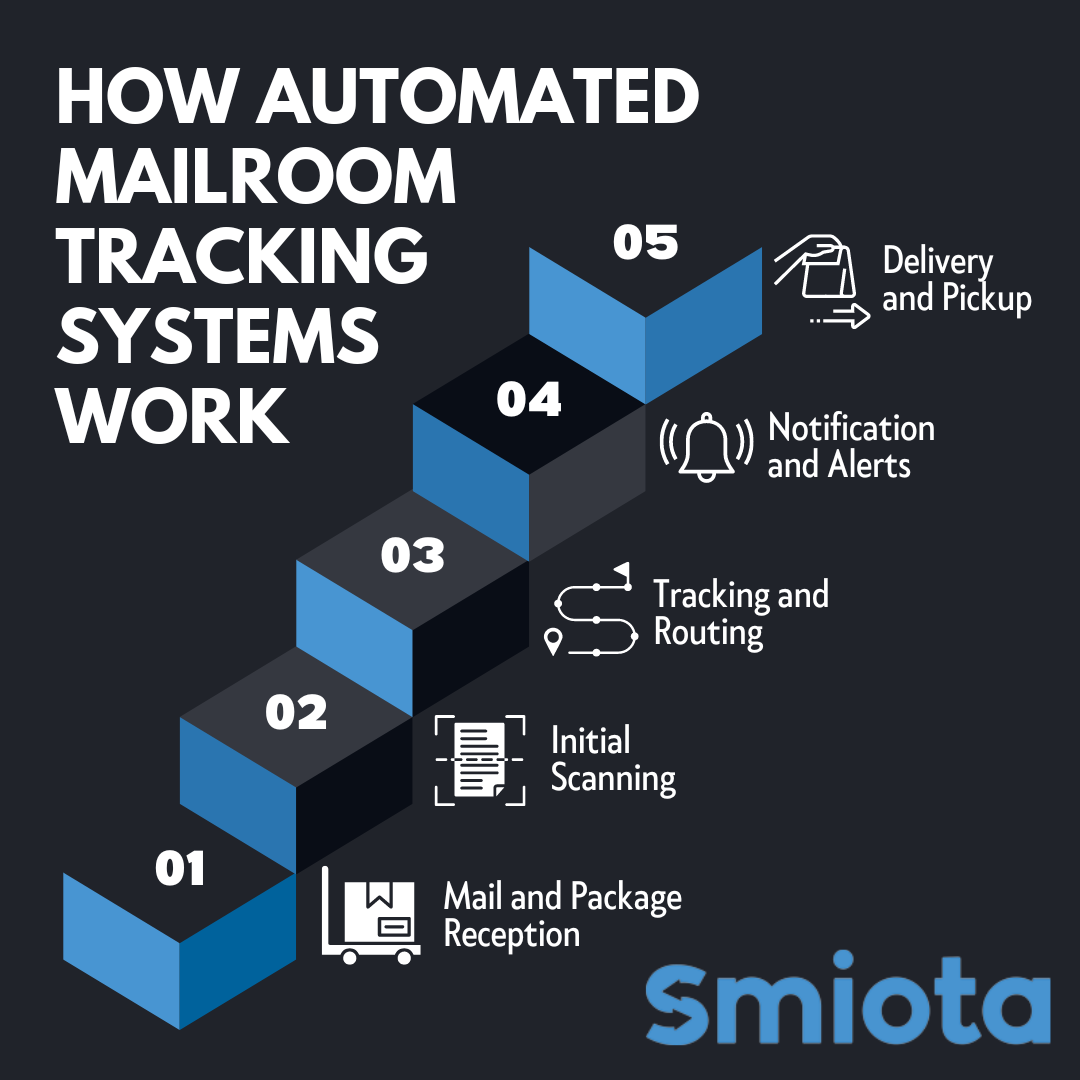
Mail and Package Reception:
- Incoming mail and packages arrive at the designated receiving area.
Initial Scanning:
- Staff utilize scanners to capture barcode or RFID tag data, automatically logging each item into the system.
Tracking and Routing:
- Tracking: The software tracks the location and status of each item in real-time, providing instant visibility for recipients and staff alike.
- Routing: Based on pre-defined rules (e.g., recipient department, address), the system automatically routes packages to their designated location.
Notification and Alerts:
- Notifications: Recipients receive automated notifications (email or SMS) informing them of incoming mail or packages.
- Alerts: The system can also send alerts for urgent or high-priority items, ensuring they get the attention they deserve.
Delivery and Pickup:
- Depending on your chosen system, delivery options may include: Direct delivery to recipient desks (for internal mail) or Secure placement in designated lockers for self-service pickup (ideal for high-volume facilities).
- Secure access methods, like PIN codes or QR codes, ensure only authorized recipients can access their packages.
The Benefits of Automated Mailroom Tracking Systems
Implementing an automated mailroom tracking system isn’t just about technology; it’s about creating a more streamlined and productive work environment. Here’s how Smiota’s system can transform your mailroom into a well-conducted package management system:
Enhanced Efficiency
- Time Savings: Automating repetitive tasks frees up staff time to focus on more strategic initiatives. Experience with our customers shows that Smiota’s system can reduce mail processing time by up to 80%!
- Reduced Errors: Automated tracking and routing minimize human error, ensuring accurate and timely delivery.
Improved Security
- Secure Logging: Every item is logged and tracked within the system, providing a clear audit trail for accountability. This ensures peace of mind and helps prevent loss or misplacement of important documents.
- Access Control: Only authorized personnel can access specific mail and packages, enhancing security and preventing unauthorized access.
Increased Accountability
- Audit Trails: Detailed records of mail handling facilitate accountability and transparency. You can easily track the entire journey of an item; from the moment it arrives to when it’s delivered.
- Accountability Measures: The system holds staff accountable for accurate processing and delivery of items. This improves efficiency and fosters a culture of responsibility within the mailroom team.
Better Resource Management
- Resource Allocation: Data insights from the system help in better allocation of mailroom staff and resources. By identifying peak processing times and workload distribution, you can optimize staffing schedules and ensure smooth operations.
- Cost Savings: Reduced labor costs and increased efficiency translate to significant long-term cost savings. Smiota’s system can help you streamline your mailroom operations, freeing up resources that can be directed towards other critical areas of your business.
Points to Consider when Implementing Automated Mailroom Tracking System
Before implementing a new system, it’s crucial to understand your specific needs and ensure a smooth transition. Here are some key considerations to keep in mind:
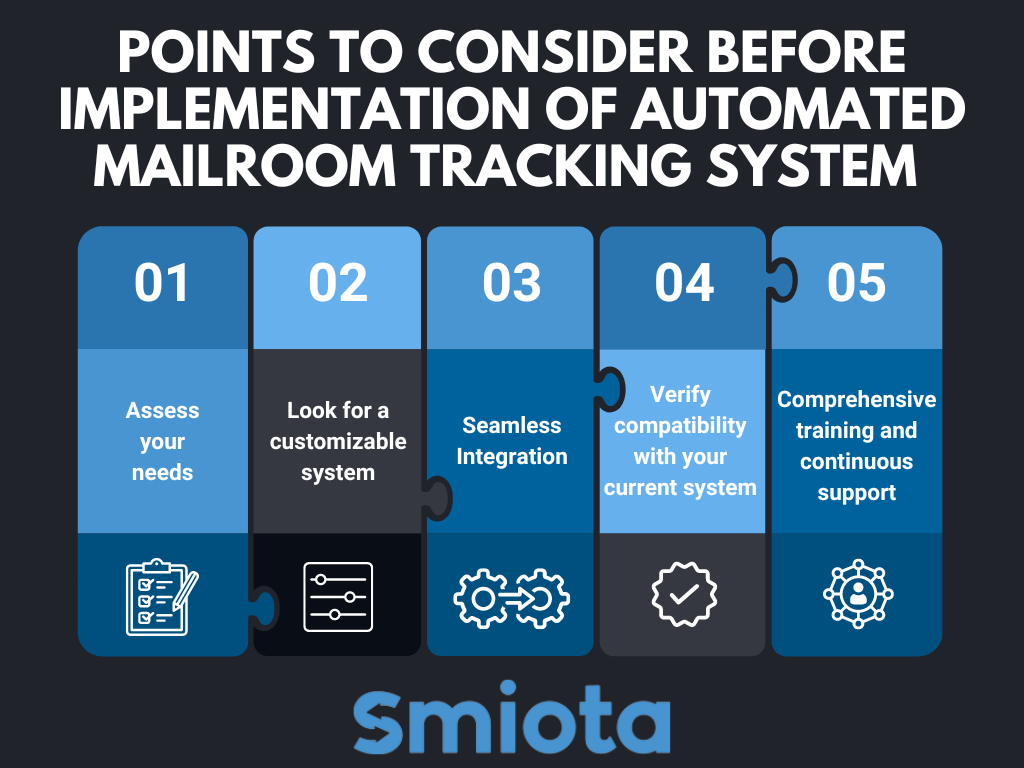
Assessing Needs
- Analyze Volume: Evaluate the average daily, weekly, or monthly volume of mail and packages your organization receives. This will help determine the system’s capacity requirements.
- Consider Recipients: Identify the types of recipients (internal departments, individuals) and their locations within your facility. This will influence the routing and delivery options you choose.
- Define Functionalities: Determine the desired functionalities – basic tracking, secure delivery options (lockers), and integration with existing systems (e.g., HR, access control). By understanding your specific needs, you can select a system that offers the right features and functionalities for your mailroom.
Customization
Smiota understands that a one-size-fits-all solution rarely works. We offer a customizable system that can be tailored to your unique needs and workflows. This ensures you get the features and functionalities that truly optimize your mailroom operations, creating a harmonious workflow for your staff and recipients.
Integration
For seamless operation, ensure the system integrates smoothly with your existing IT infrastructure. This might include:
- HR Systems: Automatic population of recipient information for internal mail delivery.
- Access Control Systems: Integration with access control systems allows for authorized locker access.
- Management Software: Data exchange with existing management software for reporting purposes.
Compatibility
Verify compatibility with your current hardware and software to avoid implementation hurdles. Smiota offers compatibility assessments to ensure a smooth integration process, minimizing downtime and disruption to your mailroom operations.
Training and Support
- Comprehensive Training: Smiota provides comprehensive training programs for your staff to ensure they’re comfortable using the new system effectively. The training program will cover all aspects of the system, from initial setup and user management to scanning, tracking, and delivery processes.
- Ongoing Support: We understand that reliable support is essential. Smiota prioritizes exceptional customer support to address any technical glitches and ensure your system runs optimally. Our dedicated support team is readily available to answer questions and provide ongoing assistance.
Conclusion
By implementing Smiota’s automated mailroom tracking system, you can transform your mailroom from an unorganized space to a neatly managed one with the following benefits.
- Saves time for both staff and recipients.
- Minimizes errors and ensures accurate delivery.
- Enhances security and access control.
- Provides detailed audit trails for accountability.
- Optimizes resource allocation and reduces costs.
Smiota offers a complete solution, featuring innovative technology, user-friendly software, customizable options, and comprehensive support.
Contact Smiota today for a consultation!
The post Technology Behind Smiota’s Automated Mailroom Tracking System appeared first on Smiota.
]]>The post Retail Analytics: Real-time Package Tracking and Data Collection using Smart Locker App appeared first on Smiota.
]]>Smart locker apps streamline package delivery and pickup processes and open new avenues for data collection and customer engagement. These applications provide a unique touchpoint with customers, enabling valuable data collection on user interactions, preferences, and feedback. As we explore the applications of retail data further, we will see how it redefines retail strategies.
Applications of Retail Data: Unveiling Insights and Steering Decisions
Data analytics empowers businesses with unprecedented capabilities to understand market dynamics, customer preferences, and operational efficiencies. Here, we explore the multifaceted applications of retail data analytics:
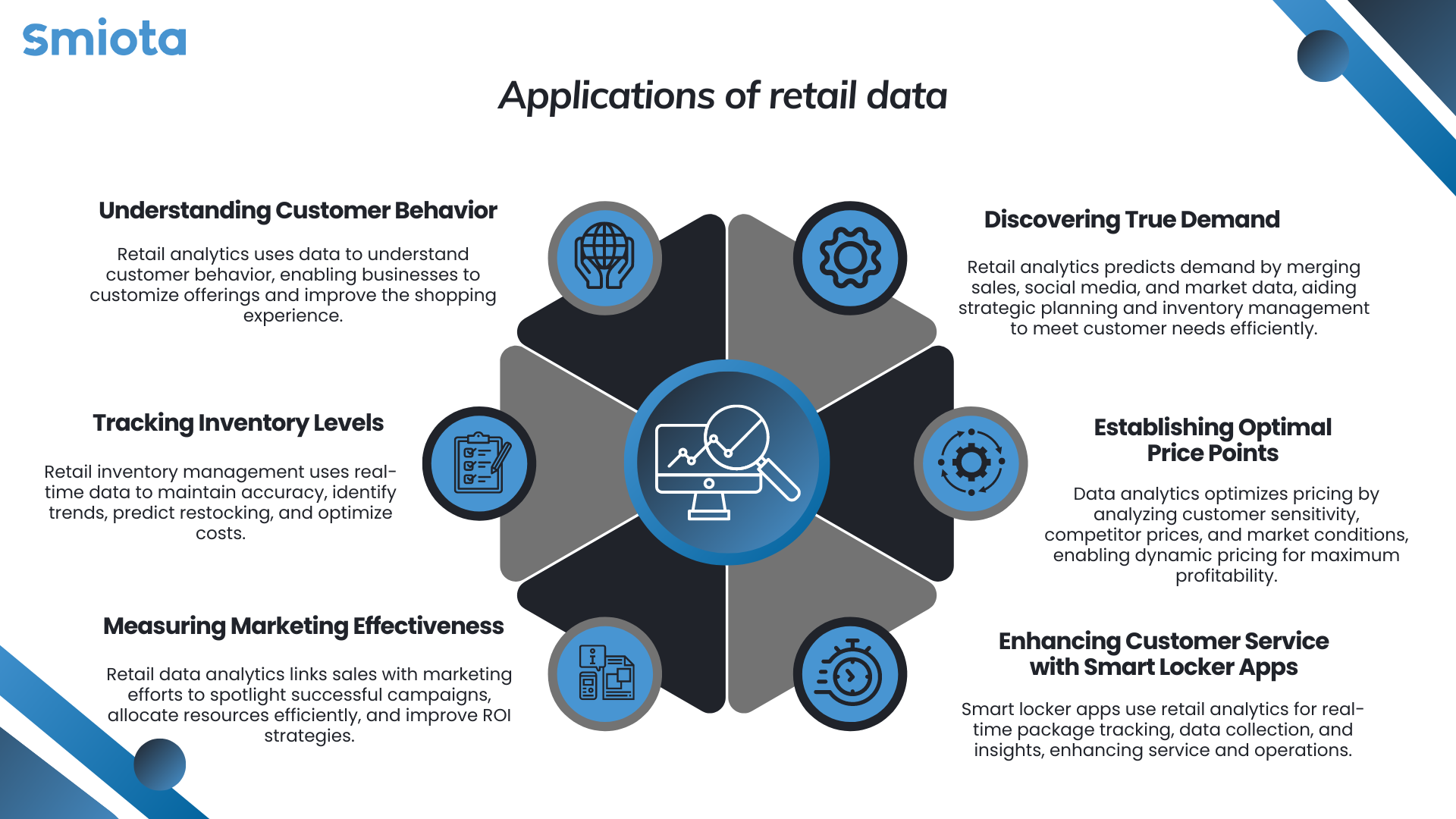
Understanding Customer Behavior
Retail analytics deciphers customer behavior by analyzing data from various touchpoints to uncover shopping patterns and preferences. Retail data insights help businesses customize offerings, optimize layouts, and personalize marketing, enhancing customer experience.
Tracking Inventory Levels
Critical in retail, inventory management uses real-time data to ensure precise inventory levels, identify product trends, and predict restocking needs. It balances demand with supply while optimizing costs.
Measuring Marketing Effectiveness
Retail data analytics evaluates marketing campaign performance, correlating sales with marketing efforts to spotlight successful campaigns, efficiently allocate resources, and improve strategies for better ROI.
Discovering True Demand
Retail analytics predicts demand more accurately by combining sales, social media, and market data. It aids in strategic planning, product development, and inventory management to efficiently meet customer needs.
Establishing Optimal Price Points
Data analytics helps set optimal prices by analyzing customer sensitivity, competitor prices, and market conditions, enabling dynamic pricing models for real-time adjustments to maximize profitability.
Enhancing Customer Service with Smart Locker Apps
Smart locker apps integrate retail analytics for real-time package tracking and data collection, streamlining deliveries and returns while gathering insights on customer preferences and logistical efficiency, improving service, and optimizing operations.
Harnessing the true potential of data-driven decision-making in the retail sector requires a deeper understanding of the data types available for analysis.
Types of Data Needed for Retail Analytics
Retail analytics thrives on diverse data types to derive actionable insights, enabling retailers to make informed decisions. With the advent of smart locker apps for real-time package tracking, the scope of data collection has broadened significantly. Here are the primary data types essential for retail analytics:
- Customer Data: Basic info (age, gender, location) plus behavioral insights (purchase history, browsing habits, app usage) are crucial for tailoring the shopping experience.
- Transaction Data: Records of purchases detailing date, time, quantity, price, and payment are vital for analyzing sales trends and understanding customer preferences.
- Inventory Data: Updates on stock levels and demand. Smart lockers enhance this with data on popular items, returns, and pickup preferences.
- Supply Chain Data: Covers order fulfillment, shipping times, vendor performance, and logistics. Smart locker app integration boosts package tracking and supply chain clarity.
- Social Media and Sentiment Data: Analyzes customer feedback and social mentions to assess public perception and satisfaction.
- Geolocation Data: Tracks customer movements for logistics optimization, targeted marketing, and service improvement, especially for smart locker placement.
Retail data analytics tools catalyze retailers to decode complex datasets, revealing patterns, trends, and opportunities hidden within the numbers. These tools help retailers sift through data to uncover trends and insights, enabling swift, informed decisions.
Types of Retail Data Analytics Tools
To leverage the vast amount of data generated by retail operations and smart locker systems, retailers require robust analytics tools designed for various functions:
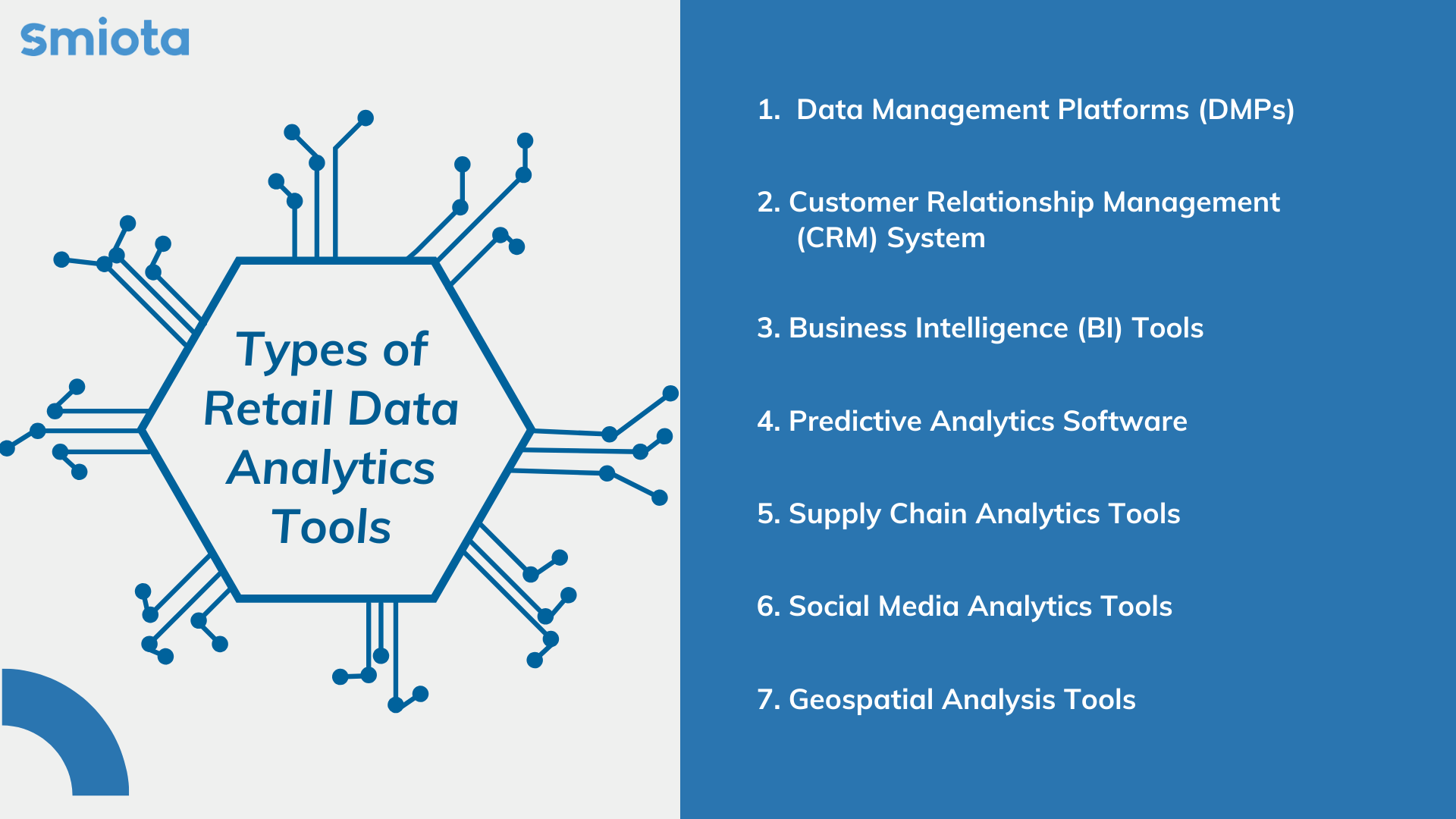
- Data Management Platforms (DMPs): These platforms collect, organize, and manage large volumes of data from different sources, making them accessible and usable for analysis.
- Customer Relationship Management (CRM) Systems: CRMs help manage detailed information about customers, enable personalized marketing, and improve customer service.
- Business Intelligence (BI) Tools: BI tools are essential for the visualization and analysis of data to identify trends, generate reports, and support decision-making processes. Examples include Tableau, Power BI, and Qlik.
- Predictive Analytics Software: These tools use machine learning algorithms and statistical techniques to predict future trends based on historical data. They are crucial for demand forecasting, personalized marketing, and inventory optimization.
- Supply Chain Analytics Tools: Specifically designed to analyze supply chain operations, these tools help optimize logistics, reduce costs, and improve efficiency. Integration with smart locker data can enhance delivery and pickup processes.
- Social Media Analytics Tools: Tools like Hootsuite Insights and BuzzSumo analyze social media data to track brand mentions, measure sentiment, and understand customer preferences.
- Geospatial Analysis Tools: These tools help analyze and visualize geolocation data to optimize delivery routes, smart locker placements, and market penetration strategies.
By leveraging these tools, retailers can comprehensively understand their operations, customer preferences, and market trends. Integrating smart locker apps into retail analytics signifies a step towards more dynamic, data-driven strategies to meet the evolving needs of the consumer and the marketplace.
Retail Analytics: Real-time Package Tracking and Data Collection using Smart Locker Apps
In our current e-commerce-driven world, seamless delivery is an expectation. But managing package deliveries, especially in busy retail environments, can be a logistical nightmare. Enter smart locker apps like that of Smiota, offering real-time package tracking and valuable data collection for retailers.
Simplifying Deliveries with Smart Lockers and Software
Smiota isn’t just an app; it’s a comprehensive delivery management system. It consists of two key components:
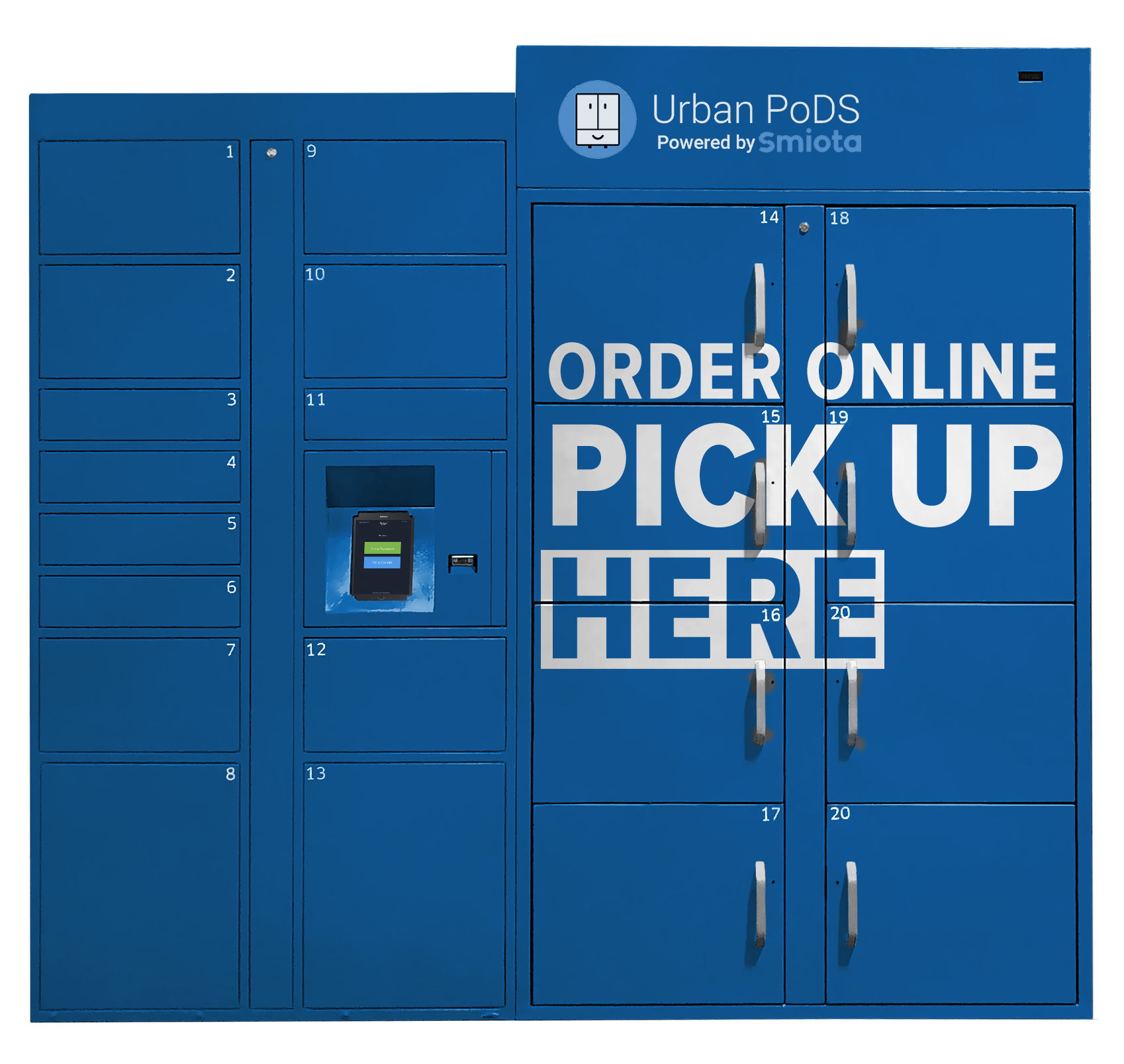
- Smart Lockers: These secure, self-service kiosks are strategically placed within retail stores. They eliminate long queues and missed deliveries by allowing customers to pick up their packages at their convenience.
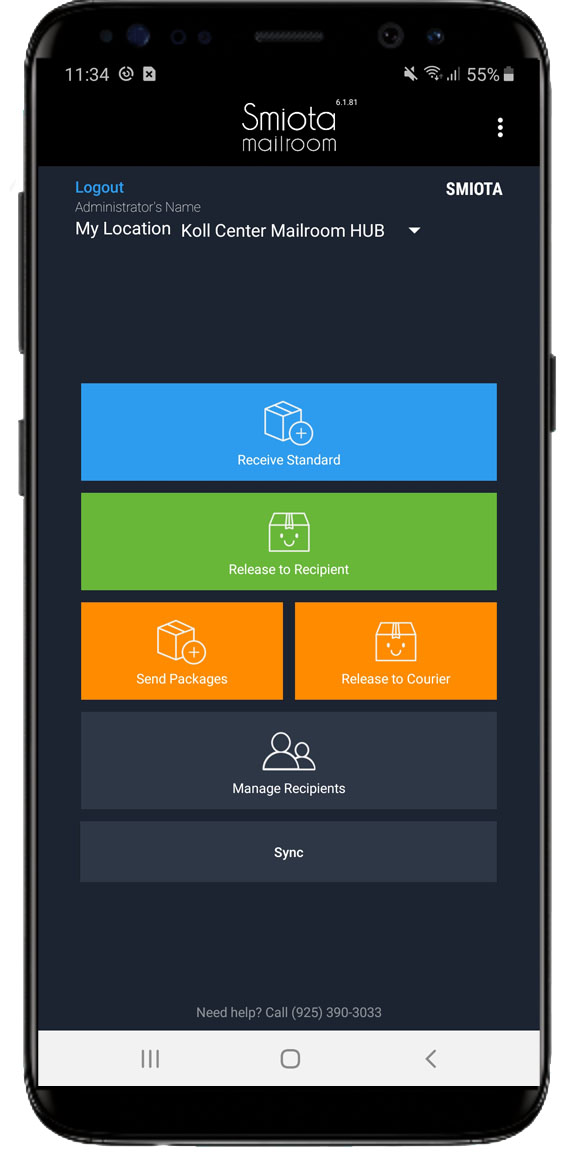
- Smiota Mailroom Software: This user-friendly software is accessible on desktops and mobile devices. It empowers retail staff to manage deliveries efficiently, track packages in real time, and gain valuable customer insights.
How Smiota Functions: A Streamlined Delivery Process
Here’s how Smiota streamlines deliveries for both retailers and customers:
- Integrates with smart lockers and mailroom systems to automate delivery and pickup, providing real-time updates and notifications.
- It includes web and mobile apps for real-time analytics, detailed reports, and transaction monitoring for full chain of custody tracking.
- It uses the Locker Delivery Operating System (L-DOS) for secure package and goods management, custom workflows, and unlimited integrations with enterprise software. L-DOS supports multiple manufacturers and connects with any smart locker hardware, including existing lockers.
- Smiota’s smart lockers are hardware and cloud-agnostic, running on any public cloud and supporting various locker types (ambient, refrigerated, frozen, and cage).
- It is designed for seamless integration with third-party applications via API, enabling a custom white-label solution with branded lockers and customized user interfaces.
- SOC 2 compliant and ISO certified, ensuring high hardware and software security standards, quality, and consistency.
- It provides real-time dashboards with live updates, reports on logistics operations, and event-driven notifications for activities like opening the locker door.
- Can integrate with other data analytics tools for further analysis and insights through APIs and bulk data extraction.
Real-Time Tracking and Data Collection: A Retailer’s Advantage
Smiota offers a treasure trove of benefits for retailers beyond just streamlined deliveries with:
- Real-Time Package Tracking: Retail staff can track every package’s location and status in real time, ensuring efficient inventory management.
- Data Collection and Analytics: The app collects valuable data on customer pickup times, preferred delivery locations, and overall foot traffic patterns. This data allows retailers to optimize store layouts, staffing schedules, and promotional campaigns based on real-time customer behavior.
- Improved Customer Satisfaction: Faster pickup times, convenience, and real-time communication lead to a more positive customer experience, ultimately boosting brand loyalty.
Conclusion: The Future of Retail Delivery
Integrating real-time package tracking and data collection capabilities in smart locker apps also marks a significant step towards sustainability in the retail sector, as these technologies lower the carbon footprint associated with the delivery process. Furthermore, the data collected through these apps can help retailers understand consumer behavior more deeply, enabling personalized marketing strategies that can drive sales and customer loyalty. This progression towards smart, data-driven solutions reflects the future of retail delivery and highlights the sector’s adaptability in meeting the changing needs of consumers in a digital world.
The post Retail Analytics: Real-time Package Tracking and Data Collection using Smart Locker App appeared first on Smiota.
]]>The post How Enterprise and University Mailrooms Can Use Smiota’s Mailroom Software and Smart Lockers appeared first on Smiota.
]]>Smiota has the perfect solution for tidying up mailrooms and getting packages to their recipients in a timely, convenient manner — combining comprehensive mailroom software with smart package lockers.
Here’s how the process works in enterprise and university settings.
Onboarding process
Before you can begin using Smiota’s system for package management at your university or facility, we need to set up a few things.
- We install the Smiota Mailroom Software on mailroom desktop and/or mobile devices.
- We install the Smiota Urban PoDs (smart package lockers) in the designated facility location.
- We work with your IT department to integrate employee or student data into the Smiota database. This can be done through API integration, SFTP upload, or CSV upload.
Once everything’s installed and all data has been uploaded, it’s time to start simplifying your mailroom receiving tasks.
Mailroom staff workflow
Using Smiota’s Mailroom Software and PoDs, your mailroom staff can manage, distribute, and track deliveries and pickups more efficiently. Here’s how.
Receiving and sorting packages with Smiota’s Mailroom Software
1. In Smiota’s Mailroom Software, tap “Receive Standard.”
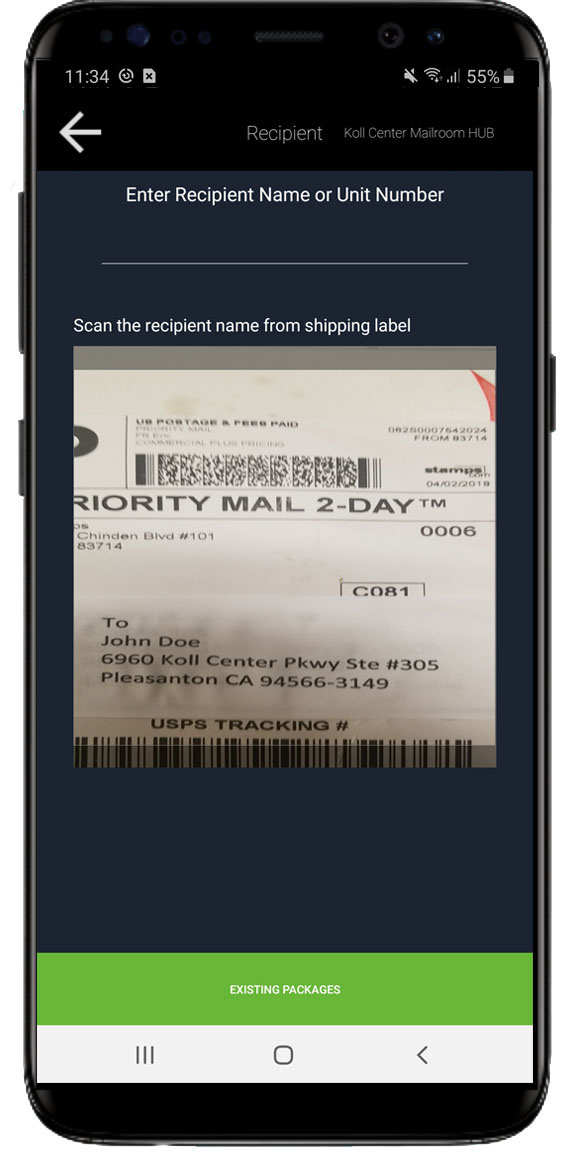
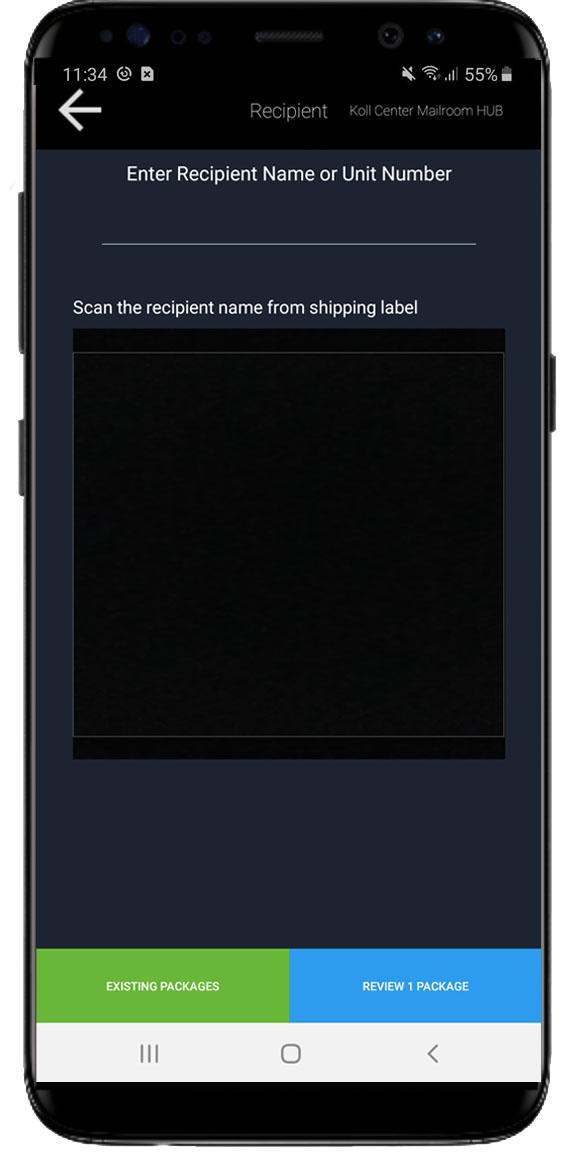
| 2. Scan the package label. The app will recognize the recipient’s name. | OR Enter a few characters of the recipient’s name or unit number and choose the correct recipient from the results. |
 |
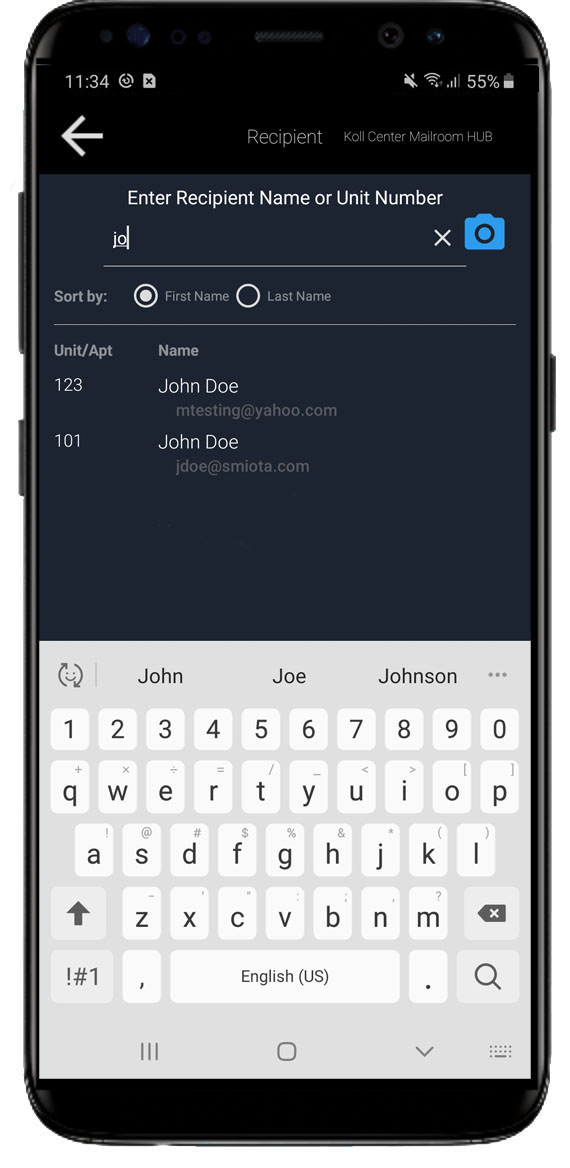 |
3. Scan the courier tracking number on the package and the app will recognize the courier’s name and tracking number. Tap “Accept Package.”
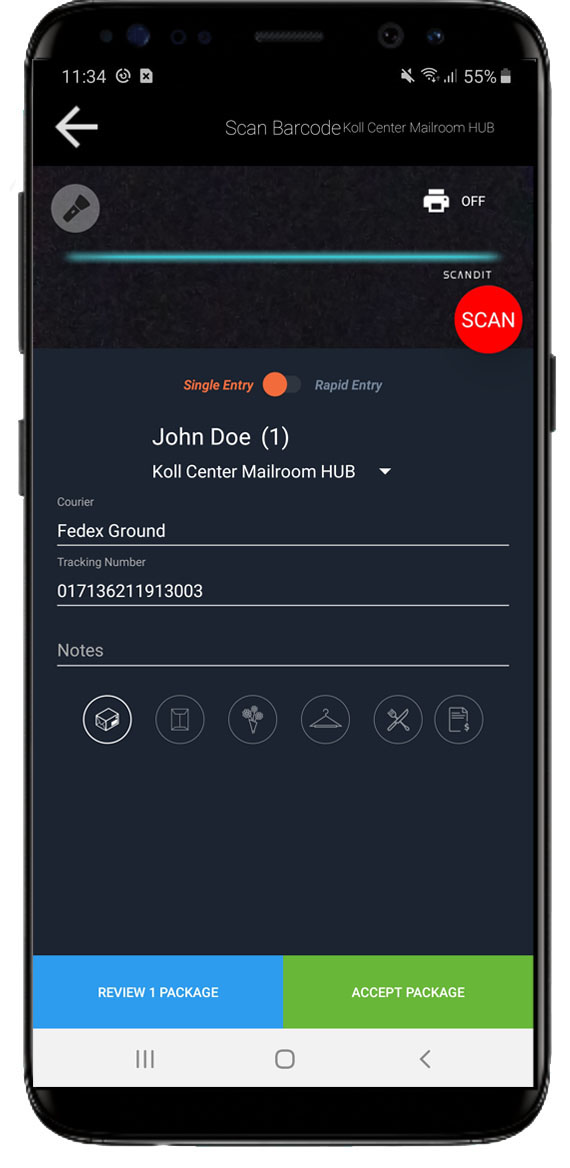
4. Tap “Review 1 Package.”
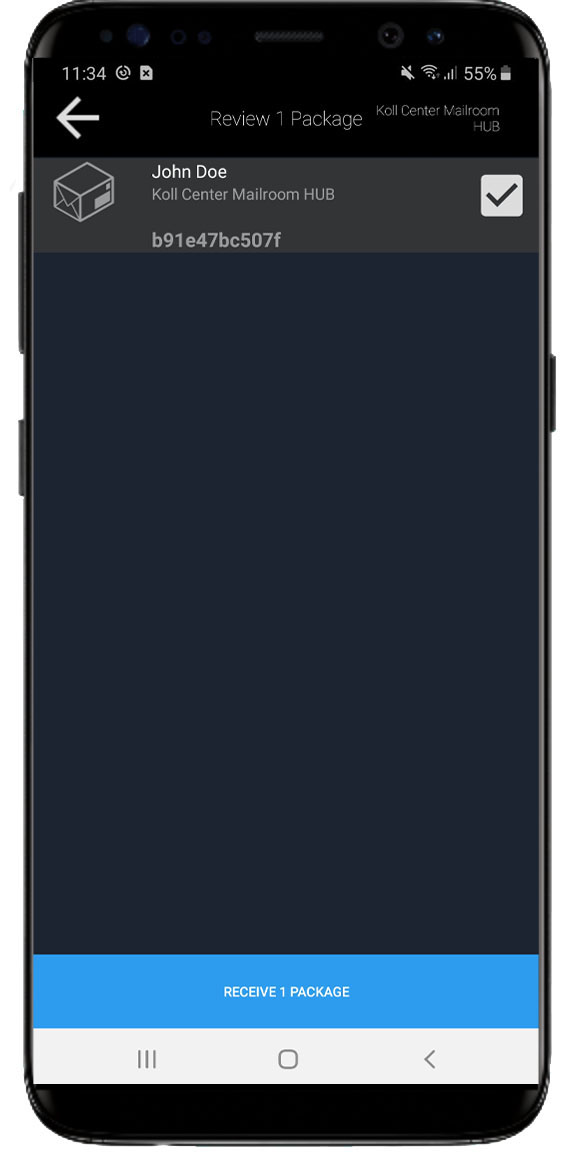
5. Tap “Receive 1 Package.”
Depositing packages into Smiota Urban PoDs
After Smiota’s Mailroom Software processes all the incoming packages, your mailroom staff can secure them into the Smiota Urban PoDs.
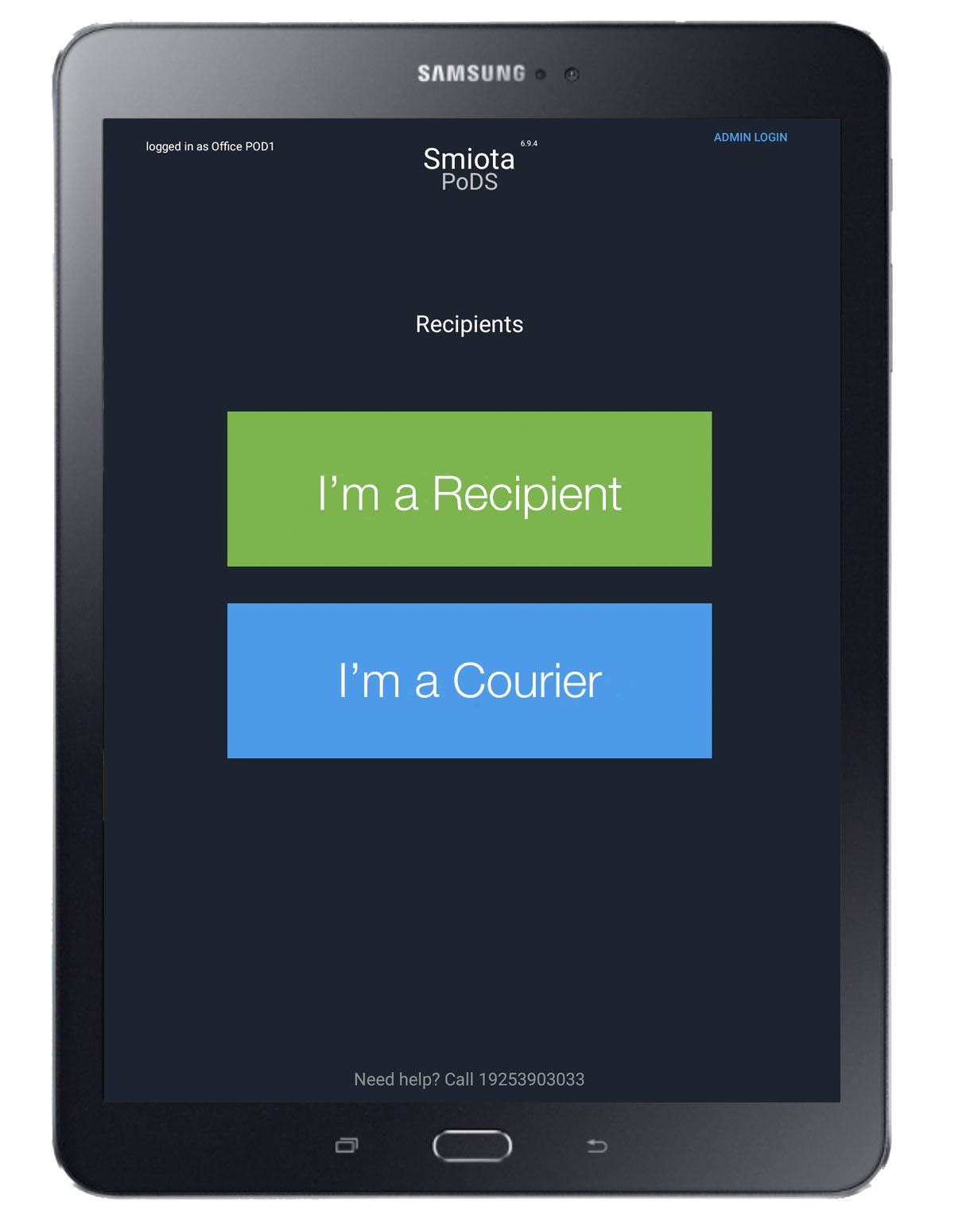
1. Using the Smiota smart locker touchscreen, tap “I’m a Courier.”
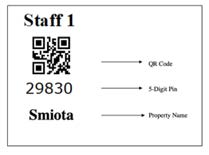
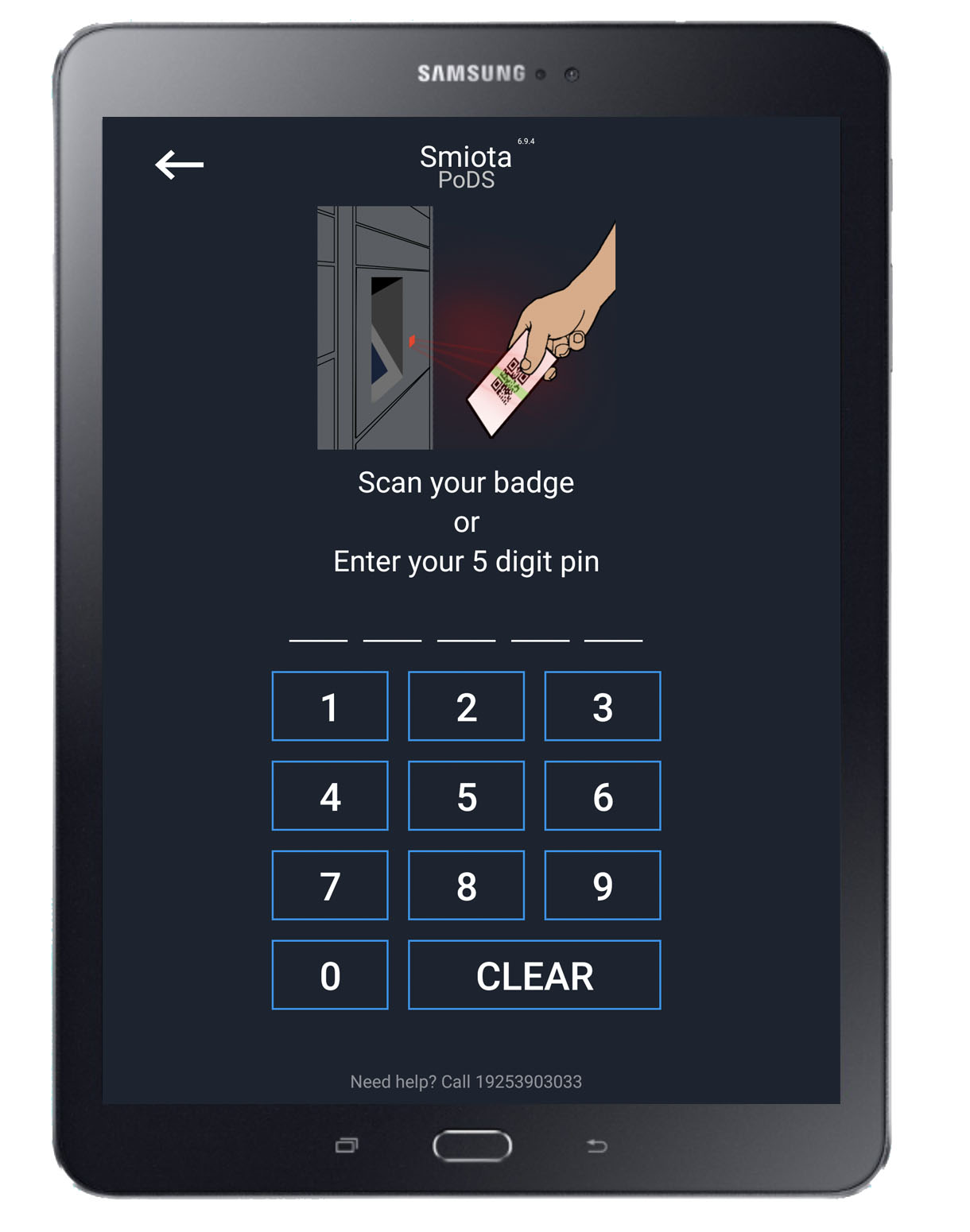
| Scan the QR Code on the staff badge | OR Enter the 5-digit pin on the staff badge |
 |
 |
2. Tap “Existing Packages.”
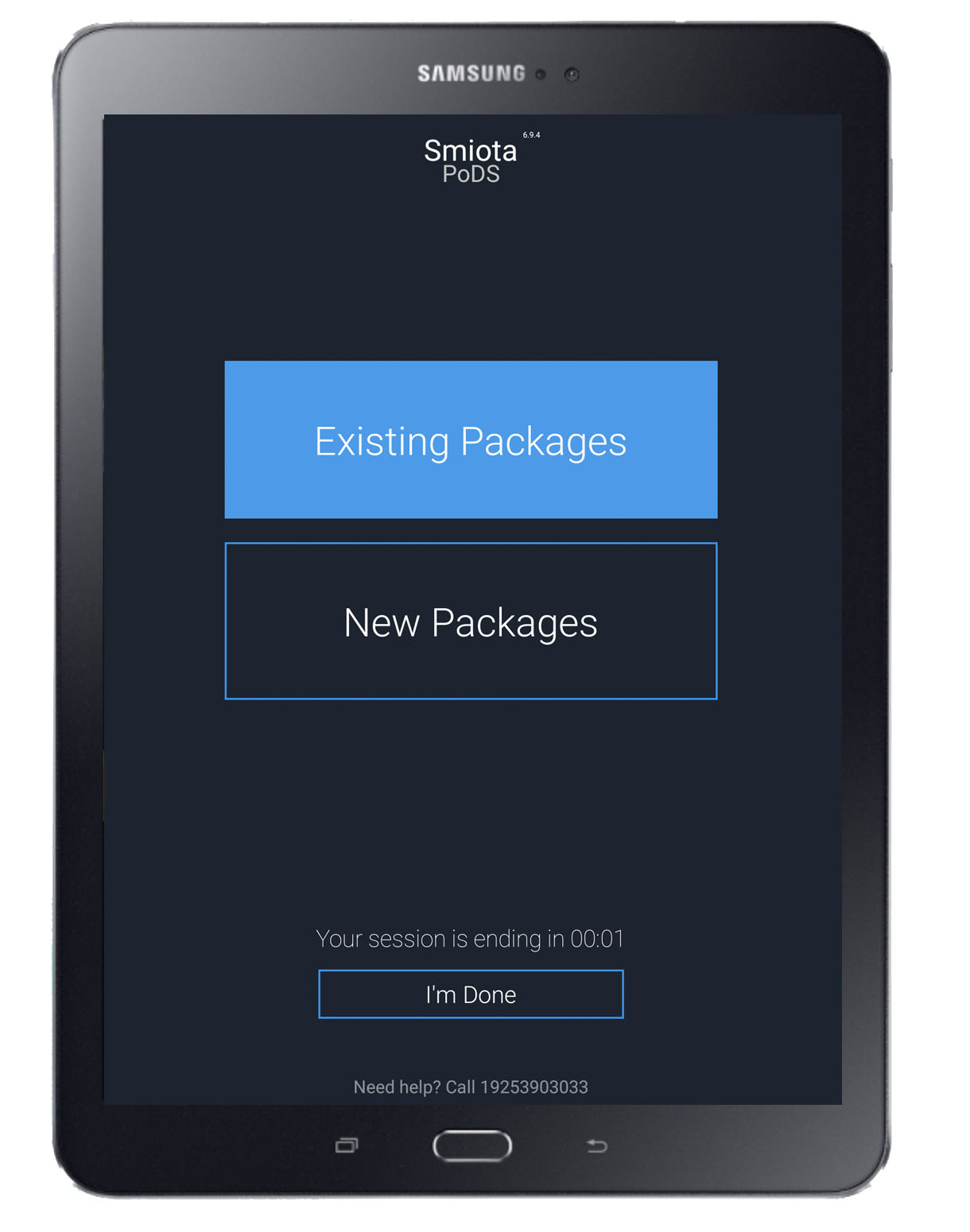
3. Scan the package label to enter the recipient and package information into the system.
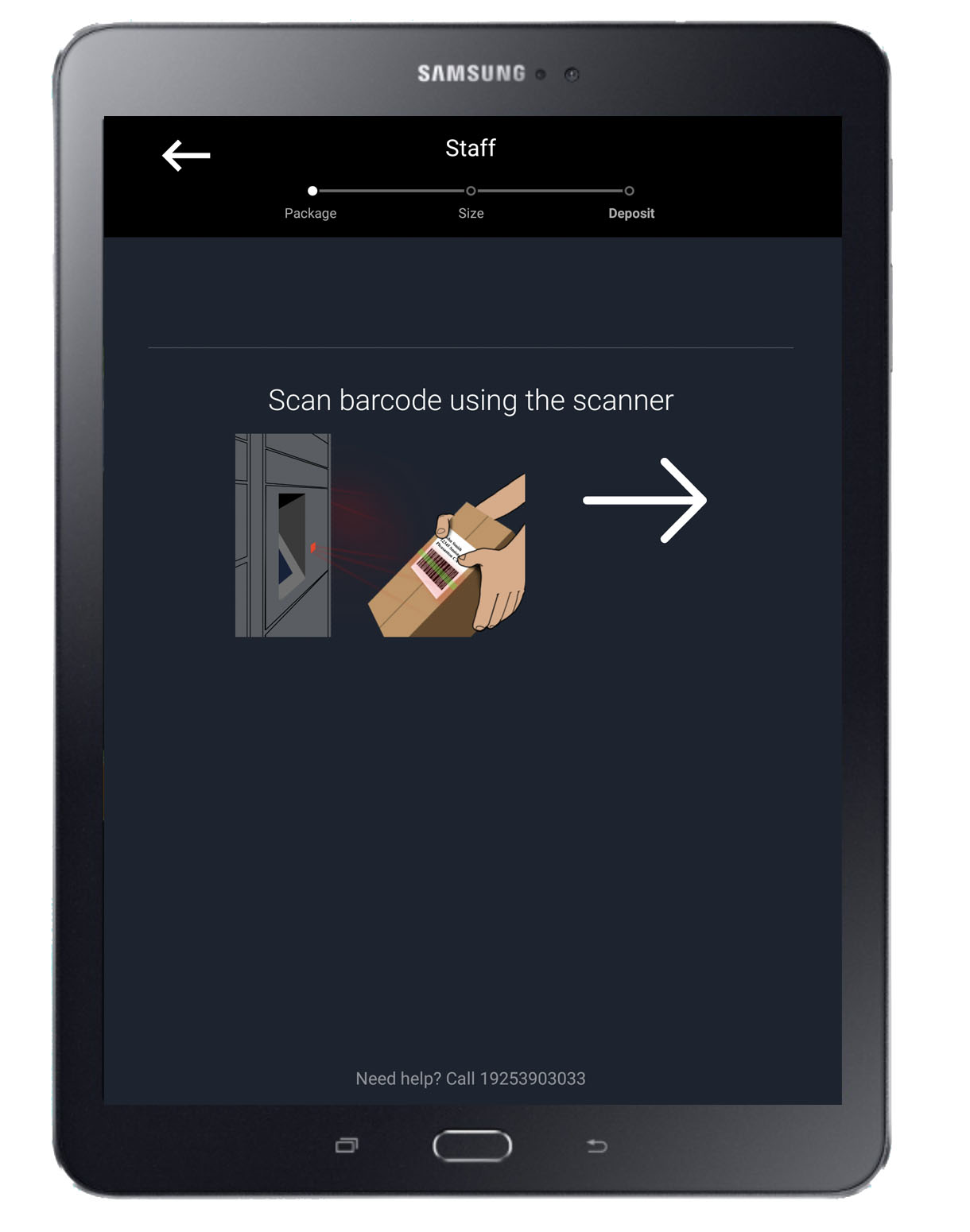
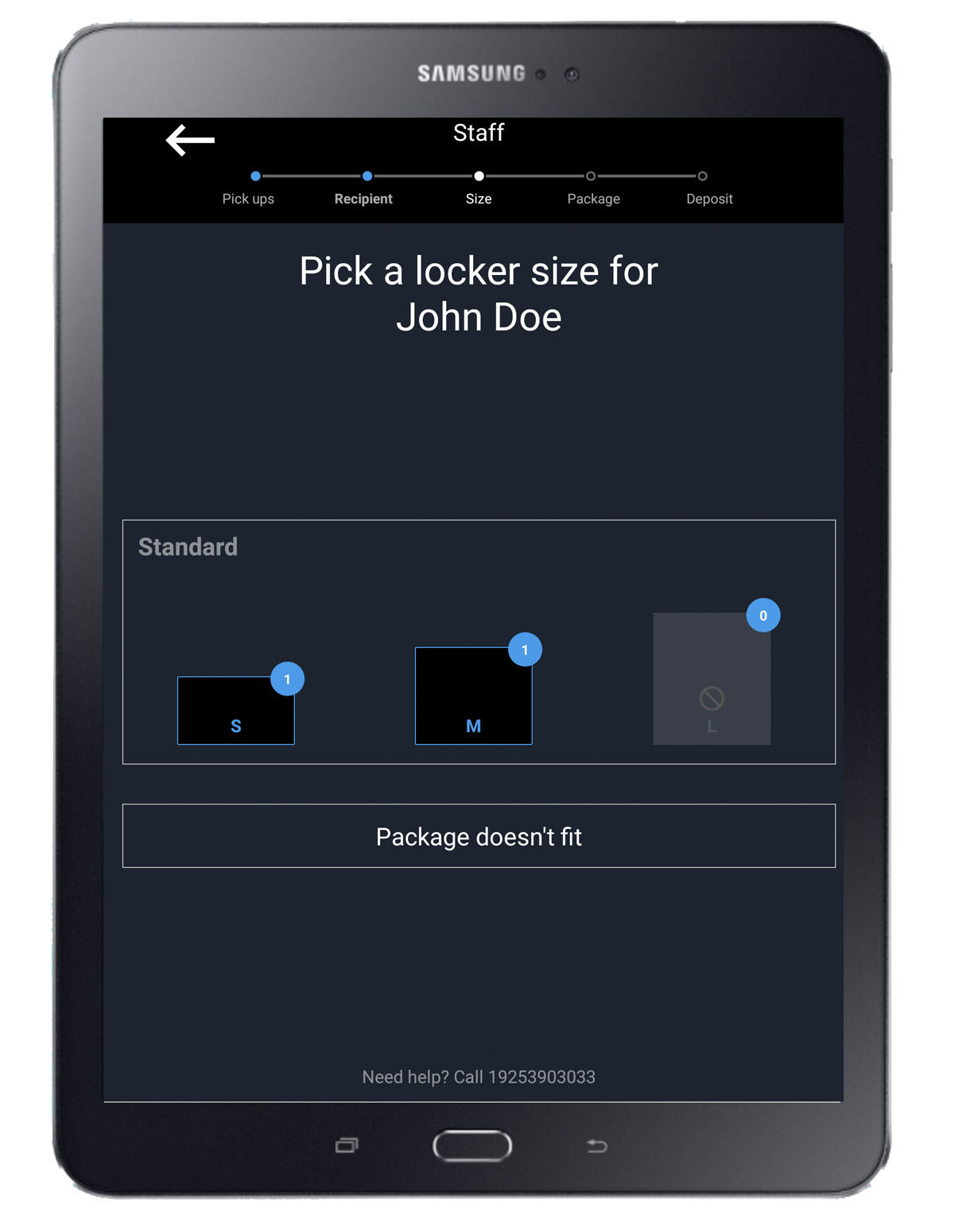
4. To unlock one of the lockers, select the locker size that’s most appropriate for the package.
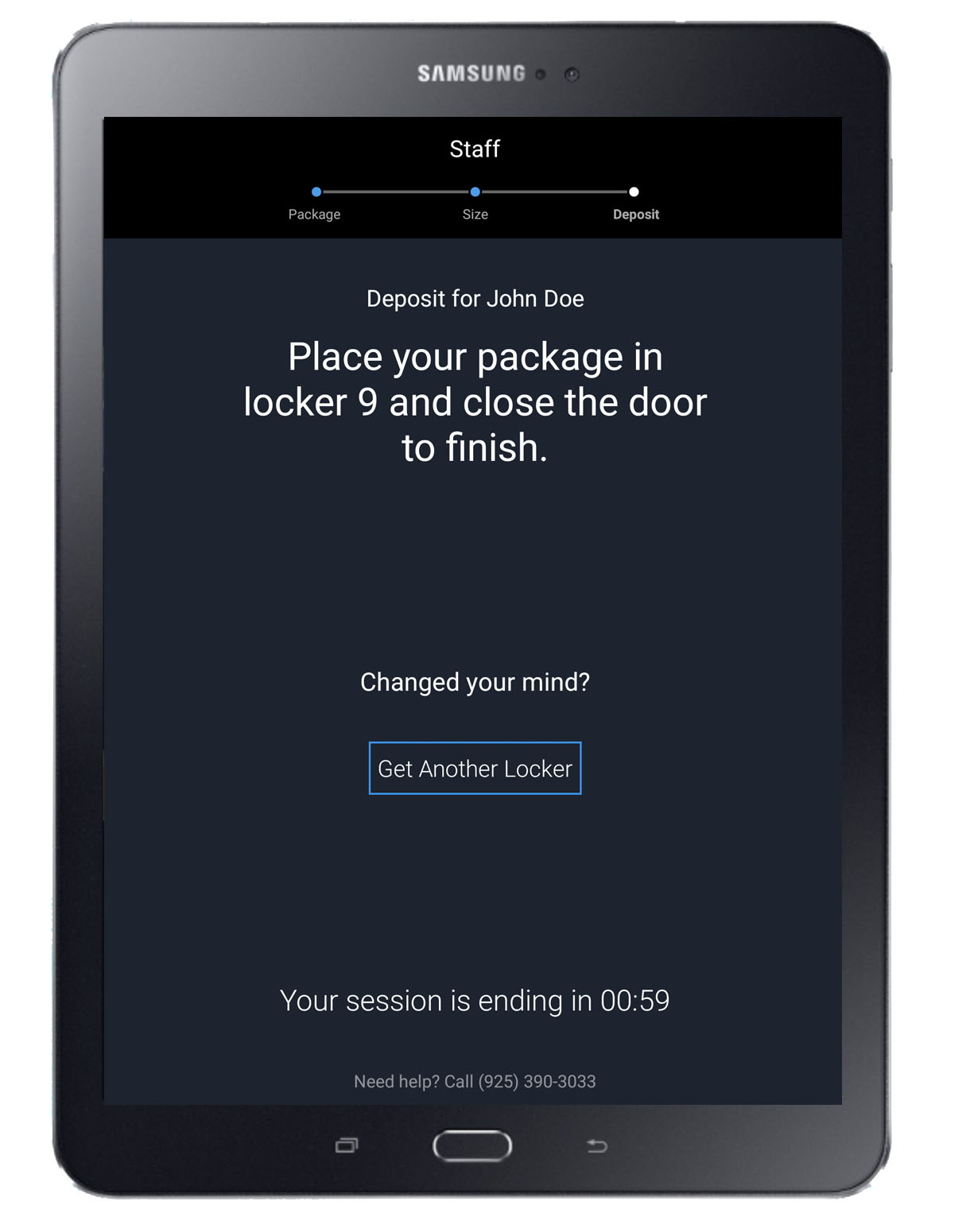
5. Place the package inside and close the door.
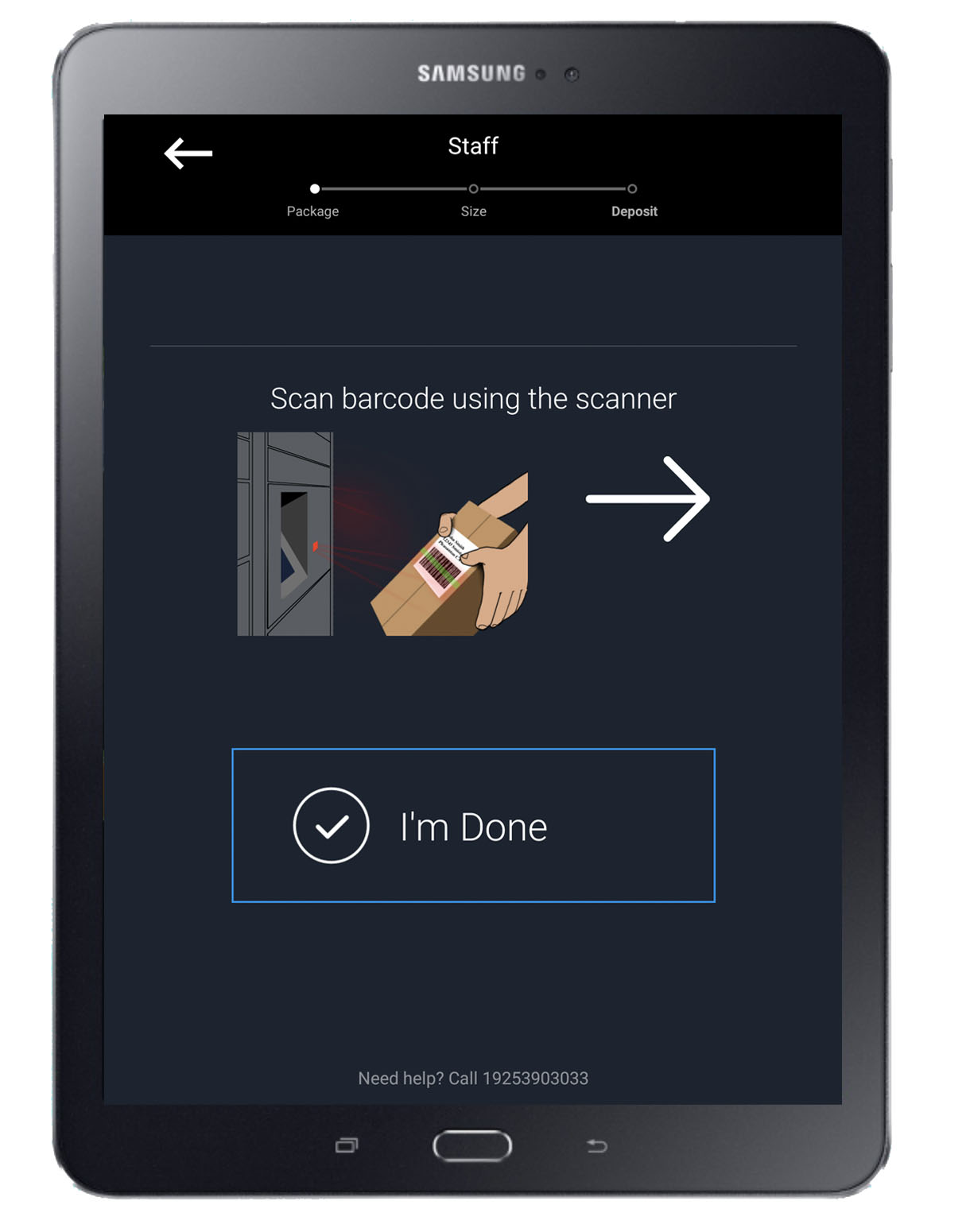
6. Scan any remaining labels to repeat the process.
7. After scanning all packages and placing them into lockers, tap “I’m Done.”
Employee and student workflow
Package recipients receive notifications — via email, text, or app alert — as soon as mailroom staff deposits their deliveries into the lockers. Employees and students can then retrieve their packages using one of the two methods below.
Picking up packages using the Smiota App
Adding the optional Smiota App (for iOS and Android devices) allows users to speed up package pickup by accessing the lockers with their smartphones.
1. Download, install, and authenticate the Smiota App from the Google Play or App store.
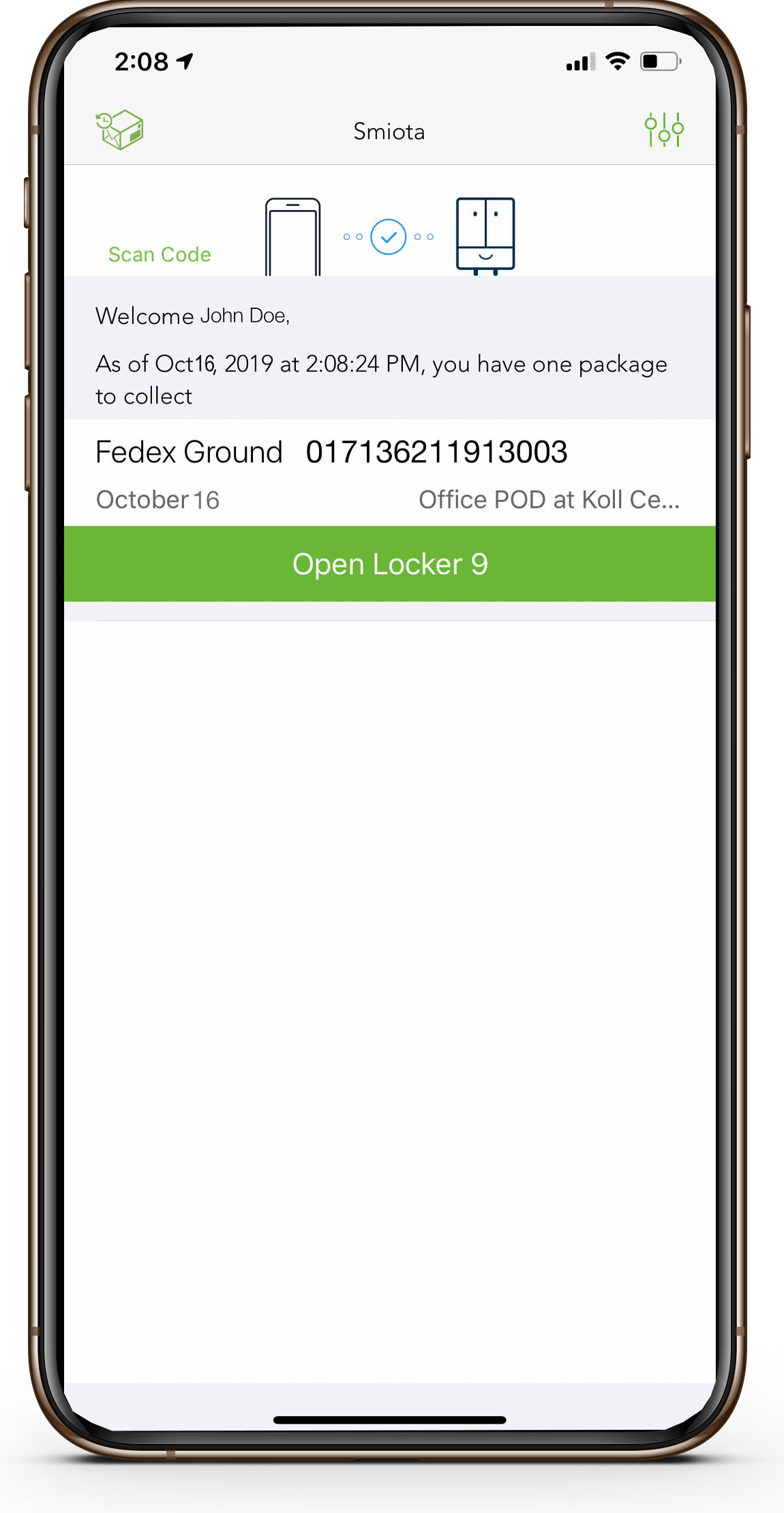
2. After receiving the pickup alert and arriving at the PoD, tap “Open Locker #” to automatically unlock the assigned locker.
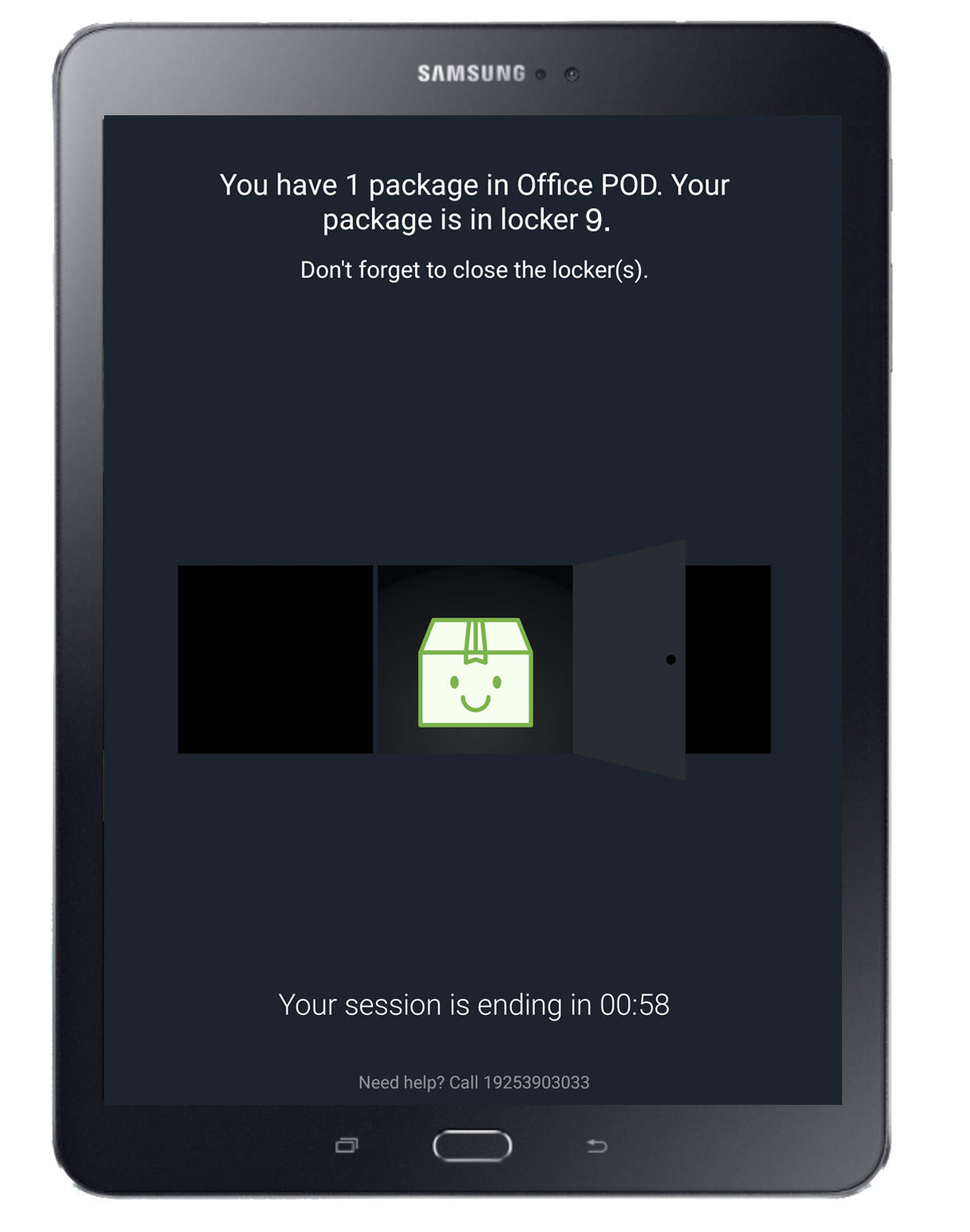
3. Collect the package and close the door.
Picking up packages from Smiota Urban PoDs using email/text notifications
1. Review the email and/or text notification.
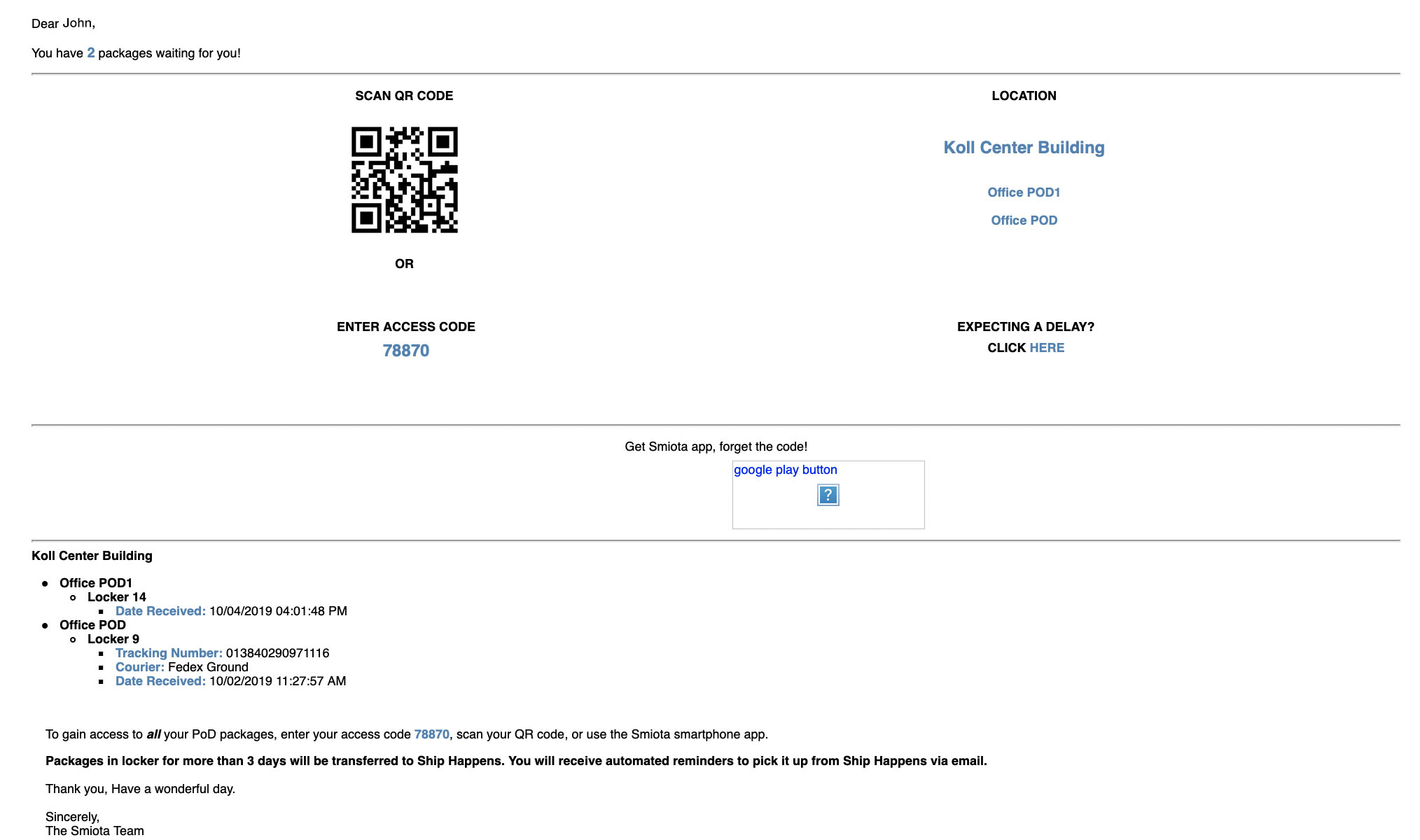
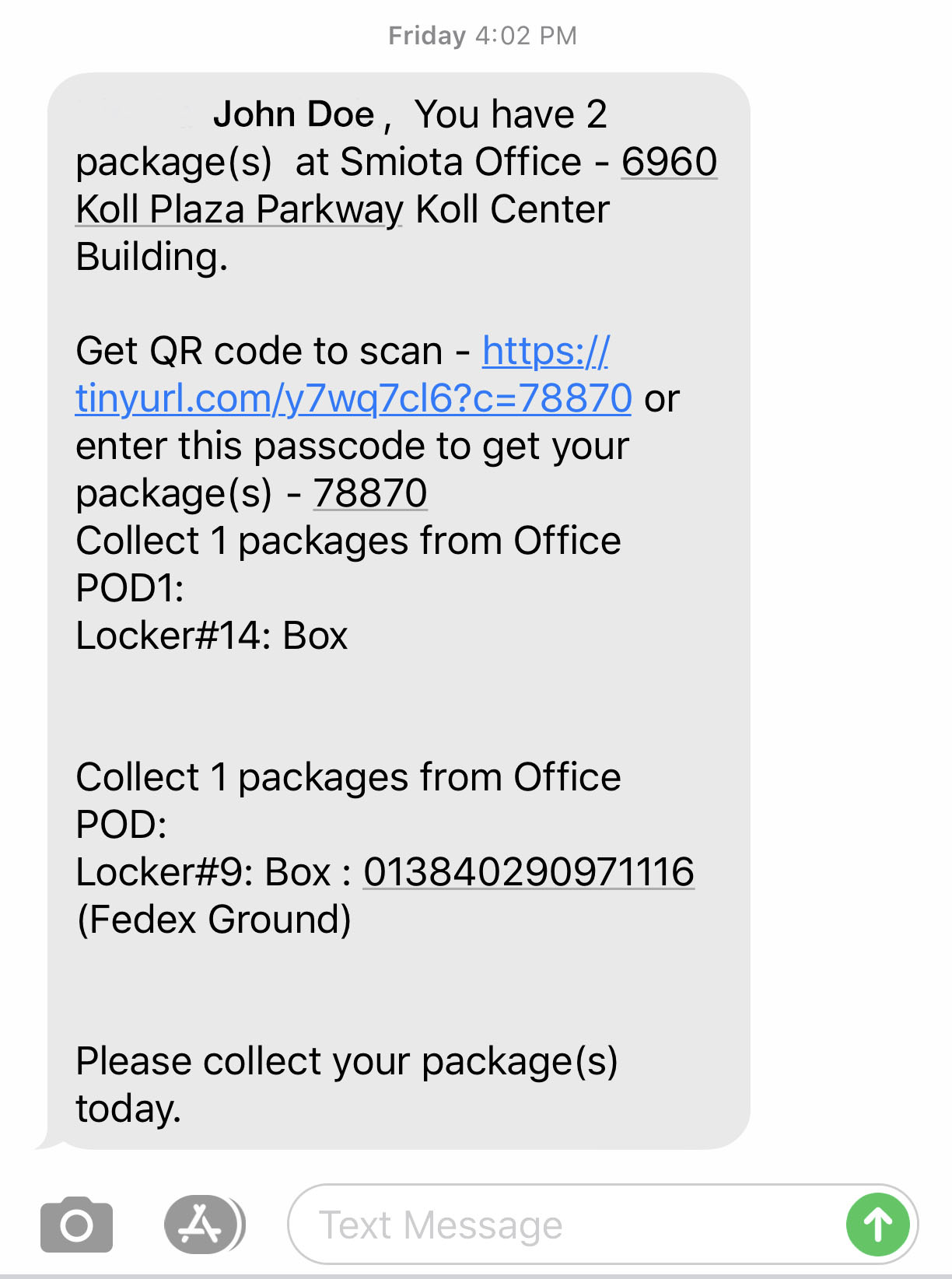
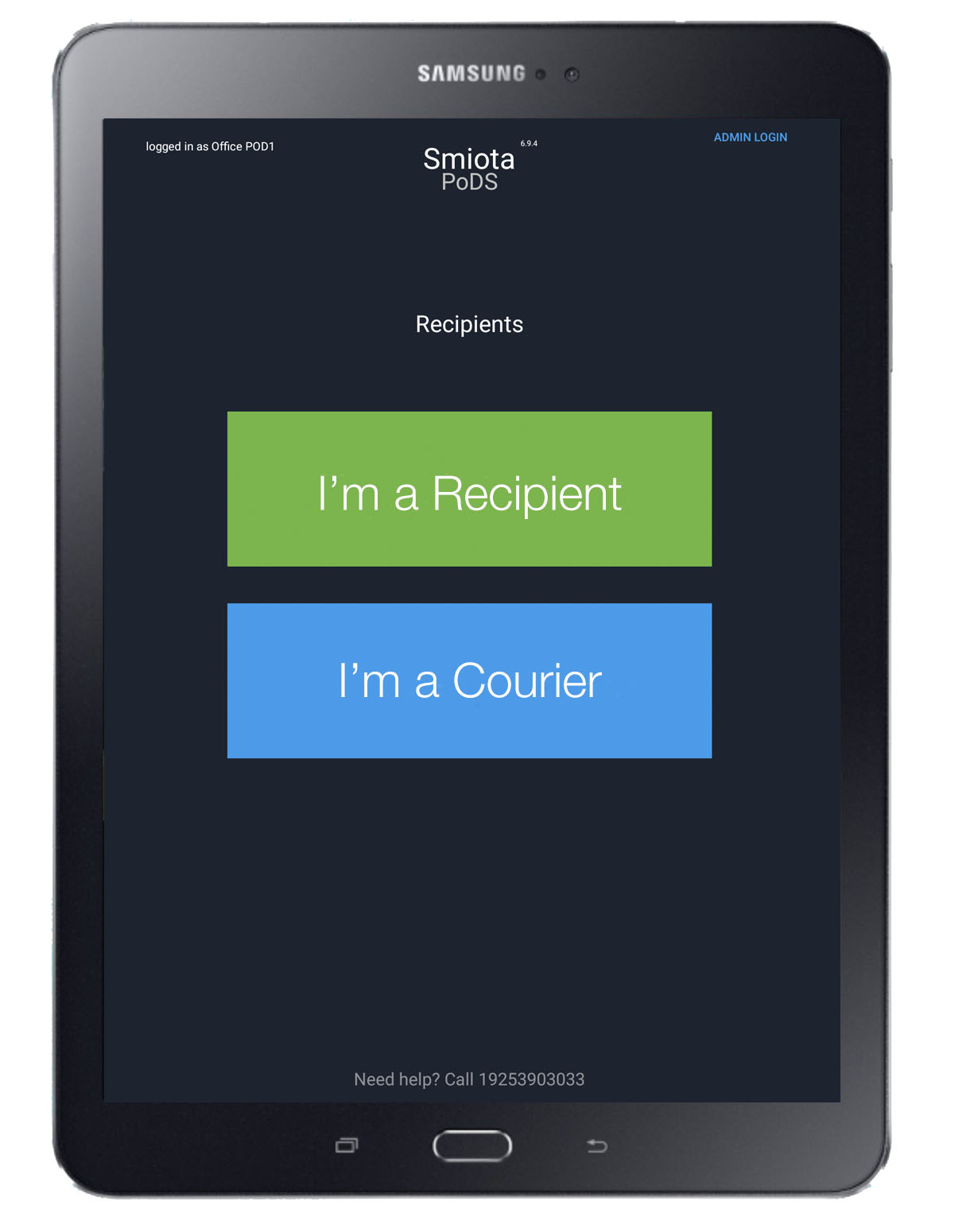
2. Using the Smiota smart locker touchscreen, tap “I’m a Recipient.”
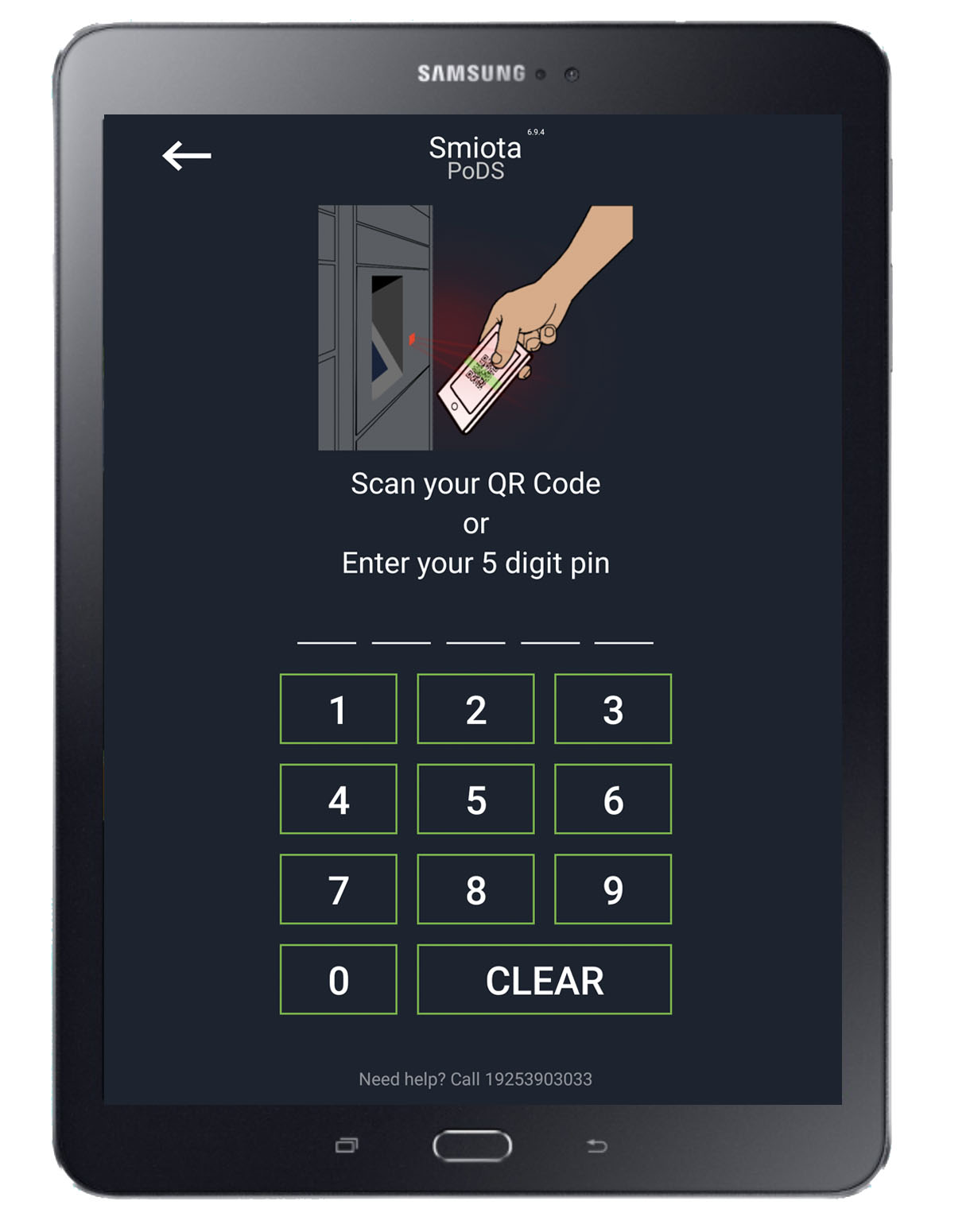
3. Scan the QR code or enter the 5-digit pin from the notification to unlock the correct locker.
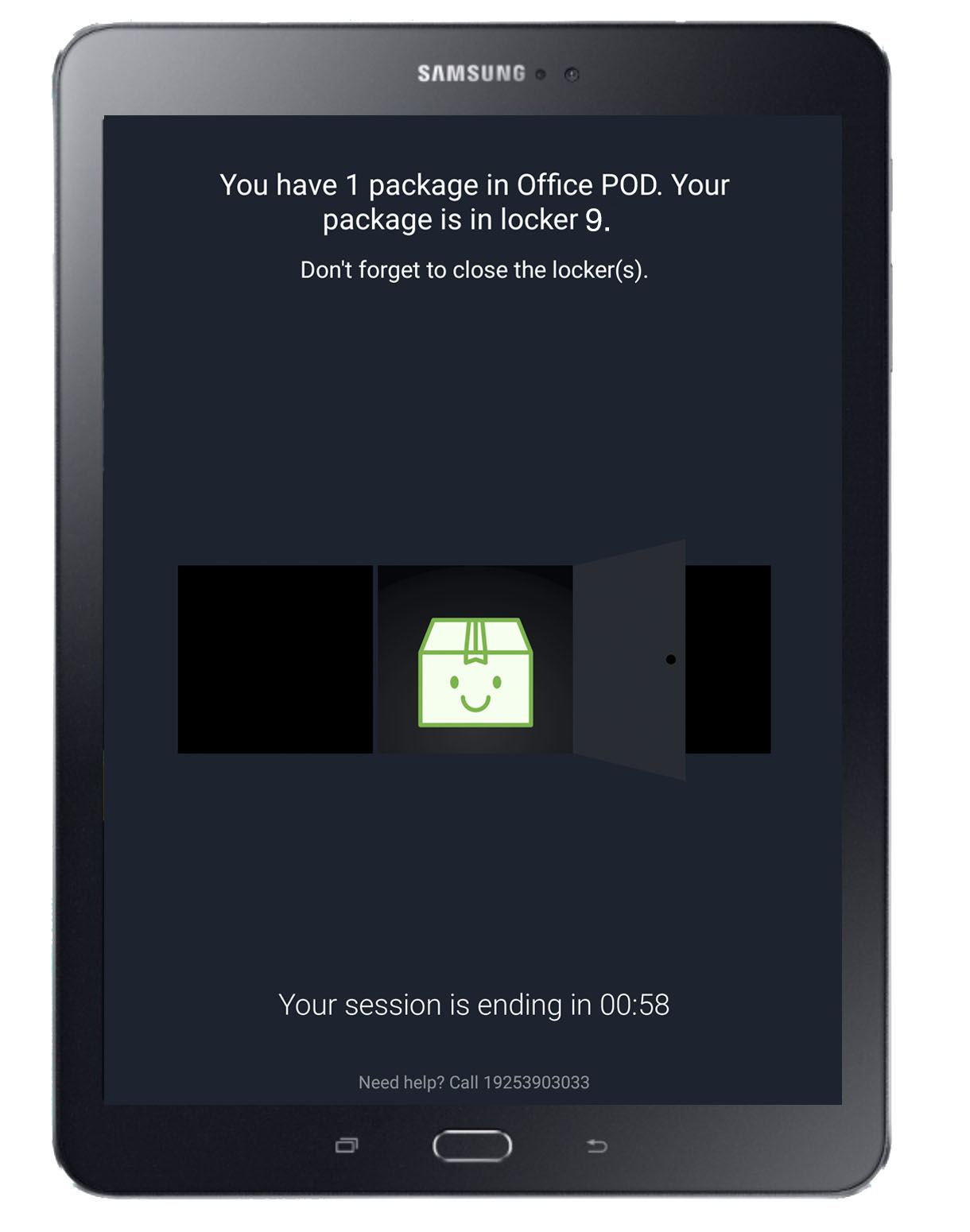
4. Pick up the package and close the door.
Ready to eliminate disorganization and long lines in the mailroom? Contact us today to learn how Smiota’s software platform and smart lockers can help.
The post How Enterprise and University Mailrooms Can Use Smiota’s Mailroom Software and Smart Lockers appeared first on Smiota.
]]>The post Smart Package Lockers: Hassle-Free Delivery for Multifamily Buildings, Corporate Offices, Retail Stores, and More appeared first on Smiota.
]]>Does any of this sound familiar?
You’re a property manager.
- Every day, boxes from Amazon, meal kits, grocery deliveries, and other packages flood your front office.
- Your staff spends hours logging deliveries and notifying residents their items have arrived.
- Residents complain that they can’t pick up their deliveries outside of regular office hours.
You run a click and collect system at a retail store.
- BOPIS customers get frustrated having to wait in long lines to pick up their orders.
- You have nowhere to store online grocery orders.
- Shoppers report a rocky in-store return process.
You’re an office manager.
- Employees take extra long breaks to go home and sign for high-value packages.
- Corporate and personal packages pile up on the receptionist desk.
- Workers are incessantly checking their phones tracking Amazon orders.
These are all common issues anywhere physical online orders cross the last yard of delivery — multifamily buildings, student housing facilities, retail stores with click and collect systems, corporate offices, and so on. And they’re likely to become even more prevalent as e-commerce continues to grow.
“Consumers spent $517.36 billion online with U.S. merchants in 2018, up 15.0% from $449.88 billion spent the year prior.” (Source)
Smart package lockers automate deliveries accurately and efficiently, taking the burden off the folks traditionally responsible for transferring packages into the right hands. This article describes how smart lockers work and why so many building managers and brand strategists are choosing them as their next value-added solution.
Why should you update your delivery methods?
Package delivery the old-fashioned way: Pen and paper
You’re probably well-acquainted with the old-fashioned way of managing package deliveries.
A delivery driver arrives with 10 or 20 or 200 packages, dropping them inside the door in the back room. Then, a front desk worker manually logs the deliveries, scoots parcels around so they’re out of the way, and spends an hour or so sending package notifications via email or text.
Later that day, or the next day, or three weeks down the road, a tenant shows up to collect their package, and a staff member has to dig through the pile of packages to find the right one.
There are many problems with this system:
- Sometimes no one is at the front desk when the delivery driver arrives, so couriers just plop packages down anywhere.
- Sometimes workers don’t send delivery notifications, so residents don’t know they have a package waiting.
- Sometimes residents never pick up their packages, so boxes accumulate until the annual clean-out-the-back-room day rolls around.
- Sometimes the contents of the packages are perishable, and, left unattended, things can get a little gross.
Manually logging deliveries isn’t an ideal, and with everyone’s desire for instant gratification (thanks, free, two-day shipping), the old-fashioned way of handling deliveries won’t cut it.
E-commerce order fulfillment of the past: Slow, unsecured deliveries
Until recently, online retailers could get away with offering shipping that moved at a snail’s pace, and at the customer’s expense no less.
Think back to online shopping five years ago. A customer would select their items online, pay for shipping no matter what, check out, and expect a courier to leave their order on the front porch, unattended, in 7-10 business days. Retailers that still adhere to these kinds of e-commerce strategies (if they’re even still around) will run into serious customer satisfaction issues.
- Customers expect free shipping, even for lower-value items.
- As for two-day shipping? Four in ten shoppers don’t want to pay for that, either.
- Most customers aware of click and collect delivery services have tried it, with their #1 reason being to avoid shipping costs.
- One in four customers have had a package stolen, and half of people know someone who has.
For retailers to survive in this competitive e-commerce market, they need to give people what they want — free, fast fulfillment — in a secure fashion.
Package delivery of the future: Smart package lockers
The problems described above are why innovative companies like Silicon Valley-based Smiota developed smart package lockers powered by cloud-based automation software.
- Smart lockers. Smart lockers allow delivery drivers to deposit packages and recipients to pick up packages 24/7. Smiota’s locker banks can accommodate packages of any size, and can also accommodate grocery, meal kits, and pharmaceutical deliveries in their refrigerated and frozen locker options. Best of all, the entire delivery process is automated — the system sends a notification via text or email to the package recipient and tracks the package from delivery to pick up.
Related reading: The Ultimate Guide to Smiota Smart Lockers
Smiota also offers package management software designed for multifamily and corporate buildings that want to secure their now-outdated mailrooms and keep full chain of custody records.
- Mailroom software. For buildings that aren’t ready for smart lockers, package management software is a tool that mailroom staff can use to receive packages, send notifications, and release packages to tenants using just a smartphone.

Both of these systems leverage cutting-edge technology to secure the last yard of delivery.
- The courier or worker scans and deposits a package in a locker or the mailroom.
- The software automatically sends the package recipient a phone notification.
- The package recipient uses a unique password or the mobile app to gain entry to the locker or mailroom.
- The system collects and retains full chain of custody records that administrators can access at any time.
It’s that easy! And smart lockers have many other benefits as well. Let’s take a closer look.
Benefits of smart lockers: Security
The old-fashioned approach to package delivery isn’t efficient, let alone secure. Smart lockers provide protection and traceability from the moment a package is placed in a locker to the moment the recipient picks it up.
Challenge #1: Theft
Package theft can happen to anyone, especially when couriers deliver parcels outside front doors or to unattended desks. Smiota CEO Manju Kashi fell victim to package theft, inspiring him to create a solution.
Package delivery rates are increasing every year. In fact, USPS shipped an impressive 6.2 billion packages in 2018, up 8.8% from 2017. More packages mean increased vulnerability to theft. Facilities that don’t have surveillance or a secure spot to place packages are especially at risk.
Smart lockers stop thieves in their tracks.
Challenge #2: Complete chain of custody
A complete chain of custody allows you to track orders back to their source. This is especially useful if something goes wrong and a package is misplaced (which, according to one former USPS employee, happens about 1% of the time, 2% during high-volume times like holiday season). Unfortunately, in most cases, the chain of custody stops the moment a package is dropped at the front desk or on someone’s porch.
Think about this issue at an apartment complex. Even if someone writes down when packages are delivered and picked up, there are limitations to keeping accurate chain of custody records. What if the recipient scoops up a delivery while the front desk staff is on lunch? What if the receptionist makes a human mistake (gasp!) and forgets to write something down?
While you may not be handling top-secret documentation or forensic evidence (or maybe you are!), a complete chain of custody is critical to building trust with your network and protecting your credibility.
Benefits of smart lockers: Efficiency
With the digital age comes a higher demand for efficiency. And traditional order fulfillment and delivery methods are, in a word, inefficient.
Challenge #1: Staffing (or lack thereof)
Most buildings and stores don’t have staff members dedicated to managing packages or a click and collect system. They have apartment managers, leasing agents, customer service managers, and sales associates. Delivery management duties usually fall to one or more of these staff members, which means they spend a lot of time during the week doing tasks outside of their primary responsibilities.
Salaries for personnel like this that can easily surpass $40K. Can you afford to have your team spending time outside their regular duties?
A package delivery system frees up your staff’s time so they can focus on higher-value tasks, like showing apartments and interacting with customers. It also allows people to pick up their packages at any time, so you don’t have to hire an extra staff member or pay overtime.
Challenge #2: Keeping up with orders and deliveries
E-commerce is taking off like gangbusters as retail giants offer fast, free shipping, the popularity of subscription boxes explodes, and people take advantage of click and collecting fresh groceries. With so many consumers enjoying the convenience of having everything shipped directly to them or skipping the checkout line in-store, more people are paying attention to the last yard of delivery than ever before.
And don’t forget holiday pandemonium. Imagine this:
Your 150-unit downtown Denver apartment building is at 90% occupancy. From the conversations you’ve had with your tenants, you know they’re scrambling to get ready for the holidays. You recommend your favorite places to shop, and at least half of your recommendations are online retailers.
Your tenants take your advice, and the week before Christmas you end up with 25 additional packages coming through the door each day. The situation can conservatively be described as chaos.
And on the other end of the transaction — the retail side — things can get equally as crazy. Holiday shoppers in 2018 click and collected 47% more than in 2017. Without some automation, in-store order fulfillment can be a major pain for both retailers and customers.
The bottom line? Managing the chaos can be incredibly time-consuming and frustrating. And people aren’t exactly known for having extra patience around the holidays.
A smart package delivery system removes this entire burden from your plate and ensures everyone knows their orders are stored securely and ready for pickup.
Related reading: Unbeatable Benefits of Smart Package Lockers for Retail Stores
Challenge #3: Measuring productivity wins
Metrics are the only way to know if new systems, practices, or policies are working. When it comes to package delivery or BOPIS order fulfillment, you might be left scratching your head. How do you know if your system is working, or, more importantly, if it’s not?
Smart lockers are powered by cloud-based software, so you have access to admin tools that can give you visibility into your operations and help boost your productivity. For example, on Smiota’s admin web app, you can:
- See your history of packages received and picked-up
- Open lockers
- Manage overdue pickups
- Remind recipients to pick up overdue packages
It’s tools like this that give smart lockers a competitive advantage over manual package management.
Benefits of smart lockers: Value-added for end users
To compete in today’s marketplace, upgrading your facilities with new amenities and technologies isn’t optional.
Challenge #1: Retaining and attracting tenants and customers
Getting the right people into your space (and enticing them to stay) is an ongoing challenge for any business.
Take multifamily as an example. Apartment tours can have potential tenants completely blown away, impatiently asking “When can I move in?” Or on the flipside, apartment seekers can sign off with a flat, “This could work…”? Offering value-added amenities like smart lockers can be the difference.
In the retail world, think about the impression you’re making on your customers. Are they thrilled with how quick and efficient your BOPIS system is, even taking extra time to shop for more? Or are they taking to Twitter to complain about long lines? Again, you could be looking at the difference between a store with smart lockers vs. one without.
Challenge #2: Keeping up with shopping trends
Ipsy. Blue Apron. Barkbox. Click and collect. Free shipping. Fast shipping. Shipping from Costco?!
The right package delivery system will help you keep up with these trends. For example, Smiota’s refrigerated smart lockers offer a solution for the meal kit and grocery click and collect trend. The lockers are completely temperature-controlled, so people can feel secure about the freshness of their food.
Modern delivery systems also make oversized packages no problem. Smart lockers come in various sizes, so they can accommodate that bulk order of laundry soap that was just too good of a deal to resist.
Choosing a package delivery system
Now that you know the main benefits of smart lockers, let’s look at how to choose the right system. Here’s what our customers tell us are the most important features of Smiota:
- Ease of use: Whenever you introduce new technology, it’s paramount that it’s easy to use and adapt to. When choosing a package delivery system, consider how easy it will be for the couriers, administrators, and end users. Also, make sure you’re getting the level of customer service support you need.
- Security: With smart lockers, packages are placed in a locker that only the courier, recipient, and in some cases, the admin can open. With secure mailroom software, it’s easy to lock down your deliveries with security cameras inside and outside the room.
- Smartphone integrations: From the end user’s point of view, being able to access delivery information on your smartphone is a must. Most package management systems offer text message notifications. Smiota goes a step further. The iOS and Android app alerts recipients as soon as their packages are dropped in the locker and allows them to open the door directly from their phone.
- No attendant necessary: Not all package delivery systems can go unattended 100% of the time. Choosing smart lockers that stand alone eliminates the time and money it takes to train someone else how to attend to it.
- Refrigerated and frozen lockers: Grocery delivery and in-store pickup is gaining traction, and you need to be prepared. Installing temperature-controlled lockers will help you get ahead of the trend.
- Pricing: This is our customers’ paramount concern. Package lockers are an investment, but a worthy one. If you crunch the numbers, you’ll conclude that the cost of lockers is significantly less than hiring another person to do what lockers can do automatically.
Related reading: Why Choose Smiota Package Management System?
—
Ready to get started with smart lockers? Contact us today!

The post Smart Package Lockers: Hassle-Free Delivery for Multifamily Buildings, Corporate Offices, Retail Stores, and More appeared first on Smiota.
]]>The post Smiota’s Top 5 Articles of 2018 appeared first on Smiota.
]]>#1 6 Shocking Stats about Package Theft
The proof is in the numbers — package theft is a colossal problem. As a quick example, nearly one third of people have had a package stolen on their porch. Learn more about so-called “porch pirates” and package theft in this collection of shocking statistics.
#2 Smiota vs. Parcel Pending vs. Luxer One vs. Others: Which Package Locker System is Your Best Fit?
Still struggling to decide which package locker system is right for your application? Look no further. In this article, we compare the top contenders in the space based on courier usability, pricing, customer support, and more!
#3 Apartment Amenities You’re Guaranteed to Notice in 2018
To kick off 2018, we put together a list of the apartment amenities that will help multifamily developers and managers get ahead in the amenities race. And if we had to guess, the perks we discuss in this article will continue to rise in popularity in 2019 and beyond.
#4 Installing Smart Home Technology in Your Multifamily Building Could Be the Best Decision You Ever Make
Smart home gadgets are becoming increasingly accessible, so renters are seeking out multifamily facilities that include things like smart thermostats and automated package lockers. Start your research into what technology might be a good fit for your units here.
#5 Play It Cool With Refrigerated Package Lockers
The demand for online grocery shopping and BOPIS options isn’t slowing down any time soon. For food and beverage retailers to keep up with demand, ensuring goods remain fresh through the whole delivery process is an absolute must. The solution? Refrigerated package lockers.
—
Smiota offers package management solutions for retail, corporate, residential, and university applications. To read more, visit our blog!
The post Smiota’s Top 5 Articles of 2018 appeared first on Smiota.
]]>The post How To Choose and Seamlessly Implement New Software at Your Properties appeared first on Smiota.
]]>Seek software with a smooth user experience
You might find software with all the bells and whistles, but if it doesn’t offer a smooth user experience, implementation will be an uphill battle. It’s best to toss the bad apples aside early, a process made simple thanks to reviews. If users report positive feedback like, “our team is more efficient and students have access to their packages 24/7,” rather than negative comments like, “this software is difficult to use and crashes constantly — don’t waste your money,” you probably have a viable option to test.
Request a demo
Fewer than 1 in 10 businesses ever fully realize the potential of their software. To make sure you’re in this elite group (rather than part of the 91% who are paying for software they don’t get the benefit of), don’t skip the demo. Sitting through a demonstration gives you the chance to ask questions, discuss potential ROI, and get a more specific idea of how the software could benefit you and your staff.
Bring in key players to review your choices
Once you’ve narrowed your choices down to a couple of options, bring employees who will be using the software into the discussion. First, explain why you’re considering implementing software at all. Then, if you have a free trial, walk your employee through the features that will benefit them the most. Lastly (and most importantly), ask if they have any questions. Listening to these key players will help you identify any employee buy-in issues that might come up so you can address them right away.
Train your staff
After you’ve made the final decision on what software to purchase, you might be eager to hand your staff login information and hope for the best. However, training is critical for successful implementation.
During training sessions, stress how the software directly benefits your staff. Talk about potential time savings, budget reallocations, and productivity boosts.
Here are some examples:
- Time savings – “This software will save you 3 hours a week on contacting tenants by phone.”
- Productivity boost – “This software will cut emailing by 50%.”
- Money savings – “This software will save our facility over $70,000 this year alone, so you will all get an immediate raise.”
Once you’ve fully explained the benefits, give everyone the opportunity to ask questions and express concerns. Then walk your staff through the software as well as any associated hardware and equipment.
Provide helpful resources
Questions will come up once your staff starts using new software. Prevent an influx of questions by providing a list of helpful resources. Here are some ideas for materials you could provide:
- Technical support number
- User guides
- YouTube tutorials
- Link to software’s FAQ page
—
The team at Smiota is here to make sure you and your staff love your new package management software. Contact us to request your free demo today!

Related reading: Rental Trends Heat Up the Competition in Multifamily Space, Welcoming Opportunity for Innovative Property Managers
The post How To Choose and Seamlessly Implement New Software at Your Properties appeared first on Smiota.
]]>The post Why Choose Smiota Package Management System? appeared first on Smiota.
]]>Package management systems are relatively new, so there aren’t a large number of options, but there are a few. Here, we identify some of the features (and red flags) to look for when assessing package management systems and explore what makes Smiota stand out.
Package management systems: What to look for, what to look out for
Package management systems save your staff time and your building money. They also add value and allure to your property, which will help you attract new tenants (especially Millennials).
But not all systems are created equal.
In a previous article, we reviewed the factors to consider when choosing a package management system. Here are a few of the most important things to look for and to look out for.
What to look for
- Ease of use. The whole point of a package management system is to make handling deliveries as easy as possible for both your staff and your residents. So, make sure you choose a system that’s easy to use right out of the box. If it has a steep learning curve, you might end up with residents who need assistance every time they receive a package.
- Flexibility. Do your residents receive a lot of groceries or oversized packages? Do they send their laundry out, so they need spaces to accommodate clothes on hangers? The system you choose should be flexible and customizable for your needs now and into the future.
- Robust reporting. How long do residents usually take to pick up their packages? Do you need more small lockers, or more refrigerated lockers? A robust reporting tool will help you answer these questions so you can make data-driven decisions for your community.
What to look out for
- Extra charges to end users. Will your residents be charged to set up their account? What about for leaving their packages in the lockers too long? Some systems automatically impose these charges (it’s one way they make money). At Smiota, we let you decide whether or not to charge your residents extra to use the lockers.
- Lack of technology integrations. Part of the allure of emerging technology is how it all works together — think of how Apple devices all seamlessly intertwine. Some package management solution providers haven’t taken advantage of the opportunity to integrate their software with user devices, for example, via a smartphone app.
The Smiota Solution
It’s our mission to make managing your packages easier, faster, and more secure. We’ve worked hard (and we continue to work) to make the Smiota package management solution the best one available.
Smiota currently offers smart lockers and mailroom software packed with user-friendly features including an iOS and Android app. Read on to learn more about our solutions and how they can benefit you.
“By installing Smiota PoDs at 9 dorms and using Smiota Mailroom app, UNLV is saving thousands yearly and has made the package experience for students and staff exceptional!”
Smart Lockers — Smiota PoDs
Smart lockers are the stars of modern package management systems. This is due to three main things:
- They completely automate the package delivery process.
- They’re secure.
- They give residents 24/7 access to their packages.
Delivery
Couriers can quickly access lockers by scanning a QR code or entering a pin. To choose a recipient and drop off a package, they search the resident database, choose which size locker they need, and pop the delivery in. They can be on their way in just minutes with full confidence the packages will make it to their intended recipients.
Receipt
Once a package is safely in a locker, Smiota’s software automatically notifies the recipient via text or the Smiota app. To access the locker, the recipient clicks a button in the app or keys in their unique code. That means no more digging around in emails for confirmation codes.
PoD units
Smiota’s main PoD unit has 13 lockers (five small, six medium, and two large) along with the built-in control center. There are several add-ons available to supplement the main unit:
- Additional standard unit: 12 doors with space for small, medium, and large packages
- Laundry lockers: Four doors designed for dry cleaning and other laundry service drop-offs
- Large lockers: Two doors for bigger packages (think bulk orders of paper products)
- Oversized lockers: One unit used for either extremely large packages or overflow if the other lockers are full
- Refrigerated and frozen lockers: Four- or eight-door temperature-controlled units
Refrigerated lockers
Chances are a few of your residents have already started using grocery or meal kit delivery services. While these services are wonderful for time-strapped folks and aspiring chefs, there is a downside: the subscribers have to be home when their kits are delivered. Otherwise, they run the risk of their food spoiling.
That’s where refrigerated lockers come into play. Instead of residents having to stay at home with phone in hand while they wait for their food delivery, refrigerated lockers offer them the freedom of flexibility. Frozen lockers are great for your staff as well because they don’t have to worry about food spoiling in the office.
Smiota’s refrigerated lockers are temperature-controlled and can be adjusted to accommodate frozen foods as well.
Fully customizable
Your space is unique, and your lockers should be too. We can build a system customized for your layout, available space, and specific needs. PoDs don’t even have to be all lined up in a row. As long as your lockers are within WiFi or cellular network range of your main control PoD, they’ll work.
Smiota Mailroom
Smart lockers are convenient, safe, and a huge time saver, but they may not be right for your building. Even if you don’t have the space for lockers, you can still implement a safe, secure package management system for all deliveries using Smiota Mailroom.
Smiota Mailroom is a software that can turn any room into a secure package delivery center. All you need is a smartphone.
Point-and-scan
When a package comes in, just open up your smartphone and scan the recipient’s name and tracking barcode. Smiota Mailroom takes care of the rest in less than five seconds. No more recording deliveries manually!
Scan multiple packages
Did one of your residents go a little nuts on Cyber Monday? Using rapid entry mode, you can enter their name just once and quickly scan all of their packages in a fraction of the time it’d take you to record every one individually.
Complete chain of custody
Smiota Mailroom takes all the guesswork out of package delivery. It provides a complete chain of custody, including recipient signature. If a resident isn’t available to pick up their package, they can delegate someone else pick it up for them, and Smiota mailroom will track the entire transaction.
“Your team has been a pleasure to work with- you have created an amazing product for residential communities!”
The Smiota Delivery App
We want Smiota to be the most convenient way to deliver and pick up packages. That’s why we built an app to use with our PoDs lockers and Mailroom software. Available for iOS and Android, the Smiota Delivery App makes picking up packages as easy as checking your Facebook feed.
With the Smiota app, users to simply walk up to the locker bank, hit a button on their smartphone, and viola! The locker opens — no access code needed. They’ll also be able to see the full package history: who delivered it, when it was dropped off, and where it was picked up. No more guesswork for you or your residents!
Customizable reporting
Our powerful administration tools make it easy to know what’s going on in your building. With our customizable reports, you can:
- Track all deliveries
- Track package time in lockers from delivery to pickup
- Track delivery time from warehouse to lockers
This helps you make decisions about the future. For example, do you need more refrigerated lockers? Is it time to start charging that couple in Apartment 204 who always wait two weeks to pick up their packages?
In addition to creating reports, admins can open lockers, manage overdue packages, and more using the Smiota webapp or PoD tablet.
Remote support
Smiota offers 24/7/365 remote support, completely eliminating the need to call someone on site for maintenance. Our technical staff can remotely troubleshoot any problems you may have, and our PoDs update automatically for any new software releases.
About Smiota’s creators
Smiota was created by a team of Silicon Valley entrepreneurs led by CEO Manju Kashi. The idea for the package delivery solution came to him after experiencing package theft at his own front door. He realized package exchanges had to be done safely and securely. Along with his team, he employed his business savvy and vision for the perfect package delivery system to bring Smiota from concept to product in less than two years.
- Manju Kashi – Chief Executive Officer
- Khurram Mahmood– Chief Technology Officer
- Kailasnath Dornadula – Chief Hardware Officer
- Waheed Rasheed– Chief Marketing Officer
The post Why Choose Smiota Package Management System? appeared first on Smiota.
]]>